Exam-Style Problems
⬅ Back to SubchapterNov 2015 p43 q1
3939
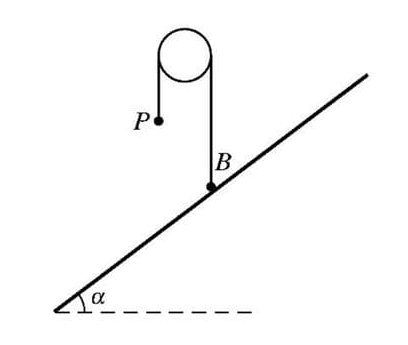
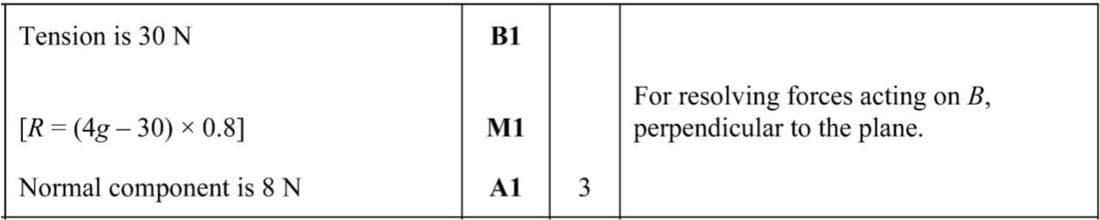
A small ball B of mass 4 kg is attached to one end of a light inextensible string. A particle P of mass 3 kg is attached to the other end of the string. The string passes over a fixed smooth pulley. The system is in equilibrium with the string taut and its straight parts vertical. B is at rest on a rough plane inclined to the horizontal at an angle of \(\alpha\), where \(\cos \alpha = 0.8\) (see diagram). State the tension in the string and find the normal component of the contact force exerted on B by the plane.
June 2015 p42 q6
3940
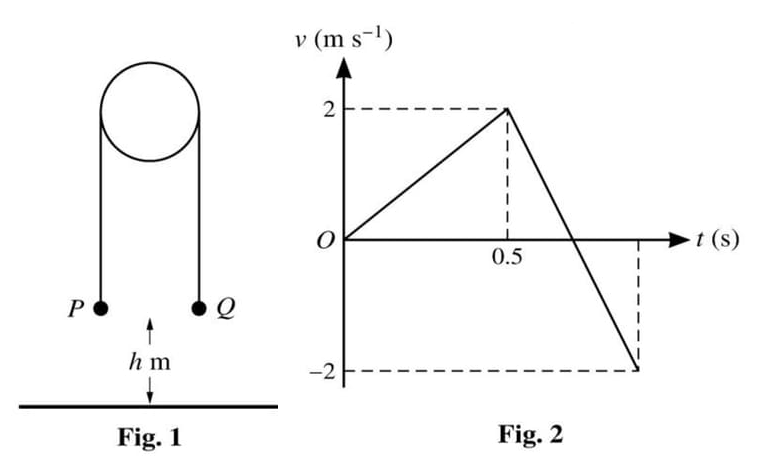
Two particles P and Q have masses m kg and (1 − m) kg respectively. The particles are attached to the ends of a light inextensible string which passes over a smooth fixed pulley. P is held at rest with the string taut and both straight parts of the string vertical. P and Q are each at a height of h m above horizontal ground (see Fig. 1). P is released and Q moves downwards. Subsequently Q hits the ground and comes to rest. Fig. 2 shows the velocity-time graph for P while Q is moving downwards or is at rest on the ground.
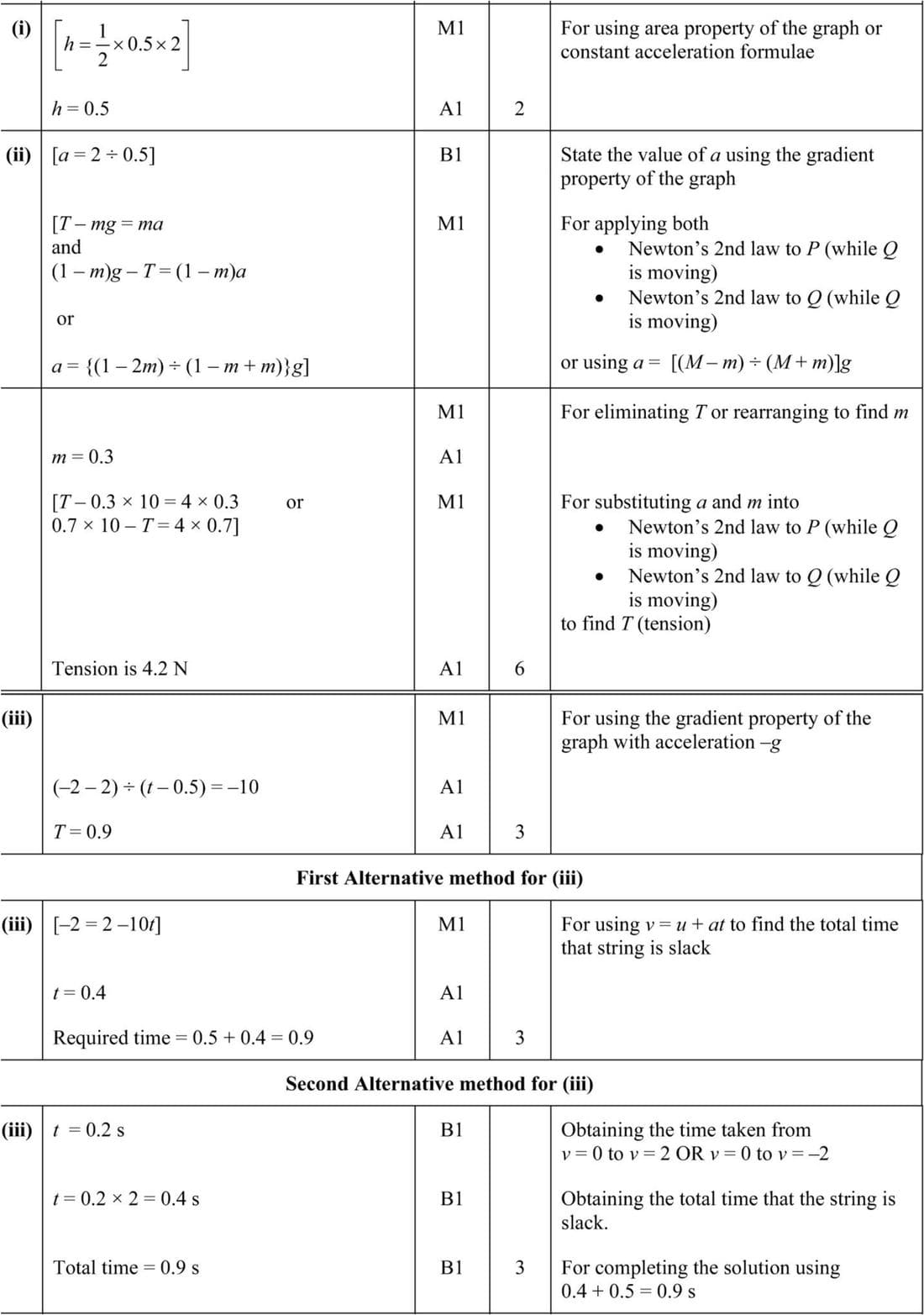
- Find the value of h. [2]
- Find the value of m, and find also the tension in the string while Q is moving. [6]
- The string is slack while Q is at rest on the ground. Find the total time from the instant that P is released until the string becomes taut again. [3]
Nov 2014 p43 q6
3941
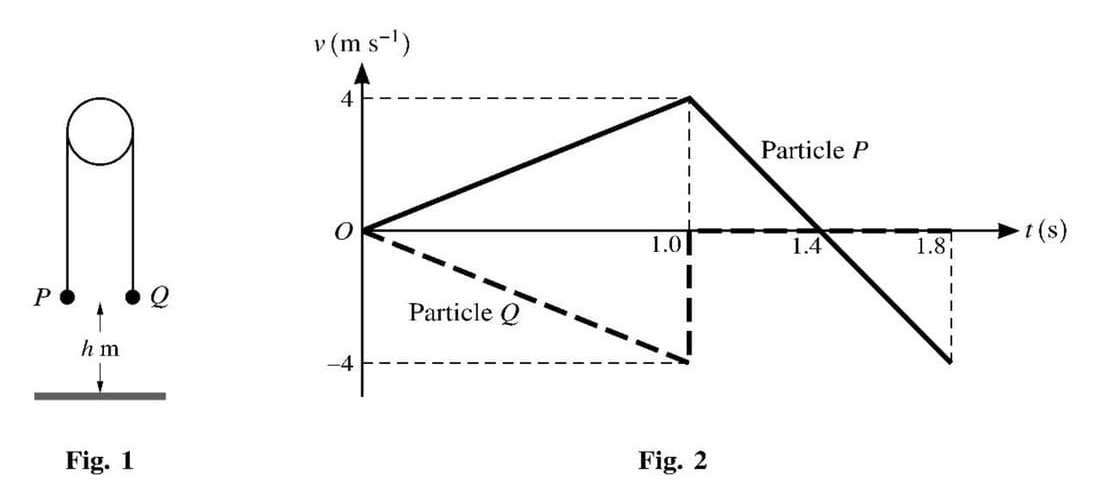
Particles P and Q have a total mass of 1 kg. The particles are attached to opposite ends of a light inextensible string which passes over a smooth fixed pulley. P is held at rest and Q hangs freely, with both straight parts of the string vertical. Both particles are at a height of h m above the floor (see Fig. 1). P is released from rest and the particles start to move with the string taut. Fig. 2 shows the velocity-time graphs for P's motion and for Q's motion, where the positive direction for velocity is vertically upwards. Find
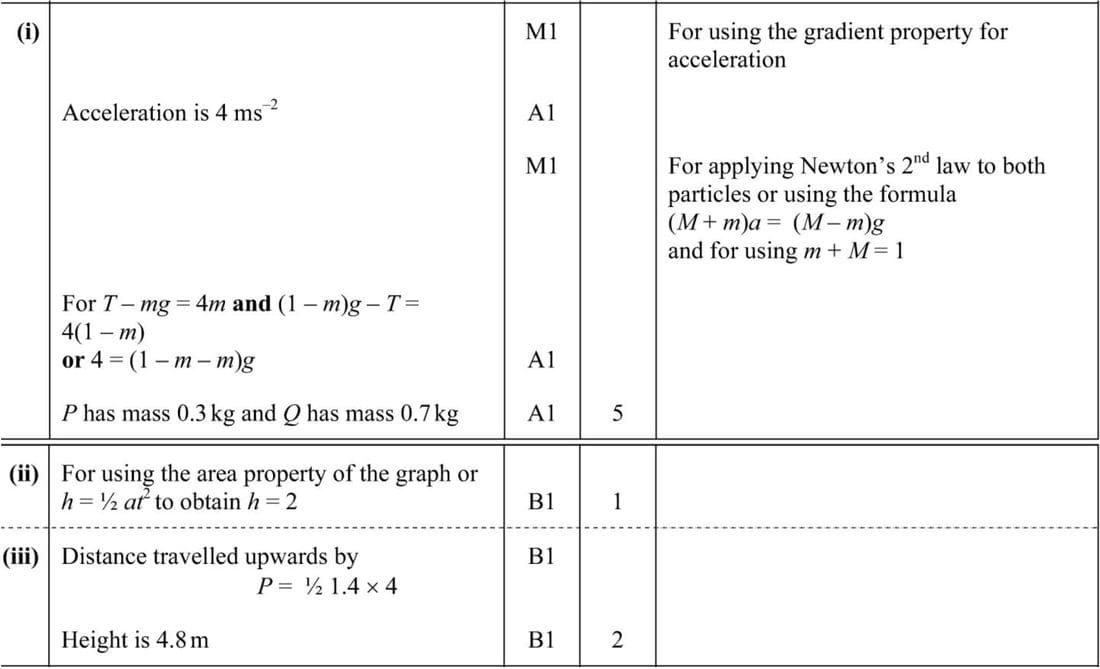
- the magnitude of the acceleration with which the particles start to move and the mass of each of the particles,
- the value of h,
- the greatest height above the floor reached by particle P.
June 2014 p41 q6
3942
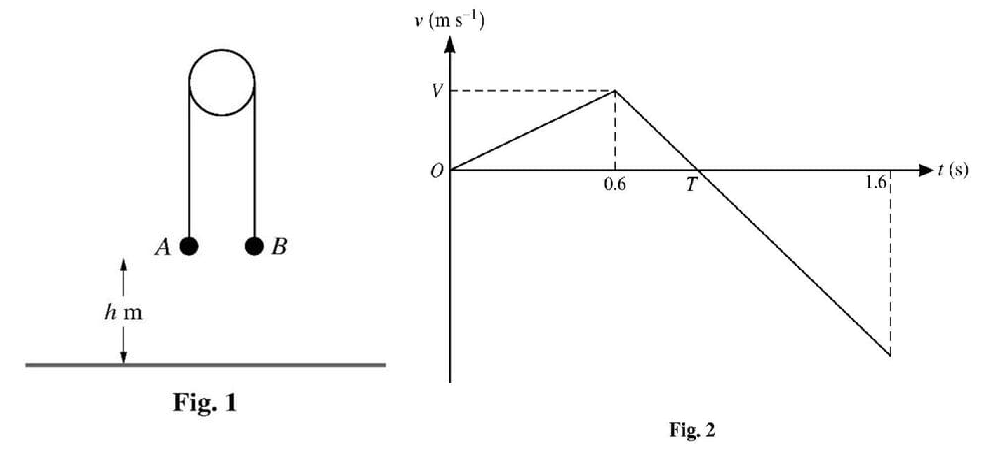
Particles A of mass 0.25 kg and B of mass 0.75 kg are attached to opposite ends of a light inextensible string which passes over a fixed smooth pulley. The system is held at rest with the string taut and its straight parts vertical. Both particles are at a height of h m above the floor (see Fig. 1). The system is released from rest, and 0.6 s later, when both particles are in motion, the string breaks. The particle A does not reach the pulley in the subsequent motion.
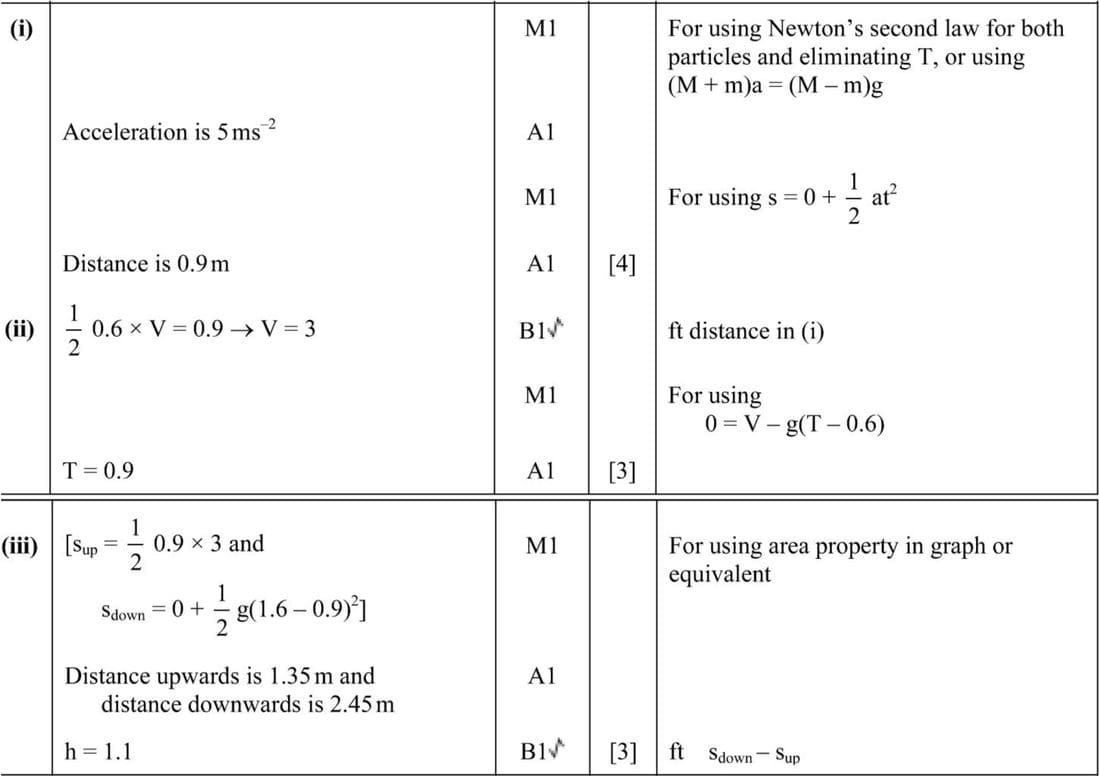
(i) Find the acceleration of A and the distance travelled by A before the string breaks.
The velocity-time graph shown in Fig. 2 is for the motion of particle A until it hits the floor. The velocity of A when the string breaks is V m s-1 and T s is the time taken for A to reach its greatest height.
(ii) Find the value of V and the value of T.
(iii) Find the distance travelled by A upwards and the distance travelled by A downwards and hence find h.
Nov 2013 p43 q2
3943
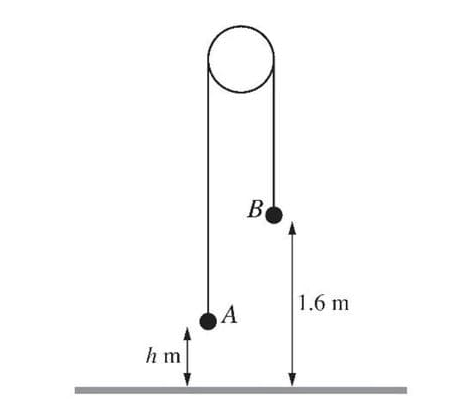
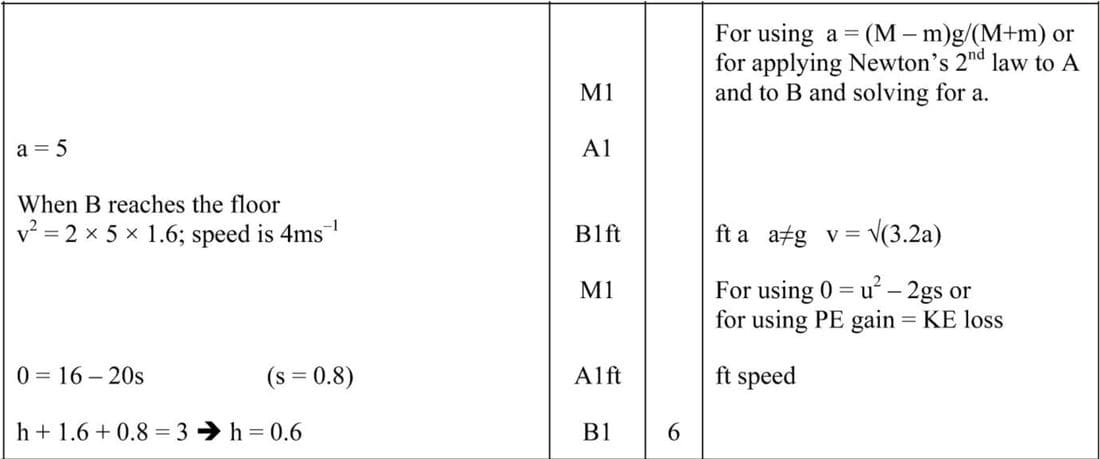
Particle A of mass 0.2 kg and particle B of mass 0.6 kg are attached to the ends of a light inextensible string. The string passes over a fixed smooth pulley. B is held at rest at a height of 1.6 m above the floor. A hangs freely at a height of h m above the floor. Both straight parts of the string are vertical (see diagram). B is released and both particles start to move. When B reaches the floor it remains at rest, but A continues to move vertically upwards until it reaches a height of 3 m above the floor. Find the speed of B immediately before it hits the floor, and hence find the value of h.