Exam-Style Problems
⬅ Back to SubchapterJune 2023 p51 q6
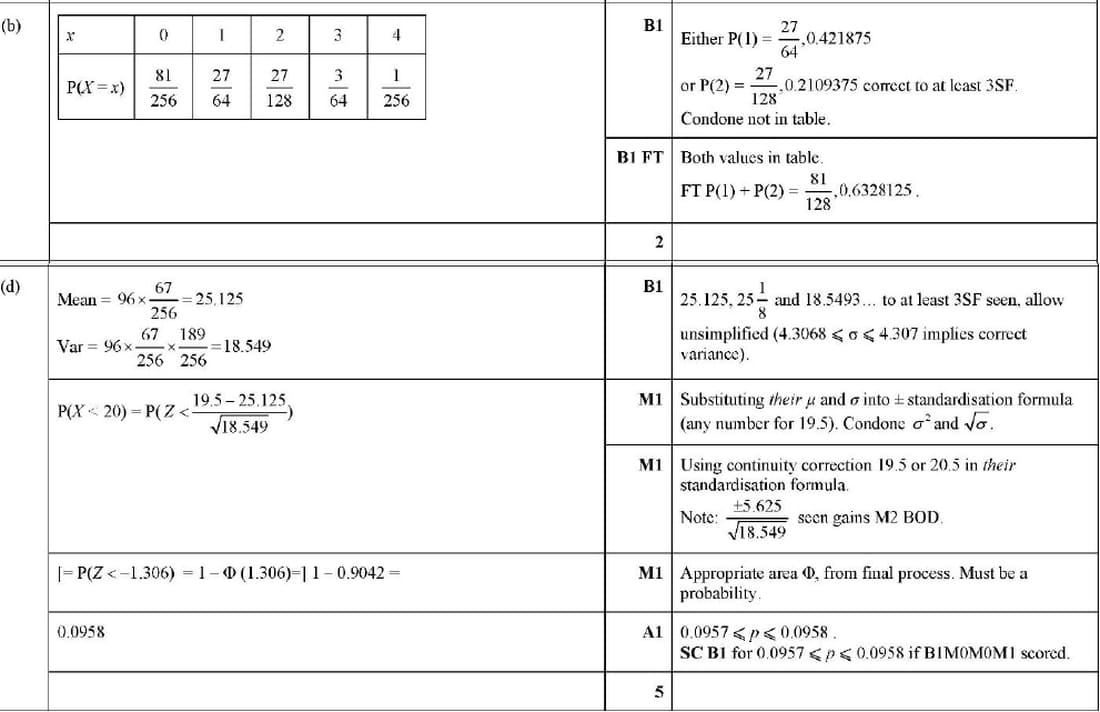
Eli has four fair 4-sided dice with sides labelled 1, 2, 3, 4. He throws all four dice at the same time. The random variable X denotes the number of 2s obtained.
(b) Complete the following probability distribution table for X.
| x | 0 | 1 | 2 | 3 | 4 |
|---|---|---|---|---|---|
| P(X = x) | \(\frac{81}{256}\) | \(\frac{3}{64}\) | \(\frac{1}{256}\) |
Eli throws the four dice at the same time on 96 occasions.
(d) Use an approximation to find the probability that he obtains at least two 2s on fewer than 20 of these occasions.
June 2009 p6 q3
On a certain road 20% of the vehicles are trucks, 16% are buses and the remainder are cars.
A random sample of 125 vehicles is now taken. Using a suitable approximation, find the probability that more than 73 are cars.

Nov 2008 p6 q2
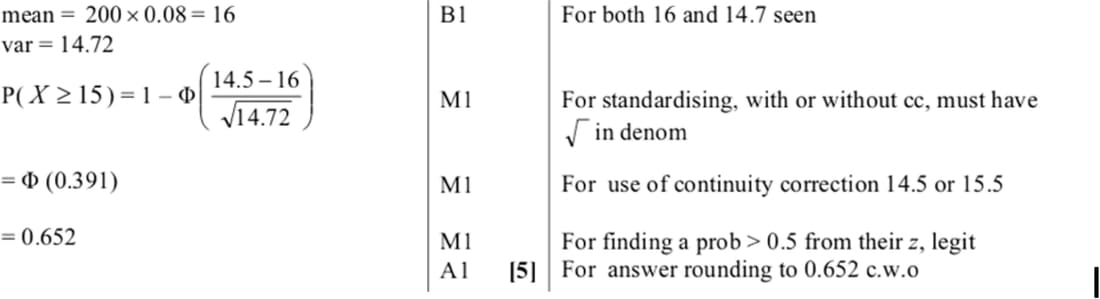
On a production line making toys, the probability of any toy being faulty is 0.08. A random sample of 200 toys is checked. Use a suitable approximation to find the probability that there are at least 15 faulty toys.
June 2008 p6 q7
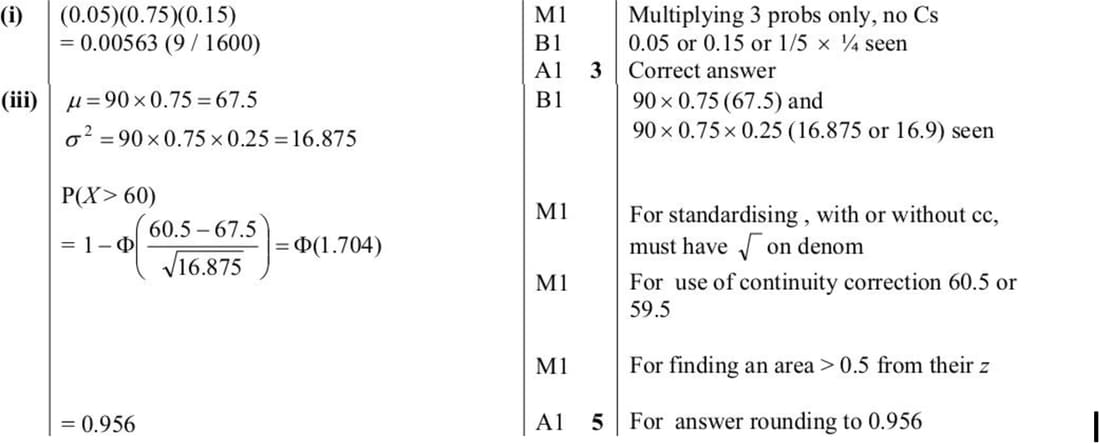
A die is biased so that the probability of throwing a 5 is 0.75 and the probabilities of throwing a 1, 2, 3, 4 or 6 are all equal.
- The die is thrown three times. Find the probability that the result is a 1 followed by a 5 followed by any even number.
- The die is thrown 90 times. Using an appropriate approximation, find the probability that a 5 is thrown more than 60 times.
Nov 2007 p6 q6
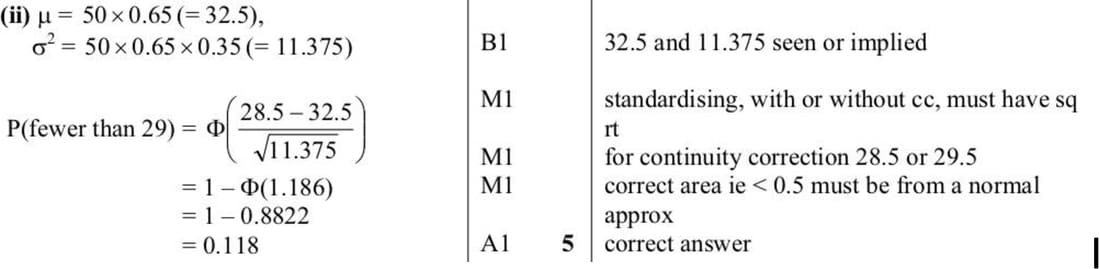
On any occasion when a particular gymnast performs a certain routine, the probability that she will perform it correctly is 0.65, independently of all other occasions.
On one day she performs the routine 50 times. Use a suitable approximation to estimate the probability that she will perform the routine correctly on fewer than 29 occasions.