Exam-Style Problems
⬅ Back to SubchapterNov 2022 p52 q2
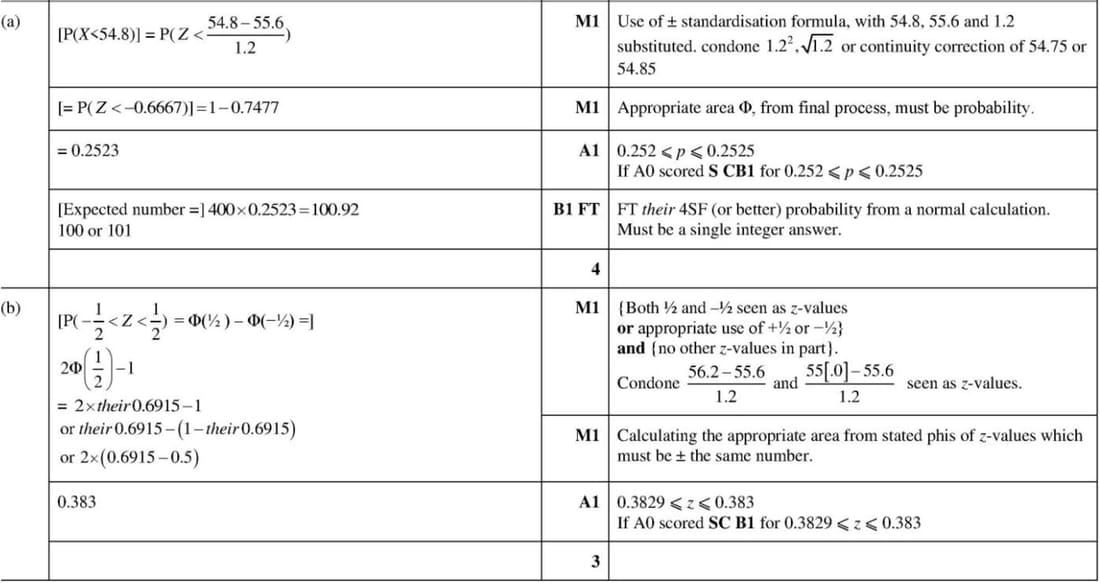
The lengths of the rods produced by a company are normally distributed with mean 55.6 mm and standard deviation 1.2 mm.
(a) In a random sample of 400 of these rods, how many would you expect to have length less than 54.8 mm?
(b) Find the probability that a randomly chosen rod produced by this company has a length that is within half a standard deviation of the mean.
June 2003 p6 q3
The height of sunflowers follows a normal distribution with mean 112 cm and standard deviation 17.2 cm. Find the probability that the height of a randomly chosen sunflower is greater than 120 cm.

Nov 2002 p6 q3
The distance in metres that a ball can be thrown by pupils at a particular school follows a normal distribution with mean 35.0 m and standard deviation 11.6 m.
Find the probability that a randomly chosen pupil can throw a ball between 30 and 40 m.

June 2002 p6 q4
On another day the mean speed of cars on the motorway was found to be 107.6 km h-1 and the standard deviation was 13.8 km h-1. Assuming these speeds follow a normal distribution and that the speed limit is 110 km h-1, find what proportion of cars exceed the speed limit.

June 2022 p53 q5
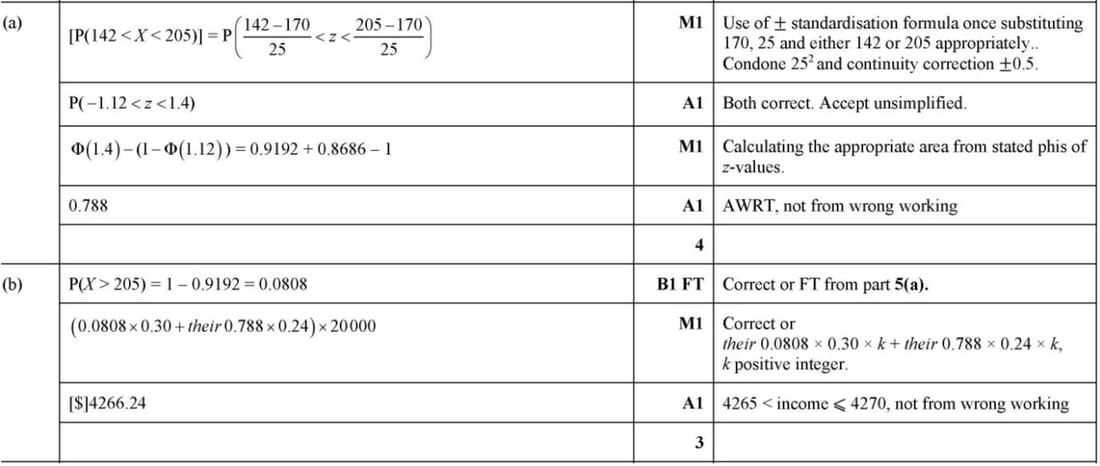
Farmer Jones grows apples. The weights, in grams, of the apples grown this year are normally distributed with mean 170 and standard deviation 25. Apples that weigh between 142 grams and 205 grams are sold to a supermarket.
(a) Find the probability that a randomly chosen apple grown by Farmer Jones this year is sold to the supermarket.
Farmer Jones sells the apples to the supermarket at $0.24 each. He sells apples that weigh more than 205 grams to a local shop at $0.30 each. He does not sell apples that weigh less than 142 grams.
The total number of apples grown by Farmer Jones this year is 20000.
(b) Calculate an estimate for his total income from this year’s apples.