Exam-Style Problems
⬅ Back to SubchapterNov 2006 p1 q7
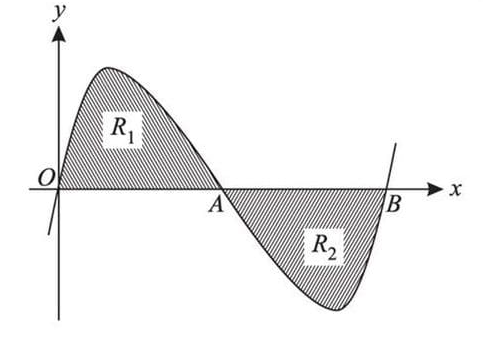
The diagram shows the curve \(y = x(x-1)(x-2)\), which crosses the x-axis at the points \(O(0, 0)\), \(A(1, 0)\), and \(B(2, 0)\).
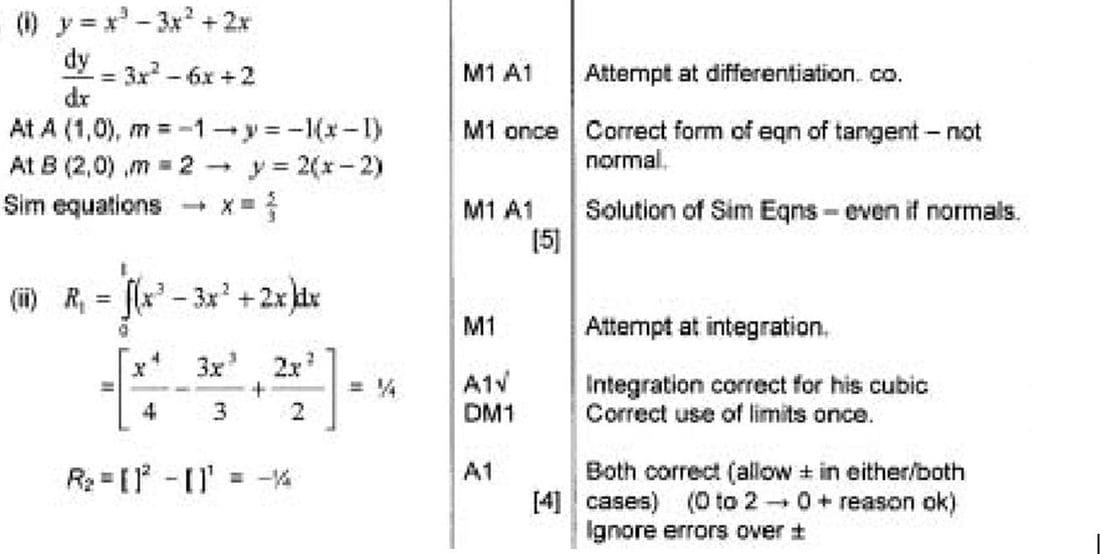
(i) The tangents to the curve at the points \(A\) and \(B\) meet at the point \(C\). Find the x-coordinate of \(C\).
(ii) Show by integration that the area of the shaded region \(R_1\) is the same as the area of the shaded region \(R_2\).
June 2006 p1 q10
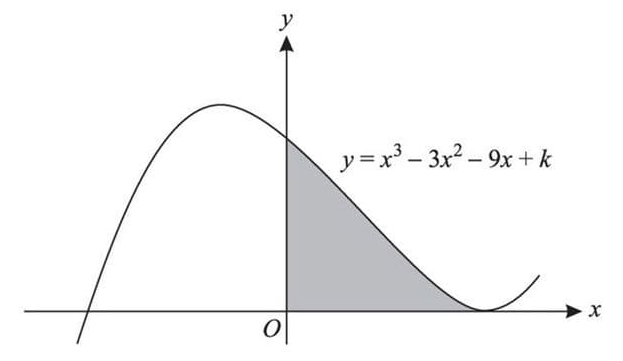
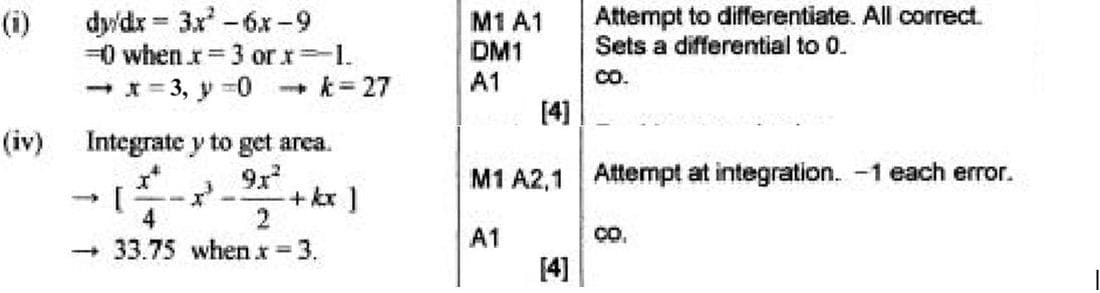
The diagram shows the curve \(y = x^3 - 3x^2 - 9x + k\), where \(k\) is a constant. The curve has a minimum point on the \(x\)-axis.
(i) Find the value of \(k\).
(iv) Find the area of the shaded region.
Nov 2005 p1 q10
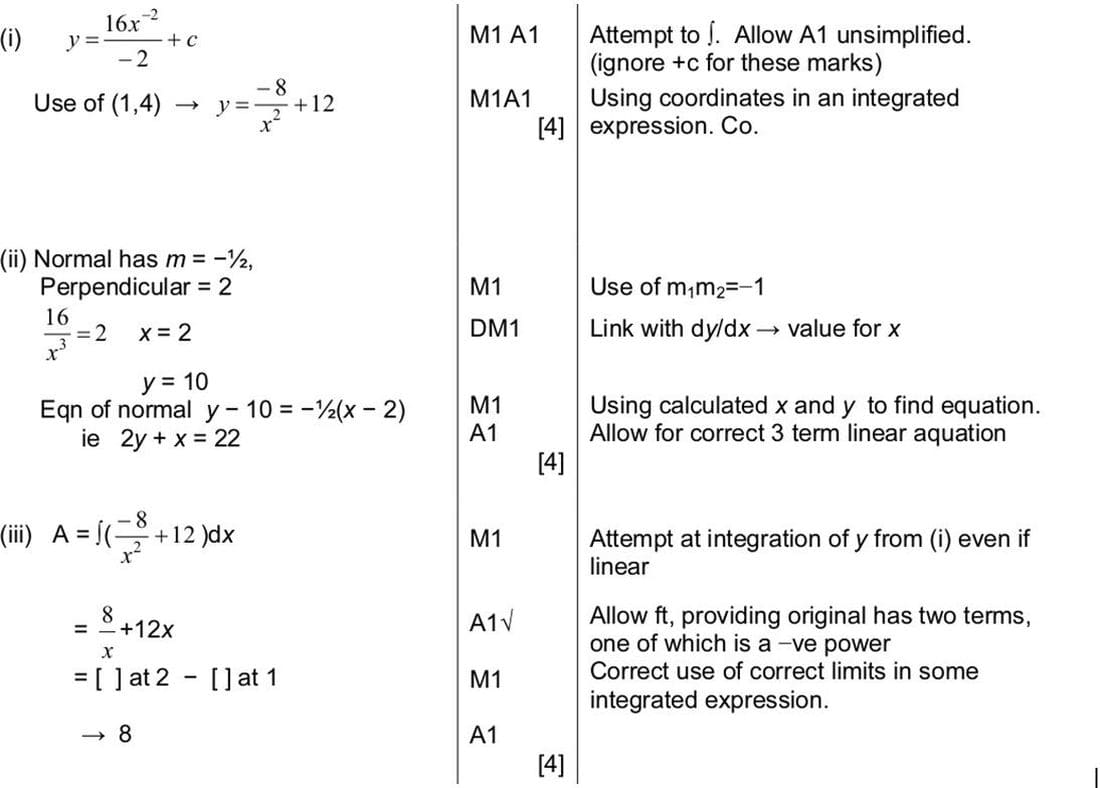
A curve is such that \(\frac{dy}{dx} = \frac{16}{x^3}\), and \((1, 4)\) is a point on the curve.
(i) Find the equation of the curve. [4]
(ii) A line with gradient \(-\frac{1}{2}\) is a normal to the curve. Find the equation of this normal, giving your answer in the form \(ax + by = c\). [4]
(iii) Find the area of the region enclosed by the curve, the \(x\)-axis and the lines \(x = 1\) and \(x = 2\). [4]
June 2005 p1 q9
A curve has equation \(y = \frac{4}{\sqrt{x}}\).
Find the area of the region enclosed by the curve, the x-axis and the lines \(x = 1\) and \(x = 4\).

June 2003 p1 q10
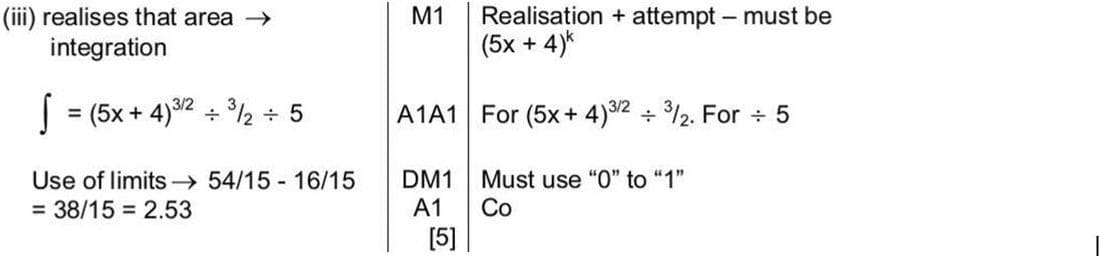
The equation of a curve is \(y = \sqrt{5x + 4}\).
Find the area enclosed by the curve, the \(x\)-axis, the \(y\)-axis and the line \(x = 1\).