Exam-Style Problems
⬅ Back to SubchapterJune 2014 p43 q2
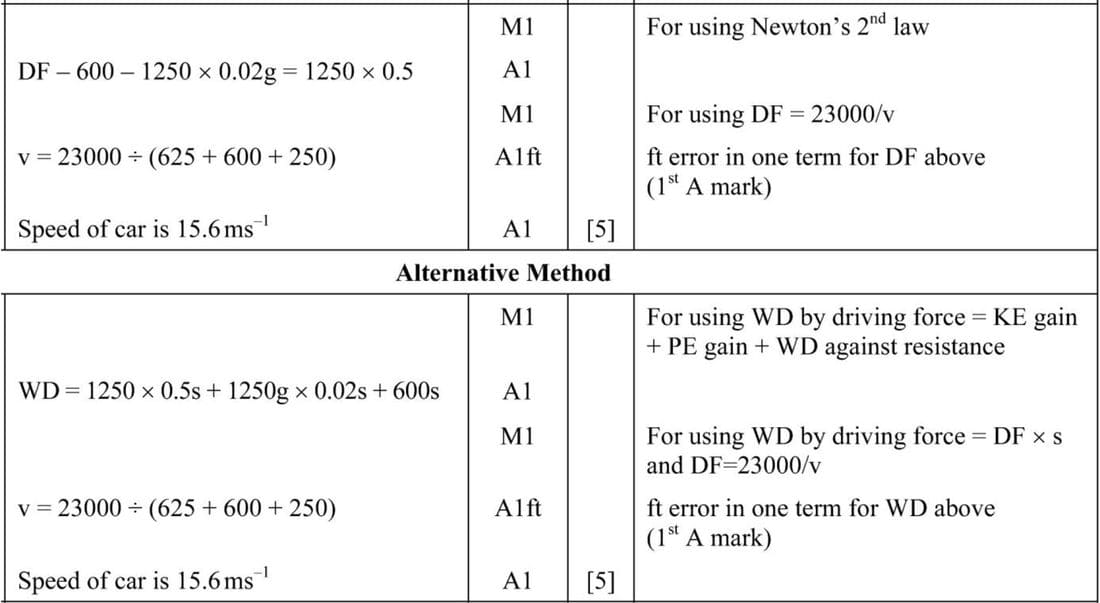
A car of mass 1250 kg travels up a straight hill inclined at an angle \(\alpha\) to the horizontal, where \(\sin \alpha = 0.02\). The power provided by the car’s engine is 23 kW. The resistance to motion is constant and equal to 600 N. Find the speed of the car at an instant when its acceleration is \(0.5 \text{ m/s}^2\).
June 2014 p42 q1
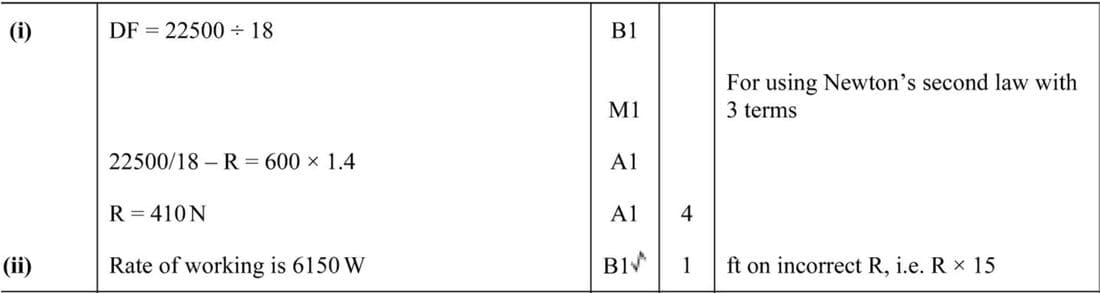
A car of mass 600 kg travels along a straight horizontal road. The resistance to the car’s motion is constant and equal to \(R\) N.
(i) Find the value of \(R\), given that the car’s acceleration is \(1.4 \, \text{m/s}^2\) at an instant when the car’s speed is \(18 \, \text{m/s}\) and its engine is working at a rate of \(22.5 \, \text{kW}\).
(ii) Find the rate of working of the car’s engine when the car is moving with a constant speed of \(15 \, \text{m/s}\).
June 2014 p41 q1
A train is moving at constant speed \(V \text{ m s}^{-1}\) along a horizontal straight track. Given that the power of the train’s engine is 1330 kW and the total resistance to the train’s motion is 28 kN, find the value of \(V\).

Nov 2013 p43 q6
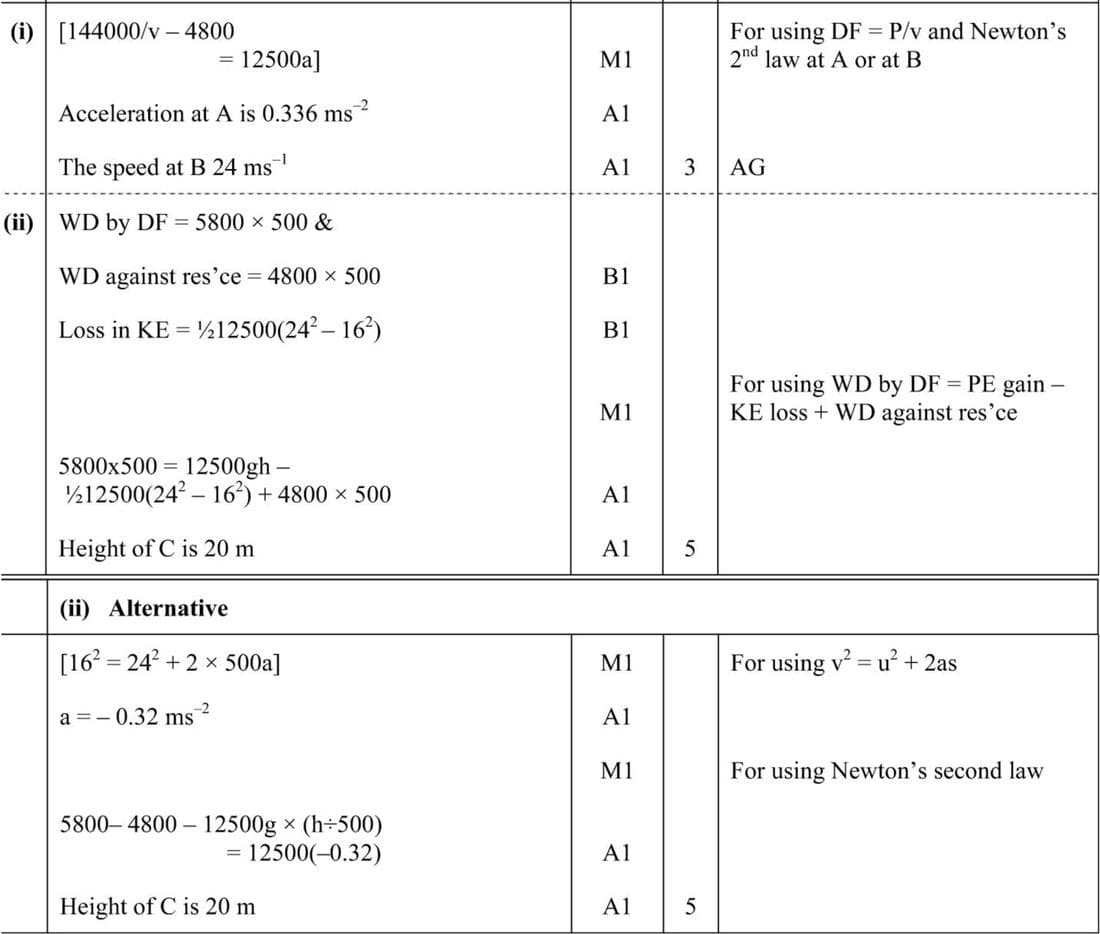
A lorry of mass 12,500 kg travels along a road from A to C passing through a point B. The resistance to motion of the lorry is 4800 N for the whole journey from A to C.
(i) The section AB of the road is straight and horizontal. On this section of the road the power of the lorry’s engine is constant and equal to 144 kW. The speed of the lorry at A is 16 m s-1 and its acceleration at B is 0.096 m s-2. Find the acceleration of the lorry at A and show that its speed at B is 24 m s-1.
(ii) The section BC of the road has length 500 m, is straight and inclined upwards towards C. On this section of the road the lorry’s driving force is constant and equal to 5800 N. The speed of the lorry at C is 16 m s-1. Find the height of C above the level of AB.
Nov 2013 p42 q3
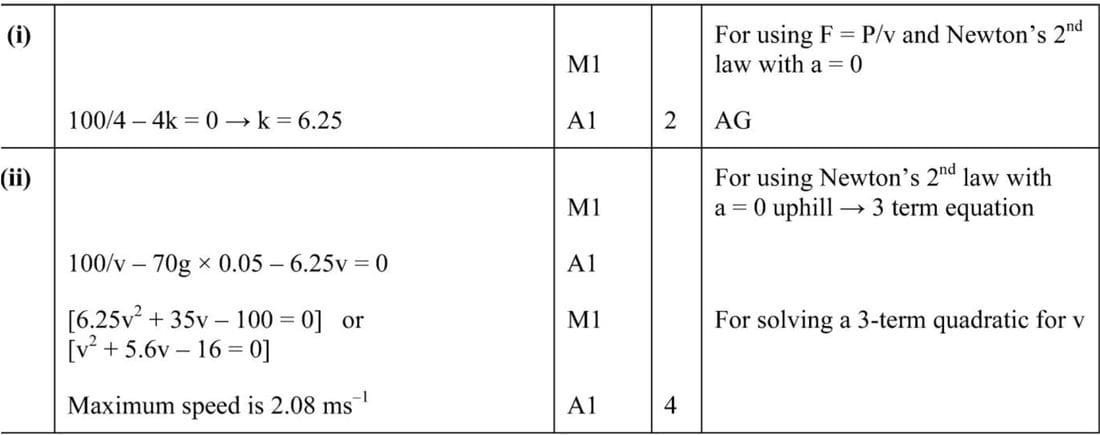
The resistance to motion acting on a runner of mass 70 kg is \(kv\) N, where \(v \text{ m s}^{-1}\) is the runner's speed and \(k\) is a constant. The greatest power the runner can exert is 100 W. The runner's greatest steady speed on horizontal ground is \(4 \text{ m s}^{-1}\).
- Show that \(k = 6.25\).
- Find the greatest steady speed of the runner while running uphill on a straight path inclined at an angle \(\alpha\) to the horizontal, where \(\sin \alpha = 0.05\).