Exam-Style Problems
⬅ Back to SubchapterJune 2022 p42 q3
3934
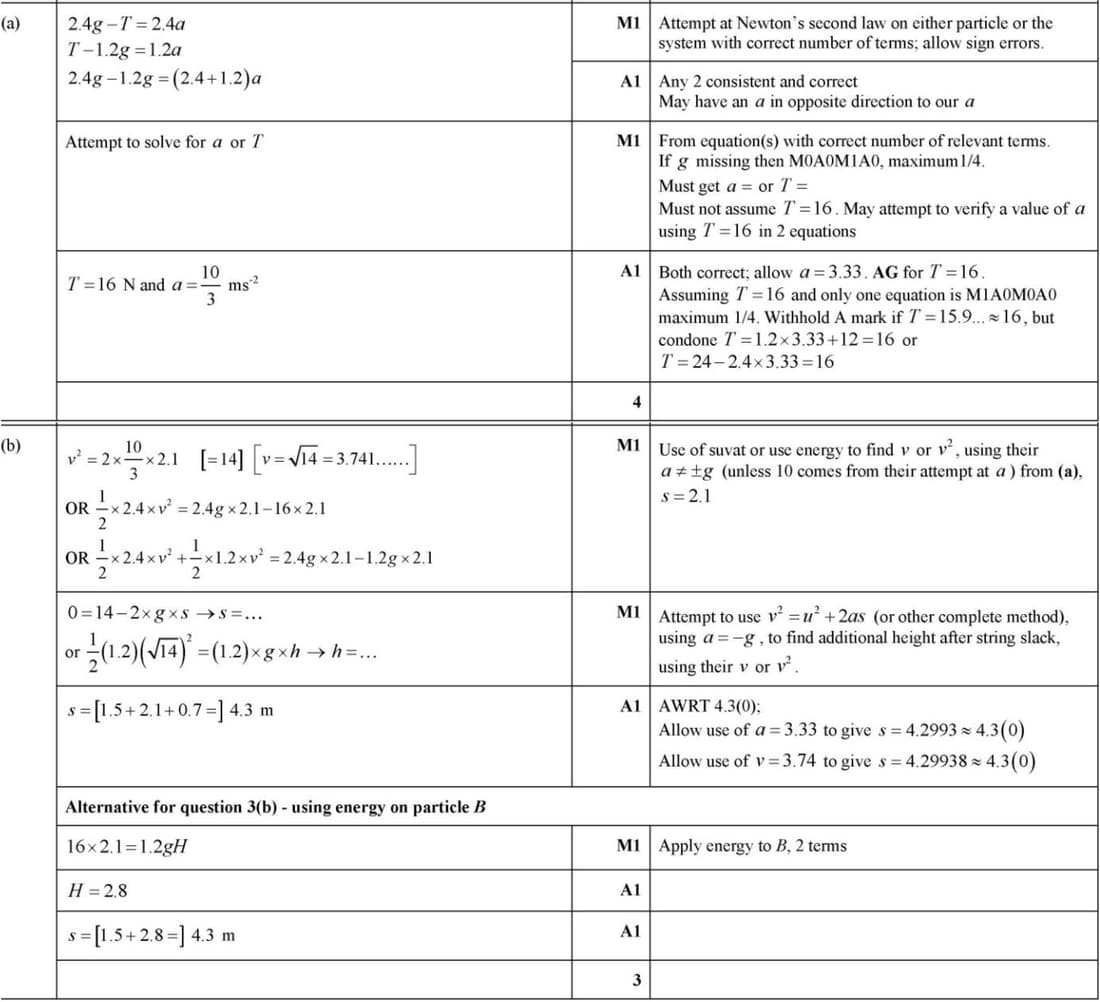
Two particles A and B, of masses 2.4 kg and 1.2 kg respectively, are connected by a light inextensible string which passes over a fixed smooth pulley. A is held at a distance of 2.1 m above a horizontal plane and B is 1.5 m above the plane. The particles hang vertically and are released from rest. In the subsequent motion A reaches the plane and does not rebound and B does not reach the pulley.
(a) Show that the tension in the string before A reaches the plane is 16 N and find the magnitude of the acceleration of the particles before A reaches the plane.
(b) Find the greatest height of B above the plane.
Nov 2017 p43 q4
3935
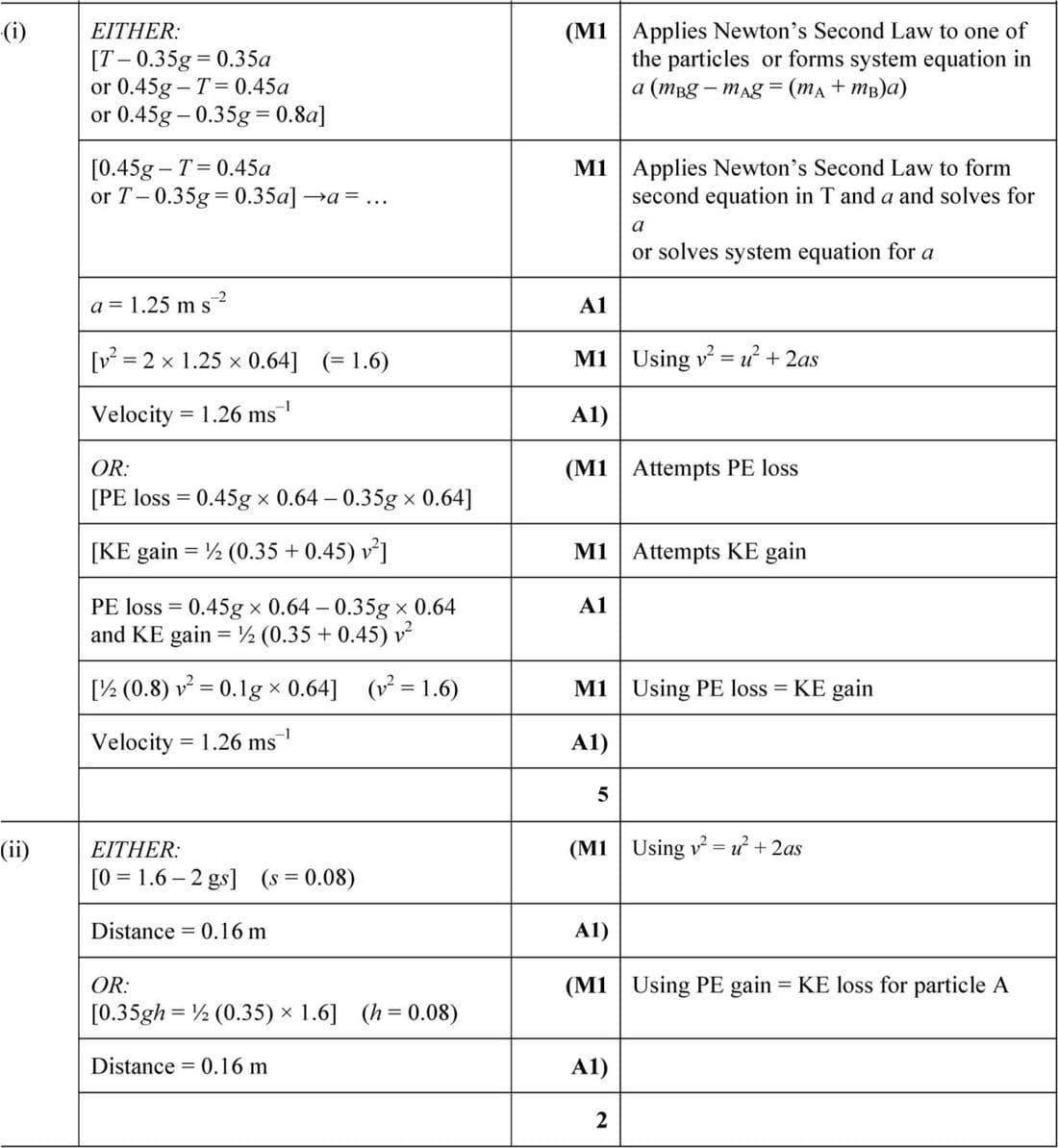
Two particles A and B have masses 0.35 kg and 0.45 kg respectively. The particles are attached to the ends of a light inextensible string which passes over a small fixed smooth pulley which is 1 m above horizontal ground. Initially particle A is held at rest on the ground vertically below the pulley, with the string taut. Particle B hangs vertically below the pulley at a height of 0.64 m above the ground. Particle A is released.
(i) Find the speed of A at the instant that B reaches the ground.
(ii) Assuming that B does not bounce after it reaches the ground, find the total distance travelled by A between the instant that B reaches the ground and the instant when the string becomes taut again.
Feb/Mar 2017 p42 q6
3936
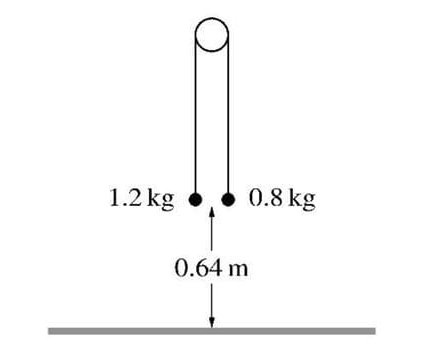
Two particles of masses 1.2 kg and 0.8 kg are connected by a light inextensible string that passes over a fixed smooth pulley. The particles hang vertically. The system is released from rest with both particles 0.64 m above the floor (see diagram). In the subsequent motion the 0.8 kg particle does not reach the pulley.
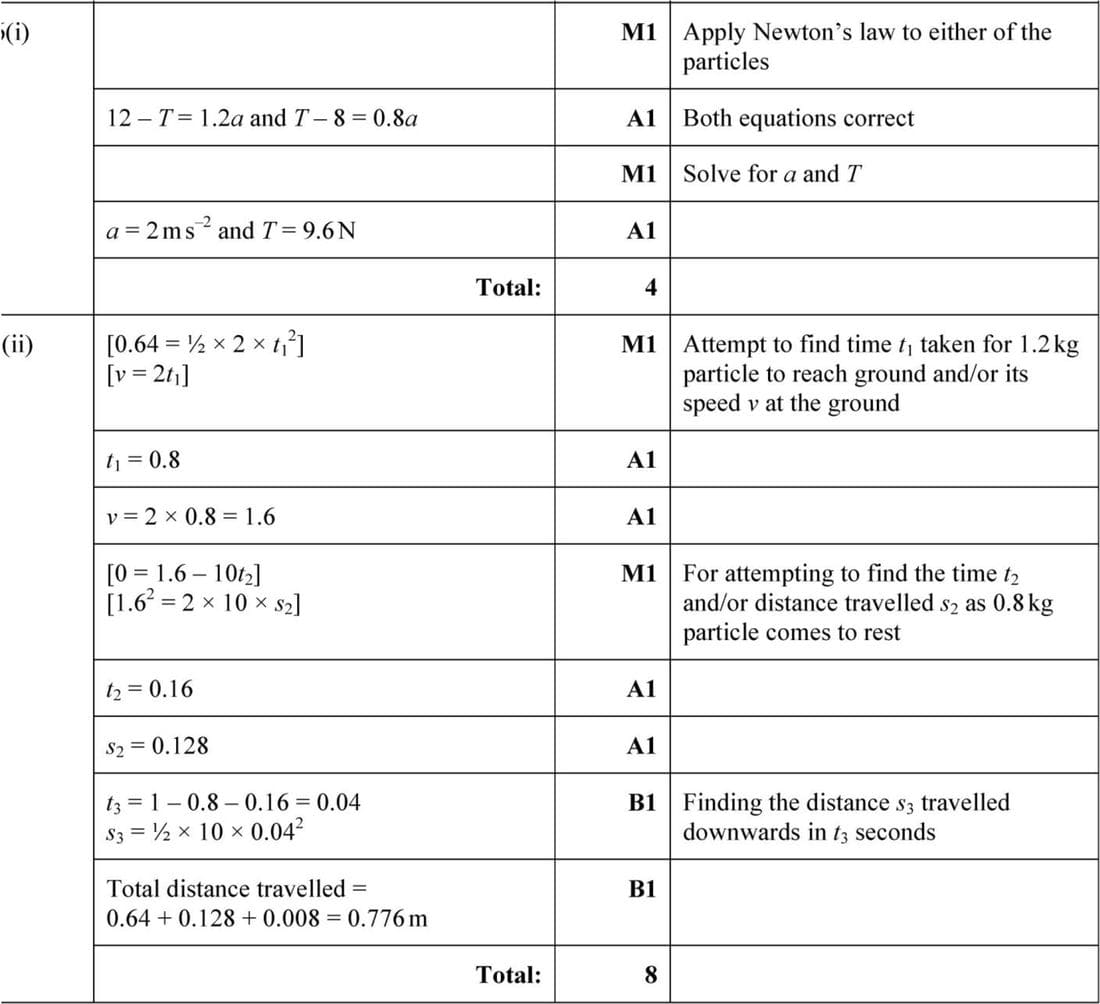
(i) Show that the acceleration of the particles is 2 m/s2 and find the tension in the string.
(ii) Find the total distance travelled by the 0.8 kg particle during the first second after the particles are released.
June 2016 p43 q6
3937
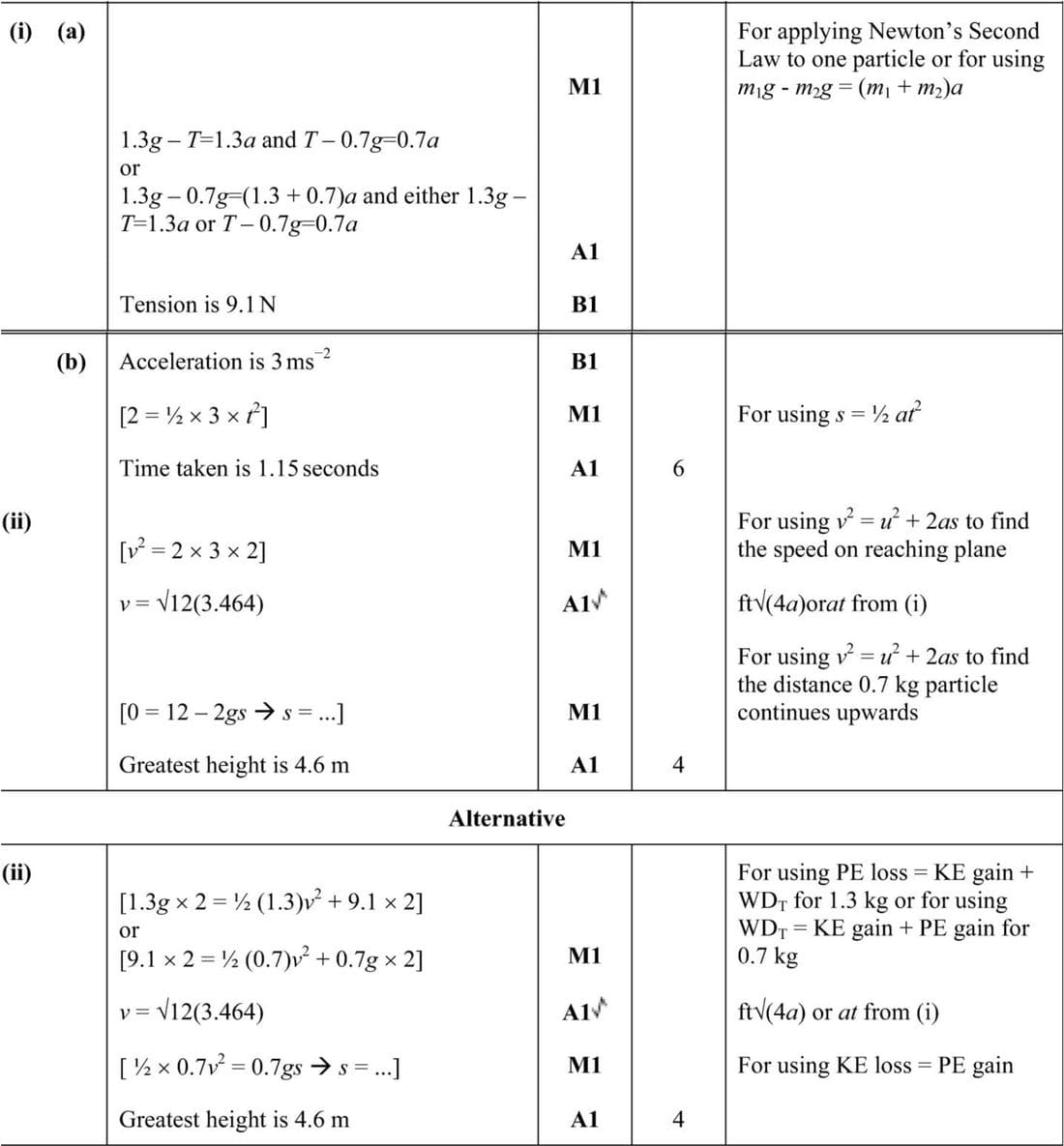
Two particles of masses 1.3 kg and 0.7 kg are connected by a light inextensible string that passes over a fixed smooth pulley. The particles are held at the same vertical height with the string taut. The distance of each particle above a horizontal plane is 2 m, and the distance of each particle below the pulley is 4 m. The particles are released from rest.
- Find
- the tension in the string before the particle of mass 1.3 kg reaches the plane,
- the time taken for the particle of mass 1.3 kg to reach the plane.
- Find the greatest height of the particle of mass 0.7 kg above the plane.
Nov 2015 p43 q4
3938
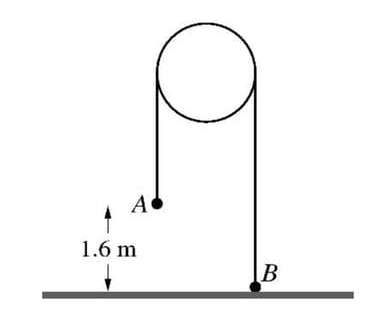
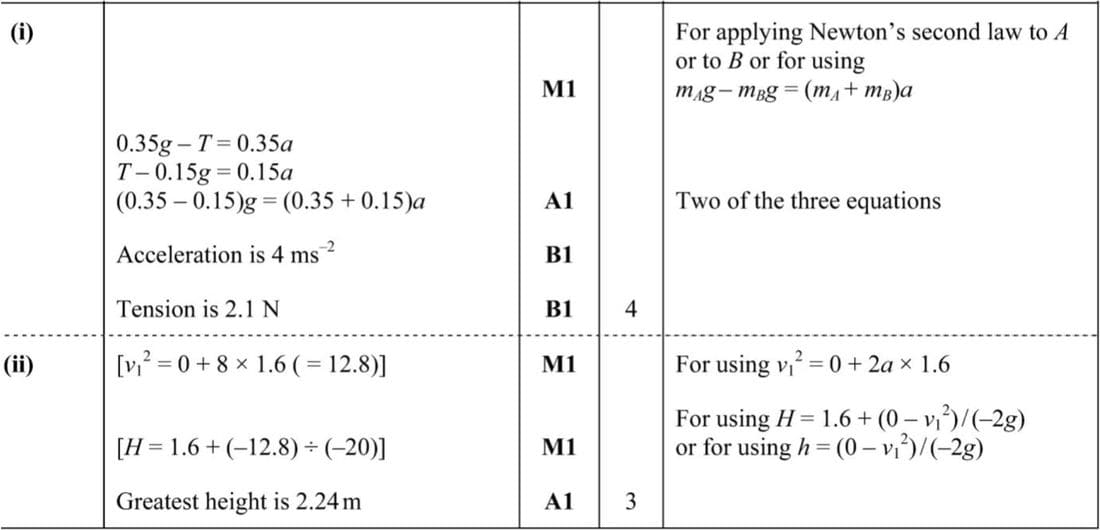
Particles A and B, of masses 0.35 kg and 0.15 kg respectively, are attached to the ends of a light inextensible string which passes over a fixed smooth pulley. The system is at rest with B held on the horizontal floor, the string taut and its straight parts vertical. A is at a height of 1.6 m above the floor (see diagram). B is released and the system begins to move; B does not reach the pulley. Find
- the acceleration of the particles and the tension in the string before A reaches the floor,
- the greatest height above the floor reached by B.