Exam-Style Problems
⬅ Back to SubchapterJune 2021 p42 q4
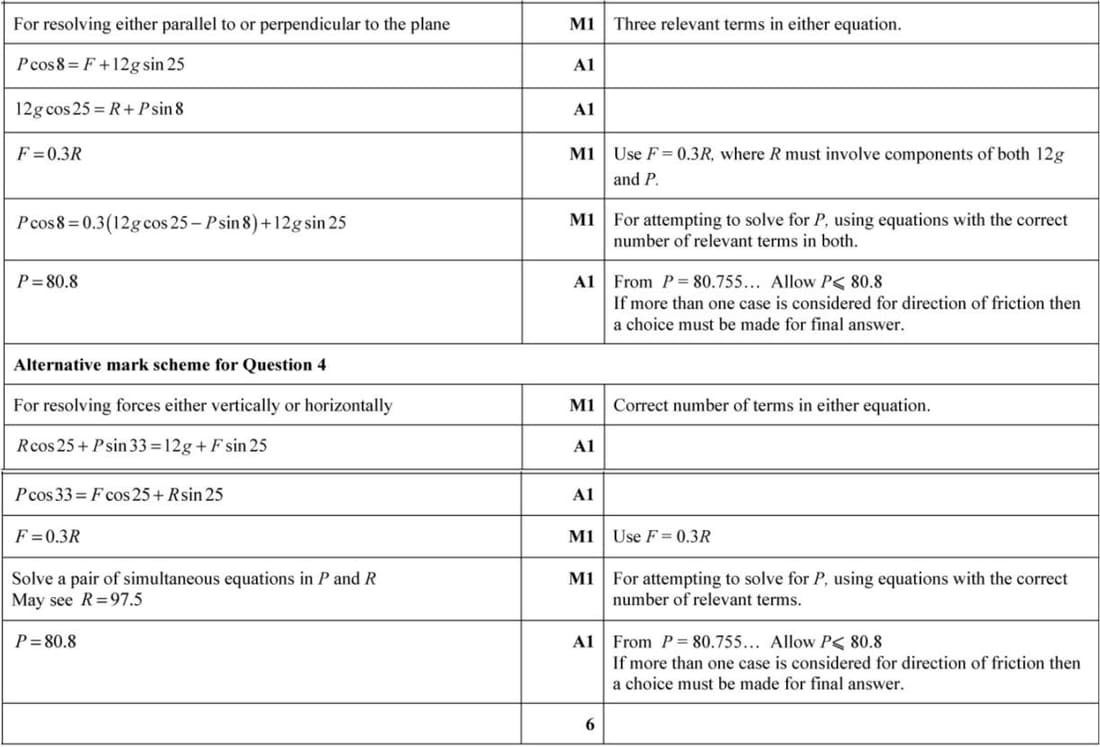
A particle of mass 12 kg is stationary on a rough plane inclined at an angle of 25° to the horizontal. A pulling force of magnitude \(P\) N acts at an angle of 8° above a line of greatest slope of the plane. This force is used to keep the particle in equilibrium. The coefficient of friction between the particle and the plane is 0.3.
Find the greatest possible value of \(P\).
June 2020 p42 q3
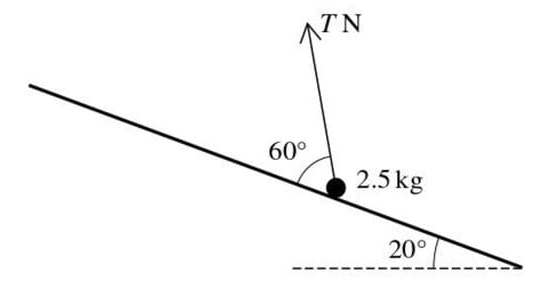
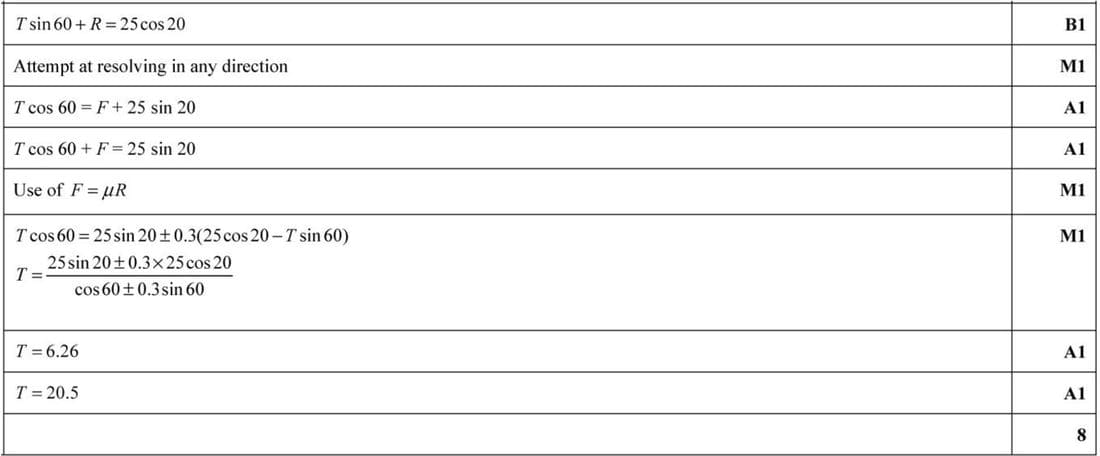
A particle of mass 2.5 kg is held in equilibrium on a rough plane inclined at 20° to the horizontal by a force of magnitude \(T\) N making an angle of 60° with a line of greatest slope of the plane (see diagram). The coefficient of friction between the particle and the plane is 0.3.
Find the greatest and least possible values of \(T\).
Nov 2019 p41 q3
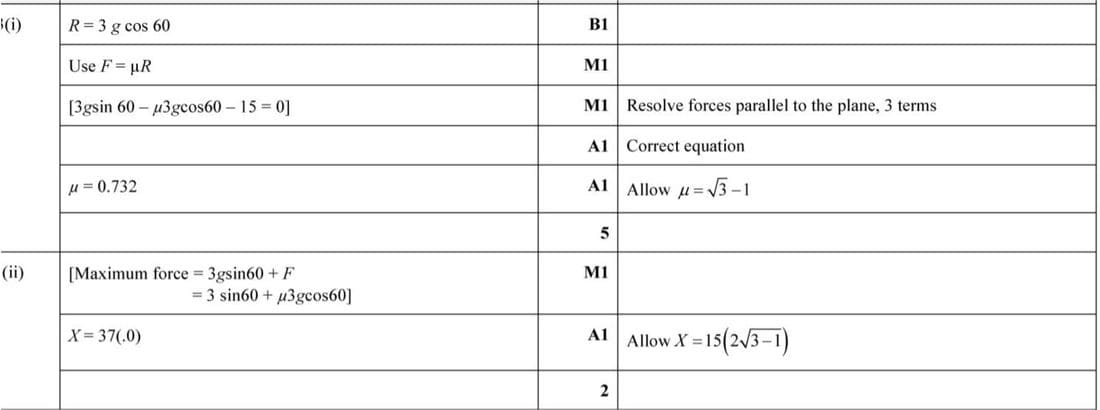
A block of mass 3 kg is at rest on a rough plane inclined at 60° to the horizontal. A force of magnitude 15 N acting up a line of greatest slope of the plane is just sufficient to prevent the block from sliding down the plane.
- Find the coefficient of friction between the block and the plane.
The force of magnitude 15 N is now replaced by a force of magnitude X N acting up the line of greatest slope.
- Find the greatest value of X for which the block does not move.
June 2018 p43 q5
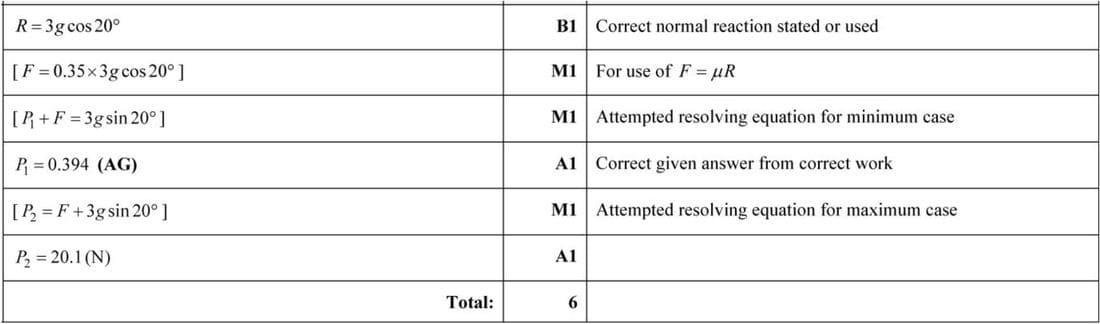
A particle of mass 3 kg is on a rough plane inclined at an angle of 20° to the horizontal. A force of magnitude \(P N\) acting parallel to a line of greatest slope of the plane is used to keep the particle in equilibrium. The coefficient of friction between the particle and the plane is 0.35. Show that the least possible value of \(P\) is 0.394, correct to 3 significant figures, and find the greatest possible value of \(P\).
June 2018 p42 q5
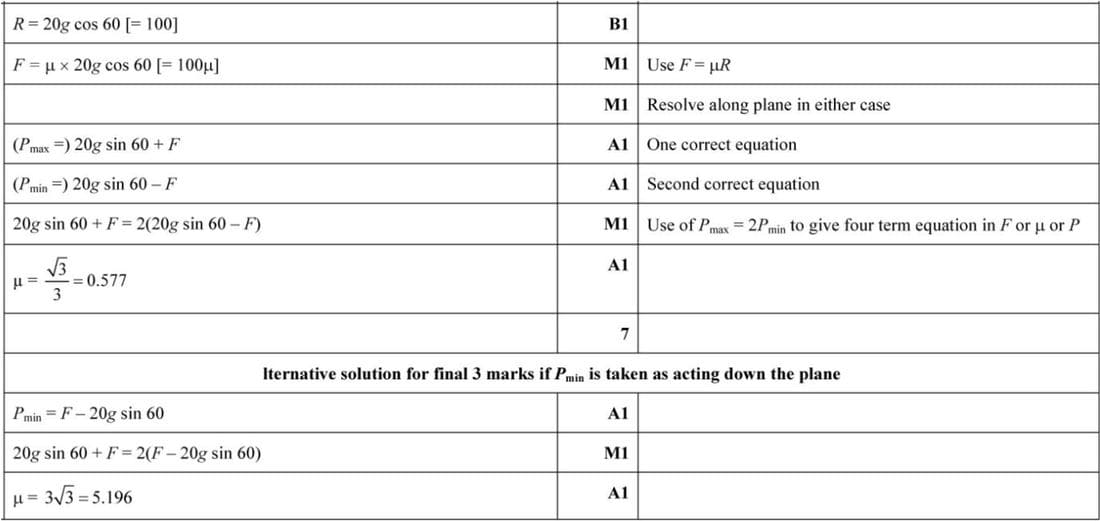
A particle of mass 20 kg is on a rough plane inclined at an angle of 60° to the horizontal. Equilibrium is maintained by a force of magnitude \(P \ N\) acting on the particle, in a direction parallel to a line of greatest slope of the plane. The greatest possible value of \(P\) is twice the least possible value of \(P\). Find the value of the coefficient of friction between the particle and the plane.