Exam-Style Problems
⬅ Back to SubchapterNov 2016 p61 q4
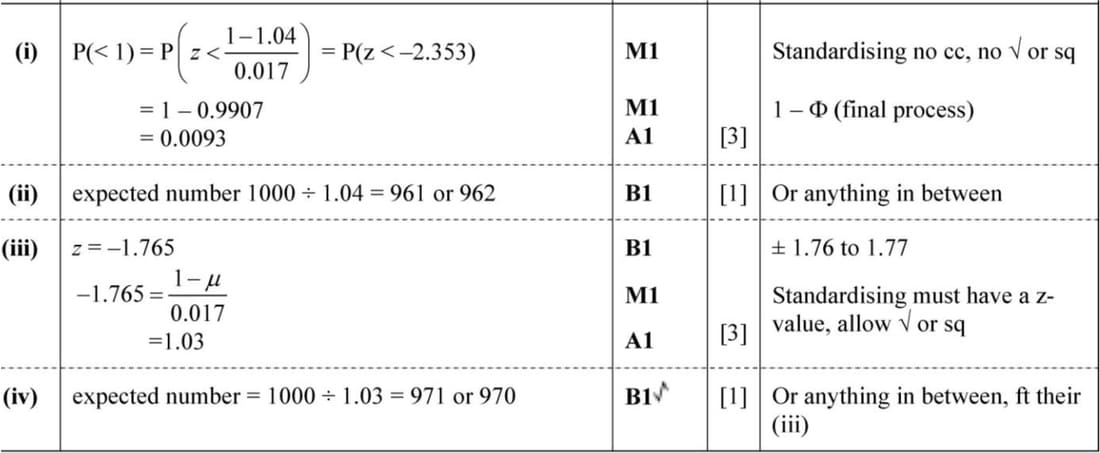
Packets of rice are filled by a machine and have weights which are normally distributed with mean 1.04 kg and standard deviation 0.017 kg.
- Find the probability that a randomly chosen packet weighs less than 1 kg.
- How many packets of rice, on average, would the machine fill from 1000 kg of rice?
The factory manager wants to produce more packets of rice. He changes the settings on the machine so that the standard deviation is the same but the mean is reduced to \(\mu\) kg. With this mean the probability that a packet weighs less than 1 kg is 0.0388.
- Find the value of \(\mu\).
- How many packets of rice, on average, would the machine now fill from 1000 kg of rice?
Feb/Mar 2023 p52 q6
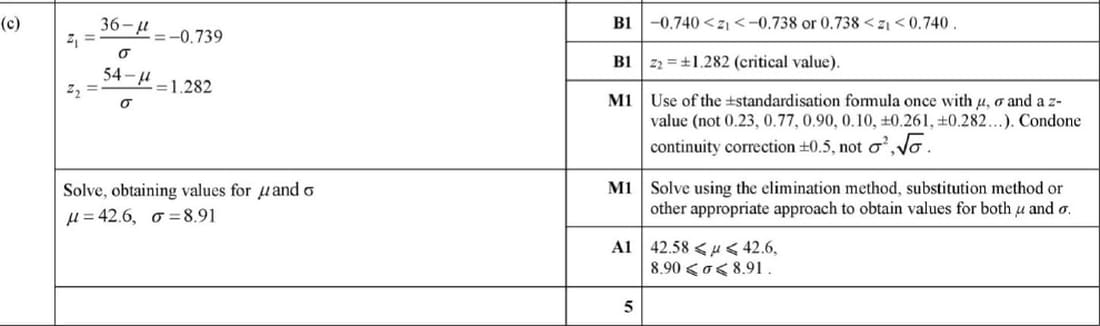
In a different cycling event, the times can also be modelled by a normal distribution. 23% of the cyclists have times less than 36 minutes and 10% of the cyclists have times greater than 54 minutes.
Find estimates for the mean and standard deviation of this distribution.
Nov 2016 p61 q1
The random variable X is such that X ~ N(20, 49). Given that P(X > k) = 0.25, find the value of k.

June 2016 p63 q5
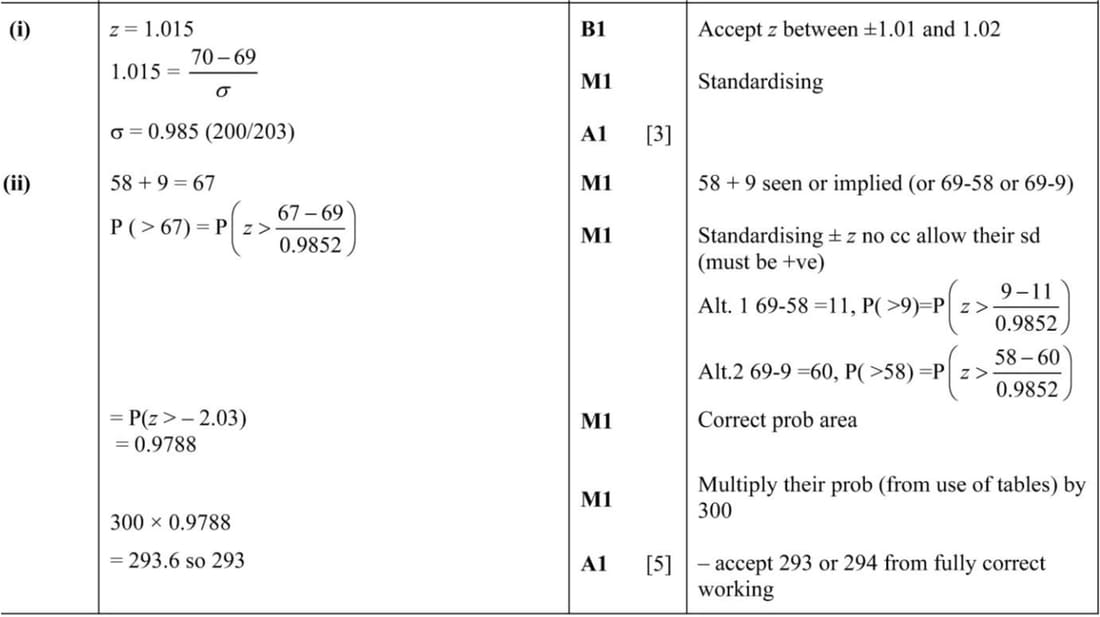
The heights of school desks have a normal distribution with mean 69 cm and standard deviation \(\sigma\) cm. It is known that 15.5% of these desks have a height greater than 70 cm.
(i) Find the value of \(\sigma\).
When Jodu sits at a desk, his knees are at a height of 58 cm above the floor. A desk is comfortable for Jodu if his knees are at least 9 cm below the top of the desk. Jodu's school has 300 desks.
(ii) Calculate an estimate of the number of these desks that are comfortable for Jodu.
June 2016 p62 q6
The time in minutes taken by Peter to walk to the shop and buy a newspaper is normally distributed with mean 9.5 and standard deviation 1.3.
On 90% of days he takes longer than t minutes. Find the value of t.
