Exam-Style Problems
⬅ Back to SubchapterJune 2013 p62 q7
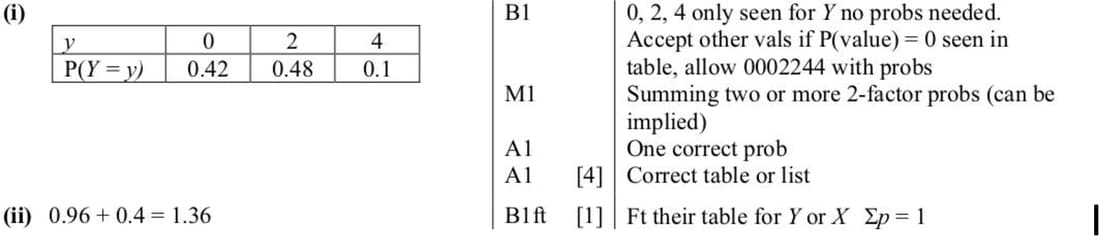
Susan has a bag of sweets containing 7 chocolates and 5 toffees. Ahmad has a bag of sweets containing 3 chocolates, 4 toffees and 2 boiled sweets. A sweet is taken at random from Susan’s bag and put in Ahmad’s bag. A sweet is then taken at random from Ahmad’s bag.
The random variable X is the number of times a chocolate is taken. State the possible values of X and draw up a table to show the probability distribution of X.
Nov 2012 p62 q6
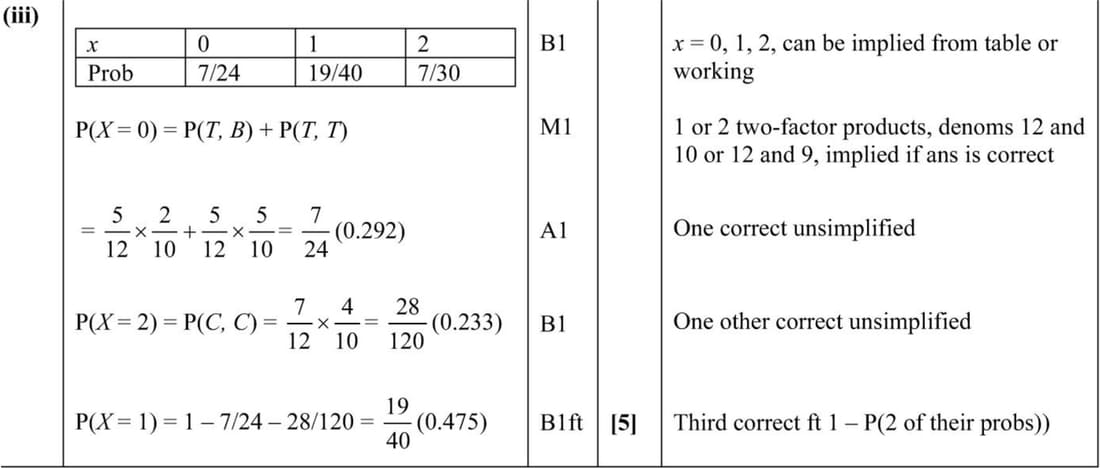
A fair tetrahedral die has four triangular faces, numbered 1, 2, 3, and 4. The score when this die is thrown is the number on the face that the die lands on. This die is thrown three times. The random variable X is the sum of the three scores.
(i) Show that \(P(X = 9) = \frac{10}{64}\).
(ii) Copy and complete the probability distribution table for \(X\).
| x | 3 | 4 | 5 | 6 | 7 | 8 | 9 | 10 | 11 | 12 |
|---|---|---|---|---|---|---|---|---|---|---|
| \(P(X = x)\) | \(\frac{1}{64}\) | \(\frac{3}{64}\) | \(\frac{12}{64}\) |
(iii) Event \(R\) is ‘the sum of the three scores is 9’. Event \(S\) is ‘the product of the three scores is 16’. Determine whether events \(R\) and \(S\) are independent, showing your working.
Nov 2012 p61 q1
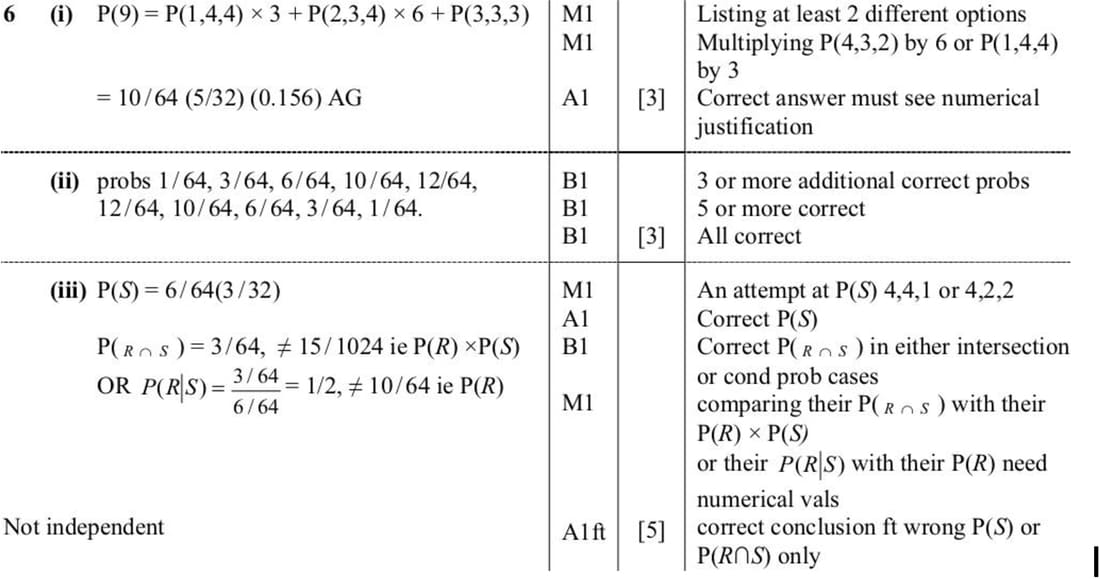
Ashok has 3 green pens and 7 red pens. His friend Rod takes 3 of these pens at random, without replacement. Draw up a probability distribution table for the number of green pens Rod takes.

June 2012 p63 q4
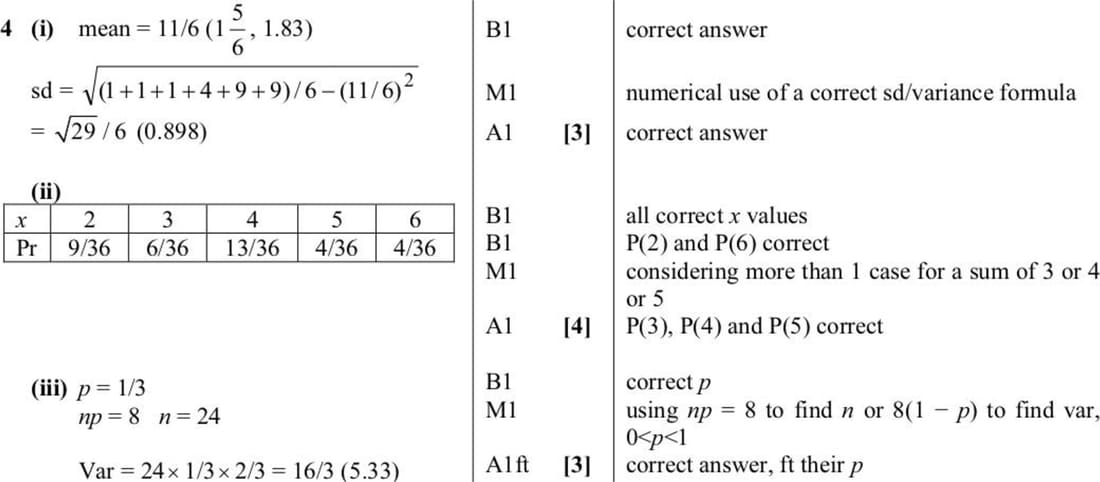
The six faces of a fair die are numbered 1, 1, 1, 2, 3, 3. The score for a throw of the die, denoted by the random variable W, is the number on the top face after the die has landed.
- Find the mean and standard deviation of W. [3]
- The die is thrown twice and the random variable X is the sum of the two scores. Draw up a probability distribution table for X. [4]
- The die is thrown n times. The random variable Y is the number of times that the score is 3. Given that E(Y) = 8, find Var(Y). [3]
June 2012 p62 q2
The random variable X has the probability distribution shown in the table.
| x | 2 | 4 | 6 |
|---|---|---|---|
| P(X = x) | 0.5 | 0.4 | 0.1 |
Two independent values of X are chosen at random. The random variable Y takes the value 0 if the two values of X are the same. Otherwise the value of Y is the larger value of X minus the smaller value of X.
- Draw up the probability distribution table for Y.
- Find the expected value of Y.