Exam-Style Problems
⬅ Back to SubchapterFeb/Mar 2019 p12 q5
Two vectors, u and v, are such that
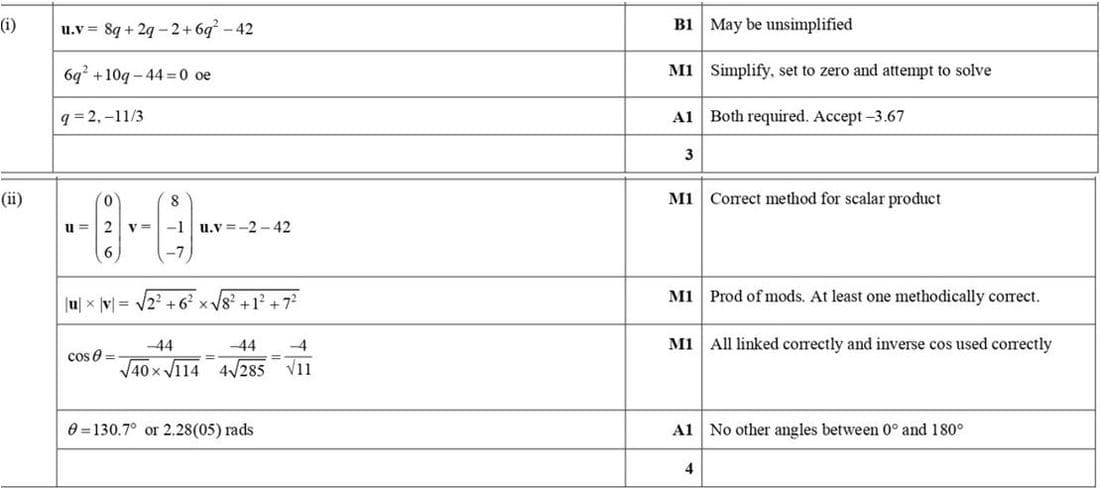
\(\mathbf{u} = \begin{pmatrix} q \\ 2 \\ 6 \end{pmatrix}\) and \(\mathbf{v} = \begin{pmatrix} 8 \\ q-1 \\ q^2-7 \end{pmatrix}\),
where \(q\) is a constant.
(i) Find the values of \(q\) for which \(\mathbf{u}\) is perpendicular to \(\mathbf{v}\).
(ii) Find the angle between \(\mathbf{u}\) and \(\mathbf{v}\) when \(q = 0\).
June 2018 p11 q7
Relative to an origin O, the position vectors of the points A, B and C are given by
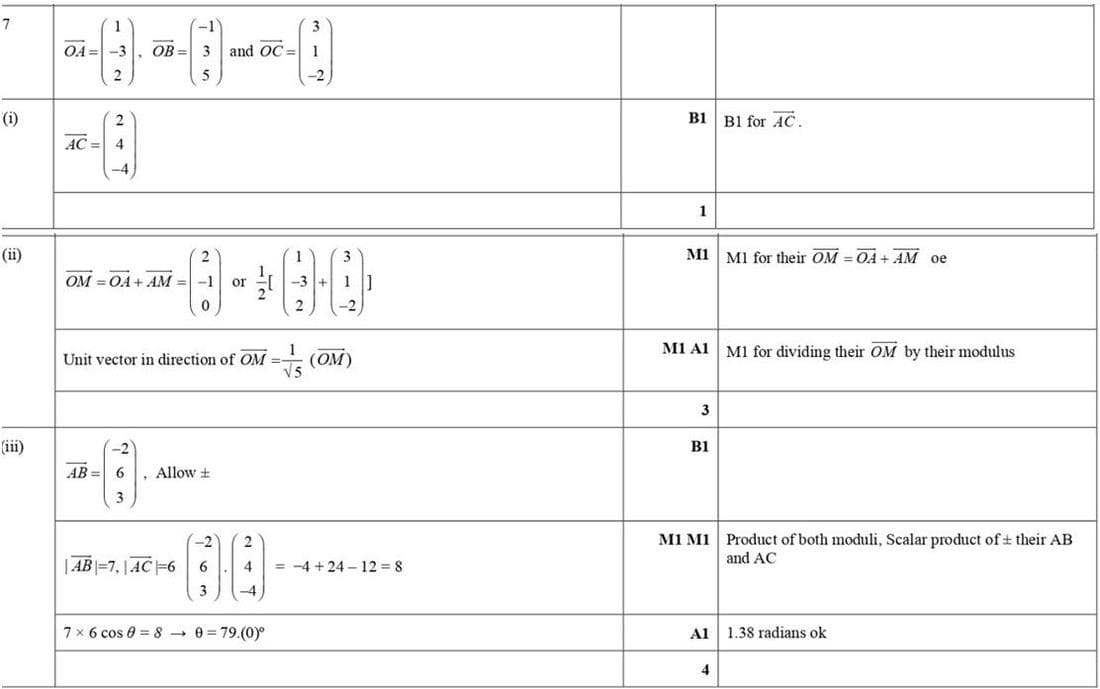
\(\overrightarrow{OA} = \begin{pmatrix} 1 \\ -3 \\ 2 \end{pmatrix}, \quad \overrightarrow{OB} = \begin{pmatrix} -1 \\ 3 \\ 5 \end{pmatrix} \quad \text{and} \quad \overrightarrow{OC} = \begin{pmatrix} 3 \\ 1 \\ -2 \end{pmatrix}.\)
- Find \(\overrightarrow{AC}\).
- The point M is the mid-point of AC. Find the unit vector in the direction of \(\overrightarrow{OM}\).
- Evaluate \(\overrightarrow{AB} \cdot \overrightarrow{AC}\) and hence find angle BAC.
Nov 2017 p13 q9
Relative to an origin \(O\), the position vectors of the points \(A, B\) and \(C\) are given by
\(\overrightarrow{OA} = \begin{pmatrix} 8 \\ -6 \\ 5 \end{pmatrix}, \quad \overrightarrow{OB} = \begin{pmatrix} -10 \\ 3 \\ -13 \end{pmatrix} \quad \text{and} \quad \overrightarrow{OC} = \begin{pmatrix} 2 \\ -3 \\ -1 \end{pmatrix}.\)
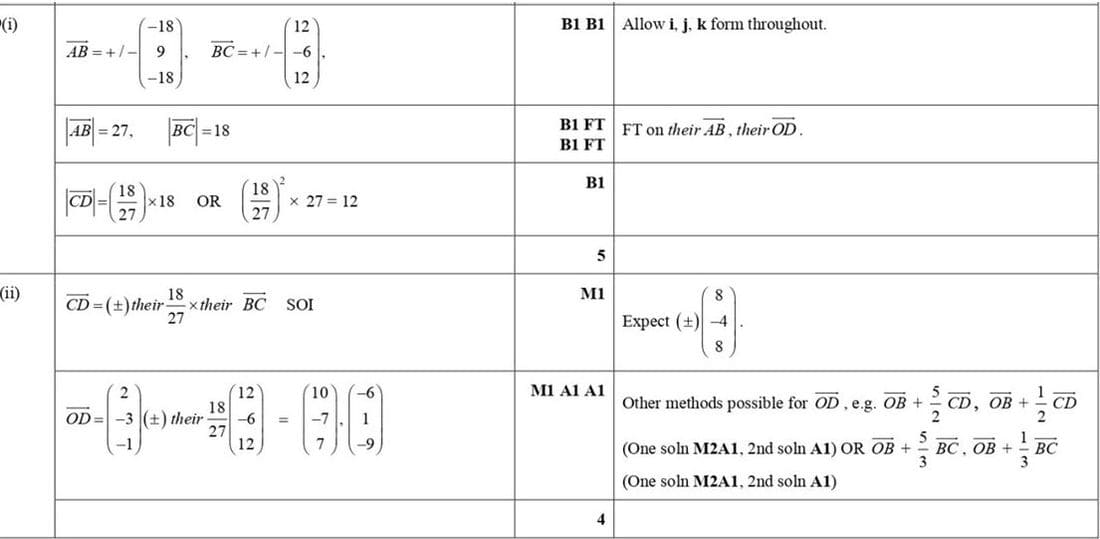
A fourth point, \(D\), is such that the magnitudes \(|\overrightarrow{AB}|, |\overrightarrow{BC}|\) and \(|\overrightarrow{CD}|\) are the first, second and third terms respectively of a geometric progression.
(i) Find the magnitudes \(|\overrightarrow{AB}|, |\overrightarrow{BC}|\) and \(|\overrightarrow{CD}|\).
(ii) Given that \(D\) is a point lying on the line through \(B\) and \(C\), find the two possible position vectors of the point \(D\).