Exam-Style Problems
⬅ Back to SubchapterNov 2017 p13 q10
1374
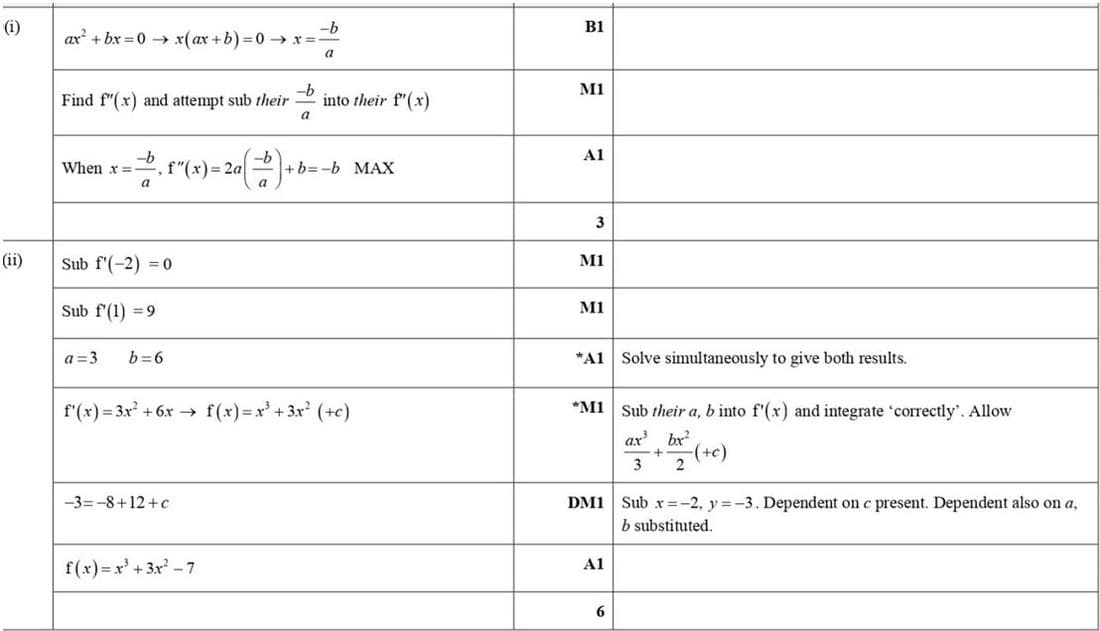
A curve has equation \(y = f(x)\) and it is given that \(f'(x) = ax^2 + bx\), where \(a\) and \(b\) are positive constants.
(i) Find, in terms of \(a\) and \(b\), the non-zero value of \(x\) for which the curve has a stationary point and determine, showing all necessary working, the nature of the stationary point.
(ii) It is now given that the curve has a stationary point at \((-2, -3)\) and that the gradient of the curve at \(x = 1\) is 9. Find \(f(x)\).
June 2017 p13 q11
1375
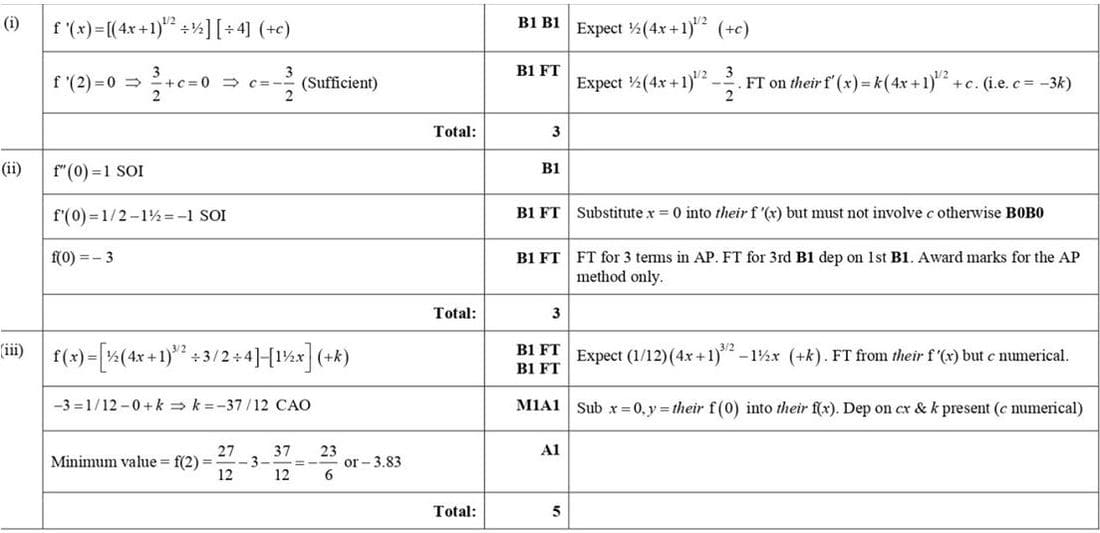
The function \(f\) is defined for \(x \geq 0\). It is given that \(f\) has a minimum value when \(x = 2\) and that \(f''(x) = (4x + 1)^{-\frac{1}{2}}\).
(i) Find \(f'(x)\).
It is now given that \(f''(0), f'(0)\) and \(f(0)\) are the first three terms respectively of an arithmetic progression.
(ii) Find the value of \(f(0)\).
(iii) Find \(f(x)\), and hence find the minimum value of \(f\).
June 2017 p11 q7
1376
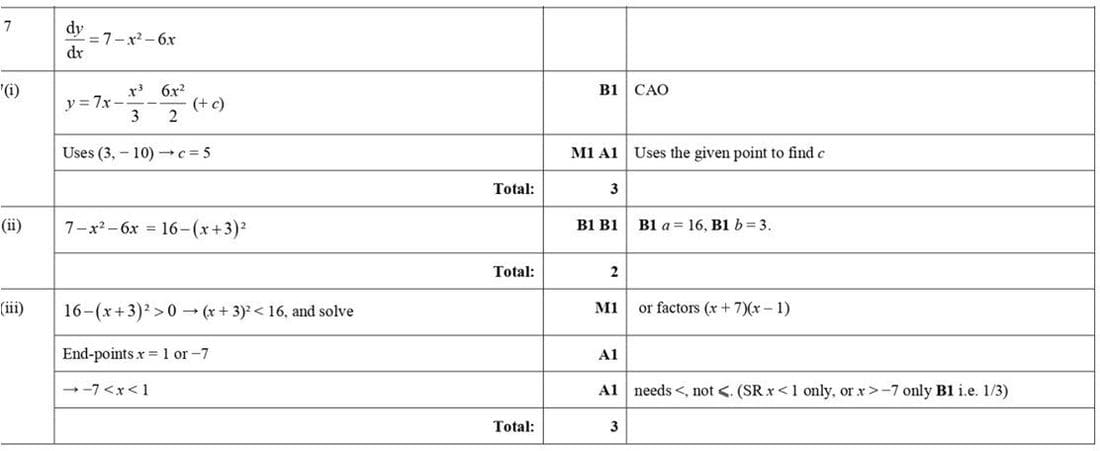
A curve for which \(\frac{dy}{dx} = 7 - x^2 - 6x\) passes through the point \((3, -10)\).
(i) Find the equation of the curve.
(ii) Express \(7 - x^2 - 6x\) in the form \(a - (x + b)^2\), where \(a\) and \(b\) are constants.
(iii) Find the set of values of \(x\) for which the gradient of the curve is positive.
Nov 2016 p13 q10
1377
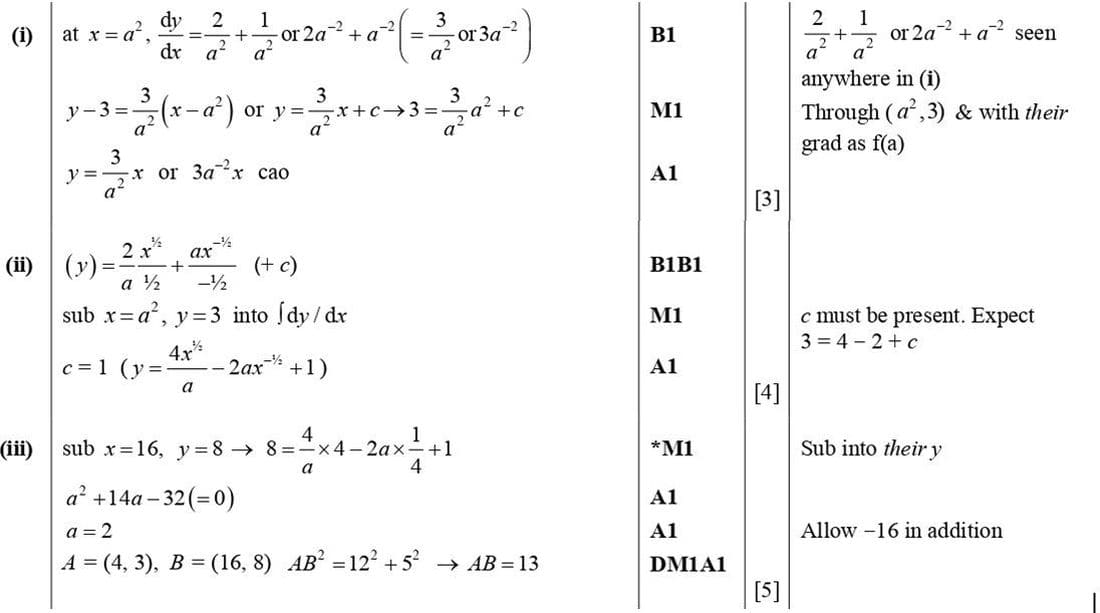
A curve is such that \(\frac{dy}{dx} = \frac{2}{a}x^{-\frac{1}{2}} + ax^{-\frac{3}{2}}\), where \(a\) is a positive constant. The point \(A(a^2, 3)\) lies on the curve. Find, in terms of \(a\),
- the equation of the tangent to the curve at \(A\), simplifying your answer,
- the equation of the curve.
It is now given that \(B(16, 8)\) also lies on the curve.
- Find the value of \(a\) and, using this value, find the distance \(AB\).
Nov 2016 p11 q10
1378
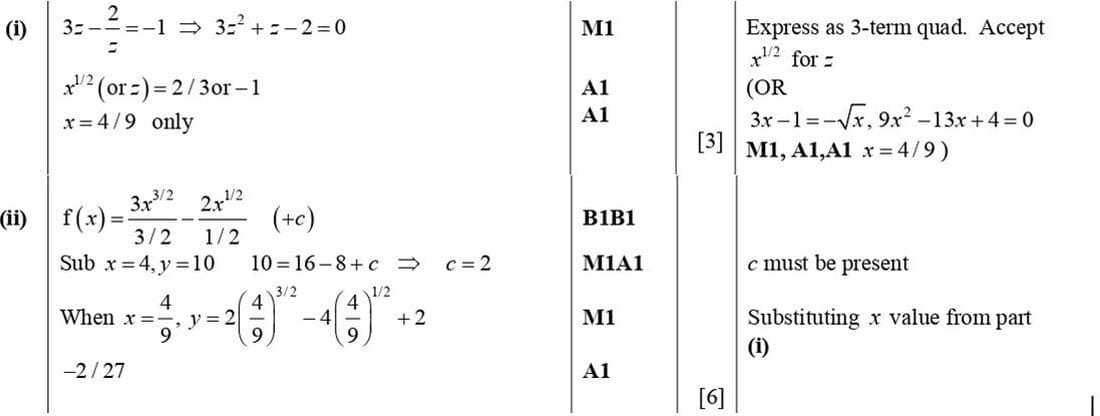
A curve has equation \(y = f(x)\) and it is given that \(f'(x) = 3x^{\frac{1}{2}} - 2x^{-\frac{1}{2}}\). The point \(A\) is the only point on the curve at which the gradient is \(-1\).
(i) Find the \(x\)-coordinate of \(A\).
(ii) Given that the curve also passes through the point \((4, 10)\), find the \(y\)-coordinate of \(A\), giving your answer as a fraction.