Exam-Style Problems
⬅ Back to SubchapterJune 2018 p13 q11
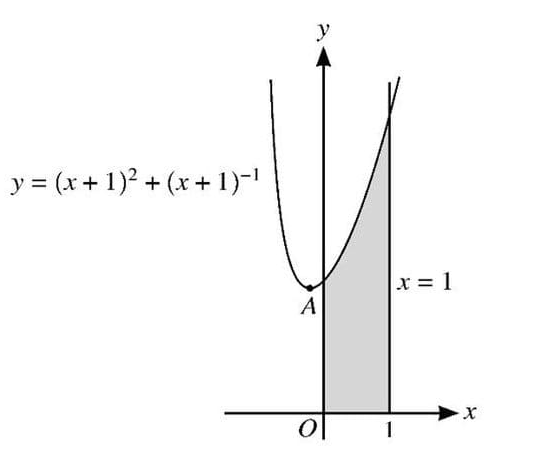
The diagram shows part of the curve \(y = (x+1)^2 + (x+1)^{-1}\) and the line \(x = 1\). The point \(A\) is the minimum point on the curve.
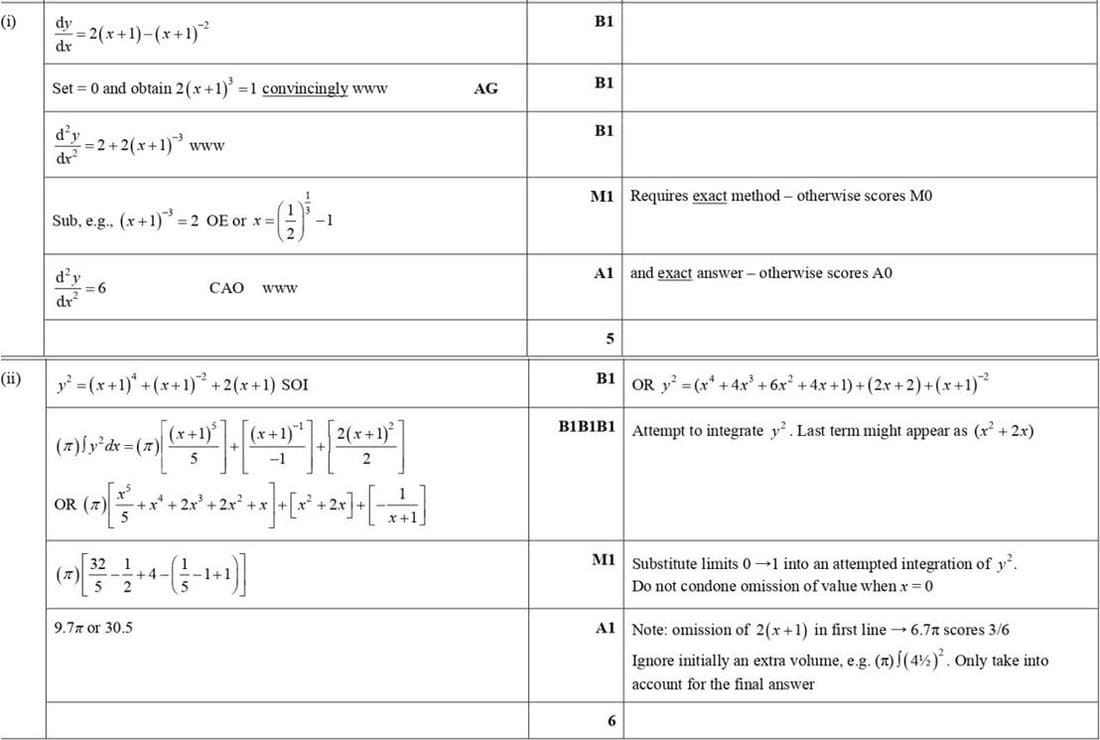
(i) Show that the \(x\)-coordinate of \(A\) satisfies the equation \(2(x+1)^3 = 1\) and find the exact value of \(\frac{d^2y}{dx^2}\) at \(A\).
(ii) Find, showing all necessary working, the volume obtained when the shaded region is rotated through 360° about the \(x\)-axis.
June 2018 p12 q11
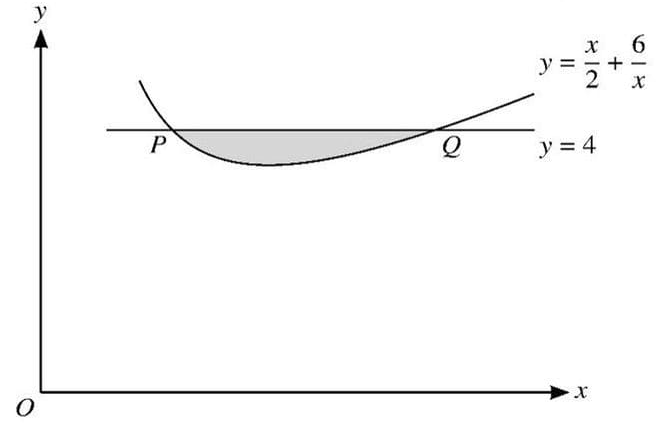
The diagram shows part of the curve \(y = \frac{x}{2} + \frac{6}{x}\). The line \(y = 4\) intersects the curve at the points \(P\) and \(Q\).
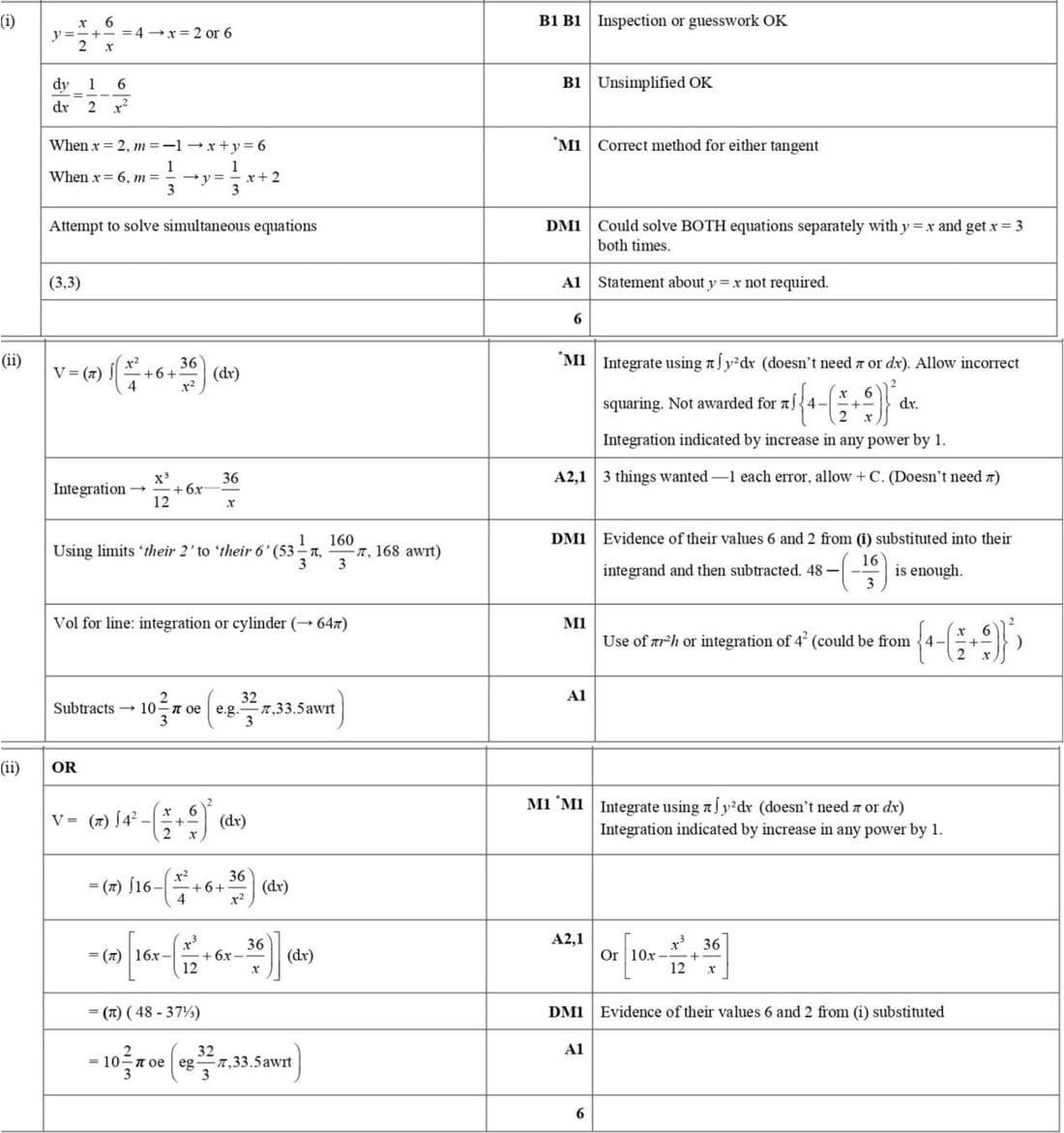
(i) Show that the tangents to the curve at \(P\) and \(Q\) meet at a point on the line \(y = x\).
(ii) Find, showing all necessary working, the volume obtained when the shaded region is rotated through 360° about the \(x\)-axis. Give your answer in terms of \(\pi\).
Nov 2017 p11 q10
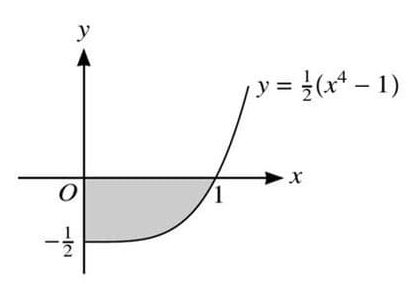
The diagram shows part of the curve \(y = \frac{1}{2}(x^4 - 1)\), defined for \(x \geq 0\).
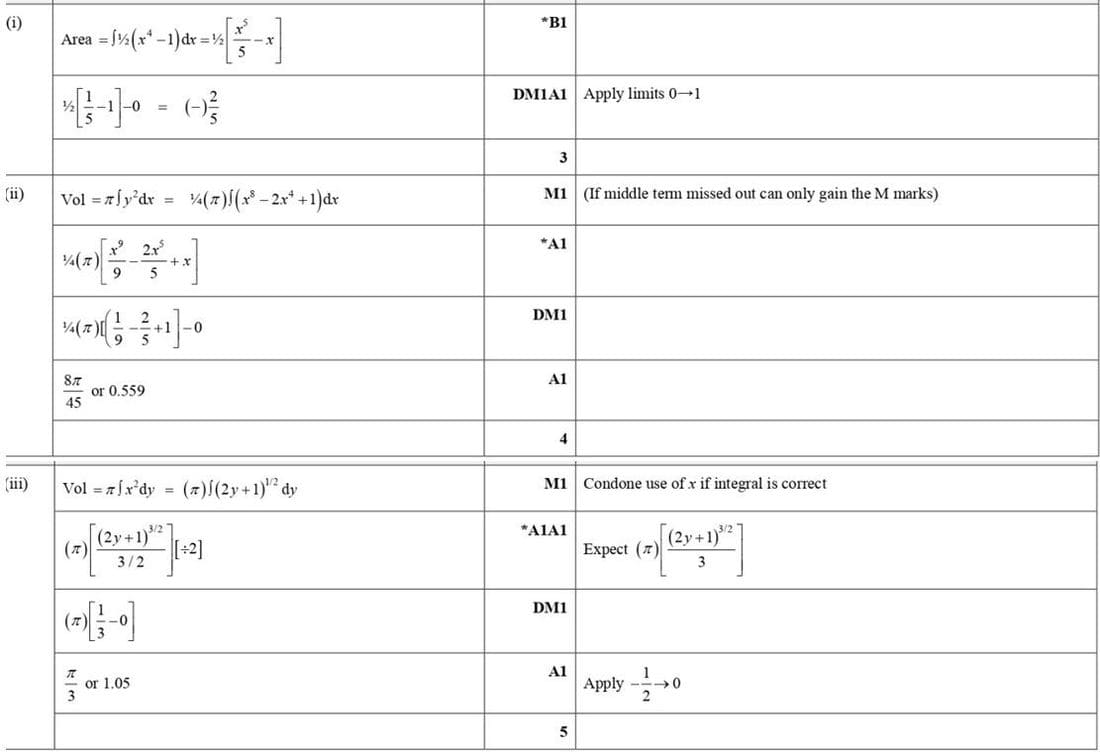
(i) Find, showing all necessary working, the area of the shaded region.
(ii) Find, showing all necessary working, the volume obtained when the shaded region is rotated through 360° about the x-axis.
(iii) Find, showing all necessary working, the volume obtained when the shaded region is rotated through 360° about the y-axis.
June 2017 p13 q10
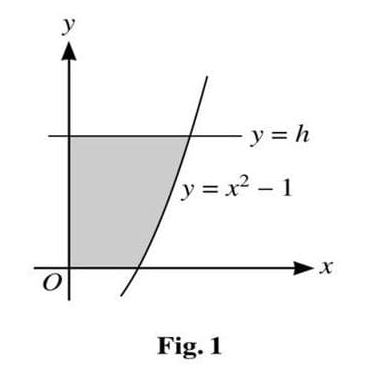
Fig. 1 shows part of the curve \(y = x^2 - 1\) and the line \(y = h\), where \(h\) is a constant.
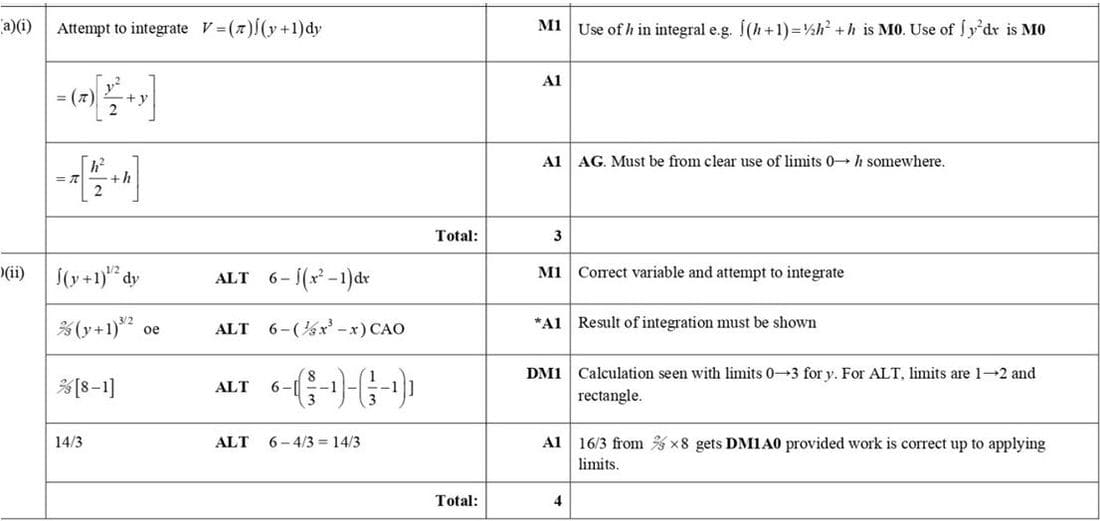
(i) The shaded region is rotated through 360° about the \(y\)-axis. Show that the volume of revolution, \(V\), is given by \(V = \pi \left( \frac{1}{2}h^2 + h \right)\).
(ii) Find, showing all necessary working, the area of the shaded region when \(h = 3\).
June 2017 p12 q6
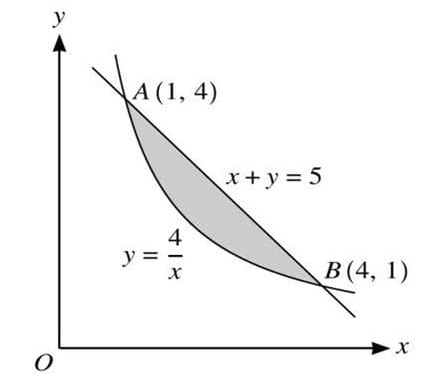
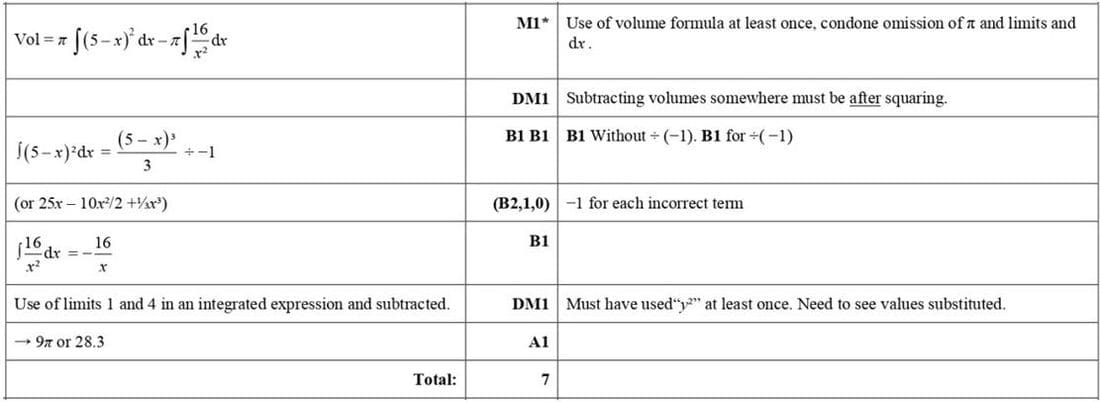
The diagram shows the straight line x + y = 5 intersecting the curve y = \frac{4}{x} at the points A (1, 4) and B (4, 1). Find, showing all necessary working, the volume obtained when the shaded region is rotated through 360° about the x-axis.