Exam-Style Problems
⬅ Back to SubchapterJune 2021 p11 q11
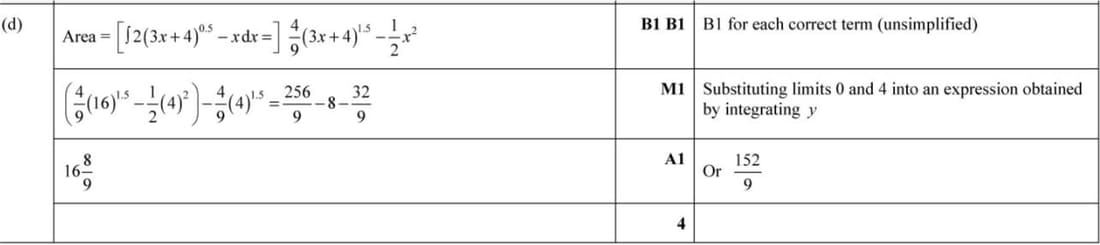
The equation of a curve is \(y = 2\sqrt{3x+4} - x\).
Find the exact area of the region bounded by the curve, the x-axis and the lines \(x = 0\) and \(x = 4\).
Problem 1266
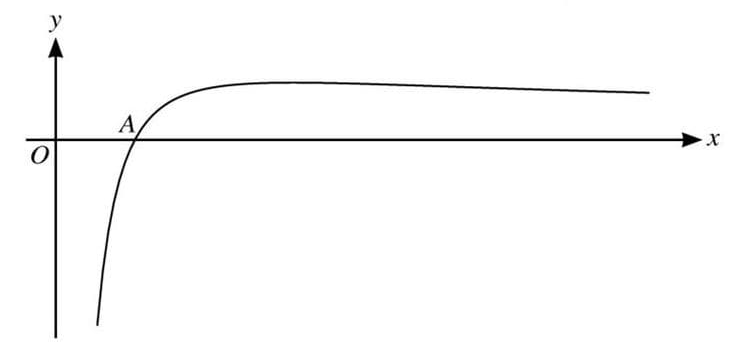
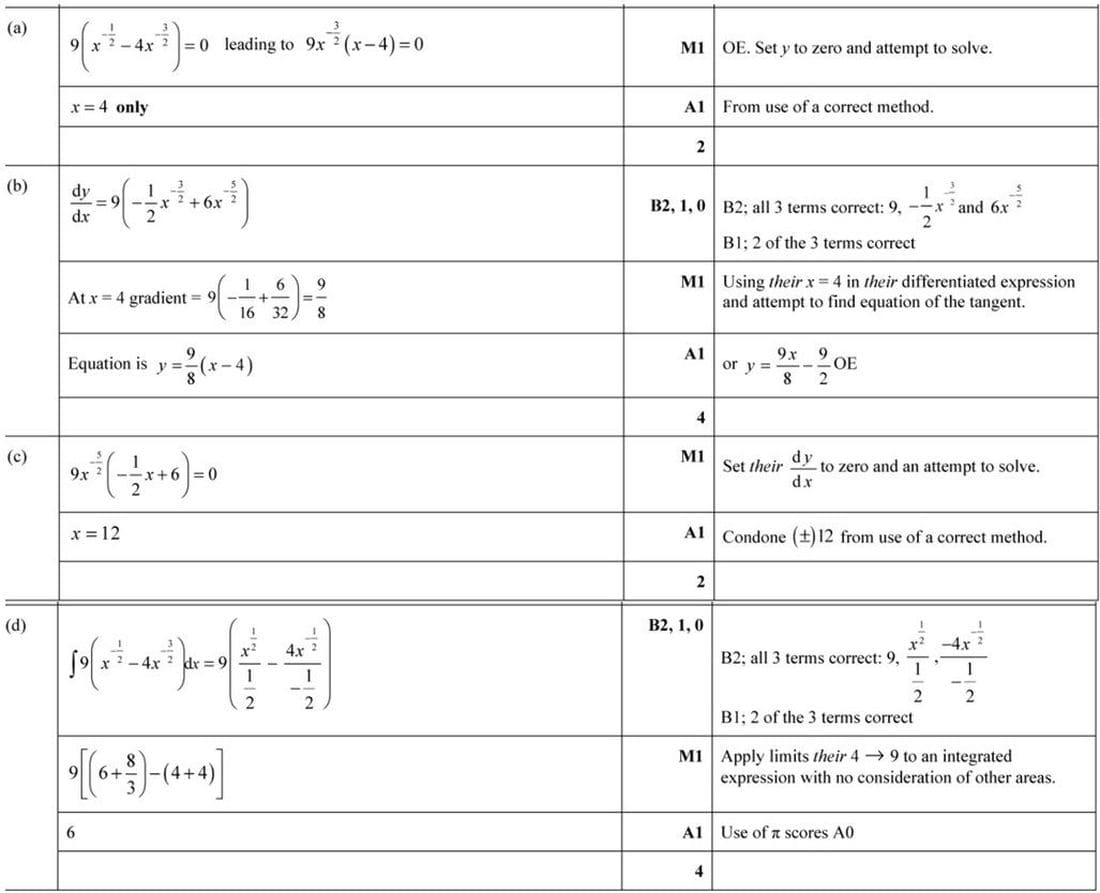
The diagram shows the curve with equation \(y = 9(x^{-\frac{1}{2}} - 4x^{-\frac{3}{2}})\). The curve crosses the x-axis at the point A.
(a) Find the x-coordinate of A.
(b) Find the equation of the tangent to the curve at A.
(c) Find the x-coordinate of the maximum point of the curve.
(d) Find the area of the region bounded by the curve, the x-axis and the line \(x = 9\).
Nov 2020 p12 q10
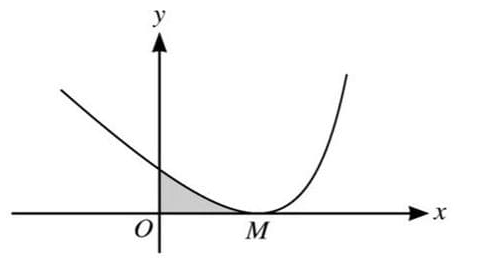
The diagram shows part of the curve \(y = \frac{2}{(3 - 2x)^2} - x\) and its minimum point \(M\), which lies on the \(x\)-axis.
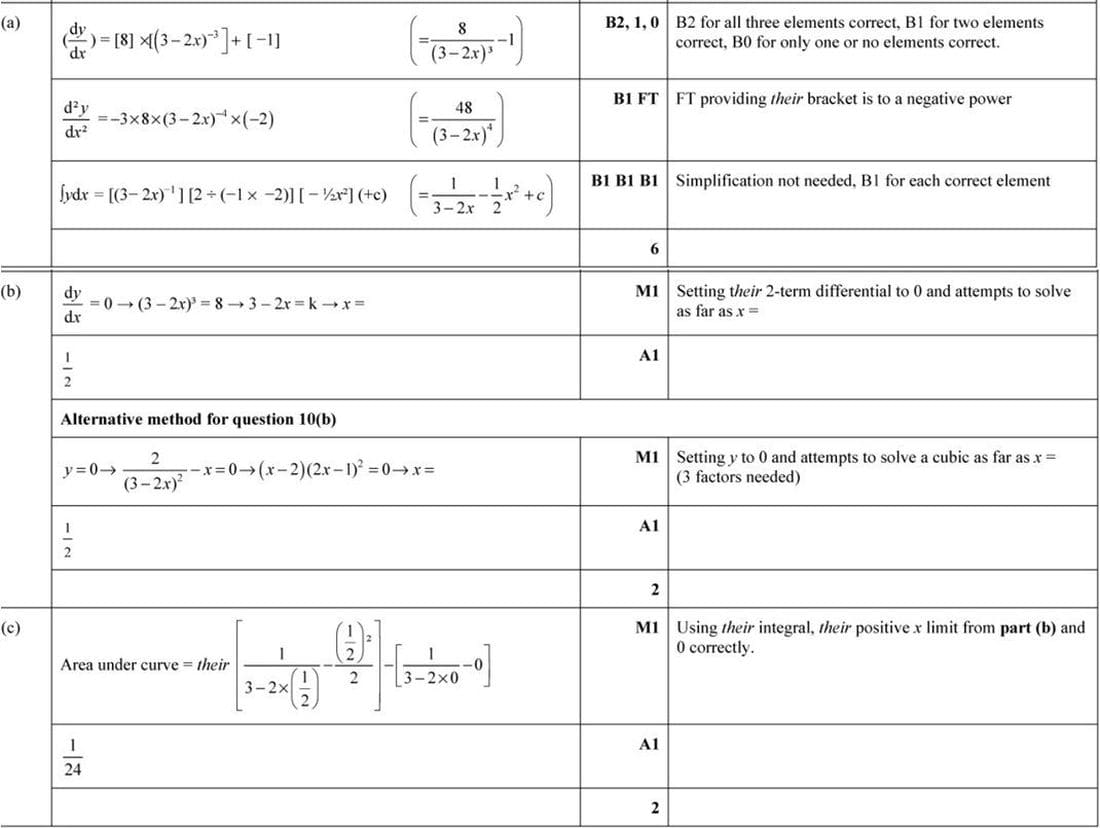
(a) Find expressions for \(\frac{dy}{dx}\), \(\frac{d^2y}{dx^2}\) and \(\int y \, dx\).
(b) Find, by calculation, the \(x\)-coordinate of \(M\).
(c) Find the area of the shaded region bounded by the curve and the coordinate axes.
Nov 2020 p11 q12
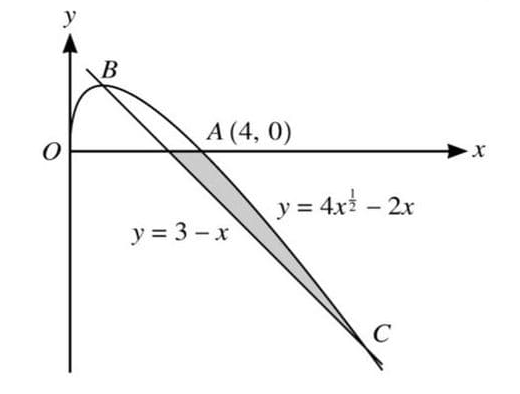
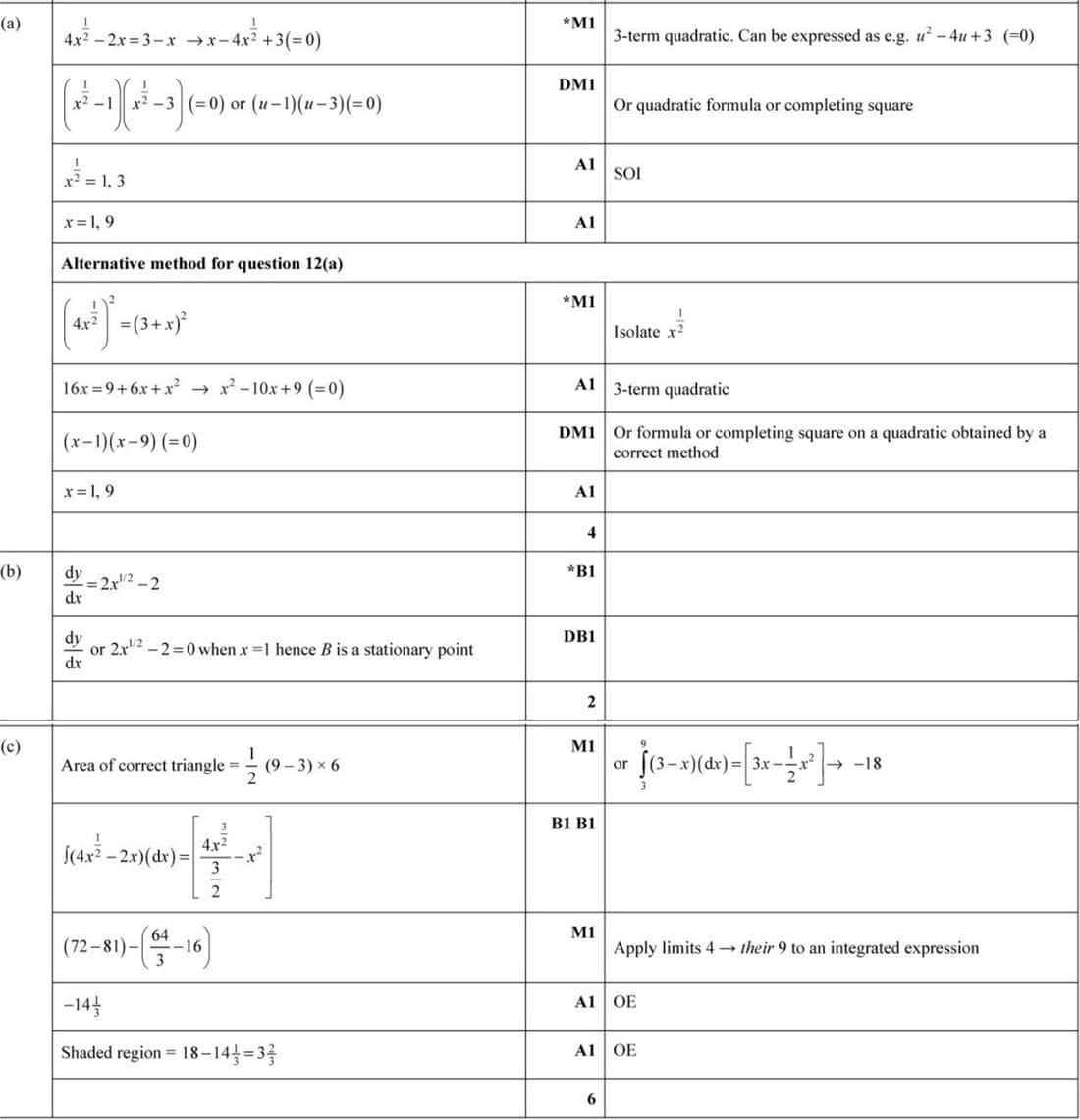
The diagram shows a curve with equation \(y = 4x^{\frac{1}{2}} - 2x\) for \(x \geq 0\), and a straight line with equation \(y = 3 - x\). The curve crosses the x-axis at \(A(4, 0)\) and crosses the straight line at \(B\) and \(C\).
(a) Find, by calculation, the x-coordinates of \(B\) and \(C\).
(b) Show that \(B\) is a stationary point on the curve.
(c) Find the area of the shaded region.
June 2020 p13 q11
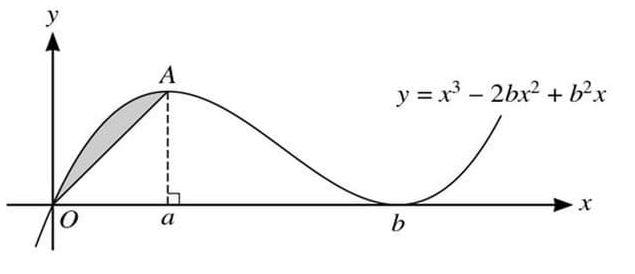
The diagram shows part of the curve with equation \(y = x^3 - 2bx^2 + b^2x\) and the line \(OA\), where \(A\) is the maximum point on the curve. The \(x\)-coordinate of \(A\) is \(a\) and the curve has a minimum point at \((b, 0)\), where \(a\) and \(b\) are positive constants.
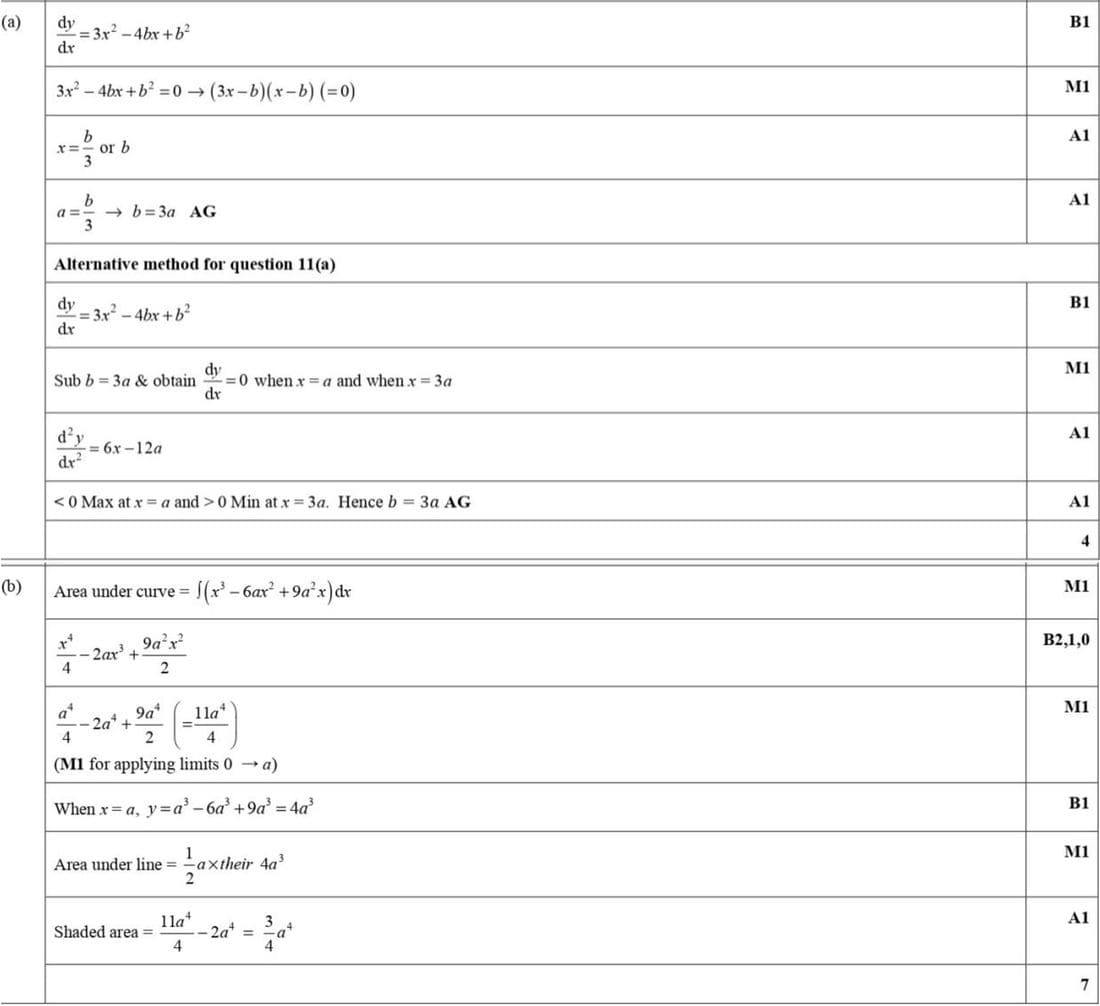
(a) Show that \(b = 3a\).
(b) Show that the area of the shaded region between the line and the curve is \(ka^4\), where \(k\) is a fraction to be found.