Exam-Style Problems
⬅ Back to SubchapterFeb/Mar 2020 p12 q4
1104
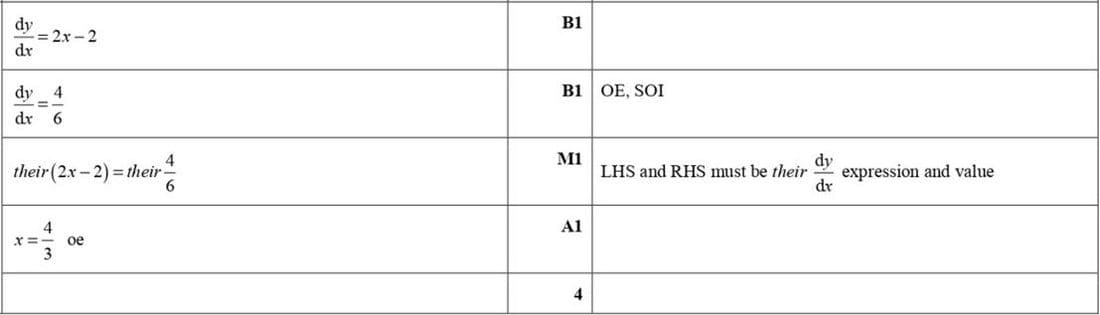
A curve has equation \(y = x^2 - 2x - 3\). A point is moving along the curve in such a way that at \(P\) the \(y\)-coordinate is increasing at 4 units per second and the \(x\)-coordinate is increasing at 6 units per second.
Find the \(x\)-coordinate of \(P\).
Nov 2019 p13 q5
1105
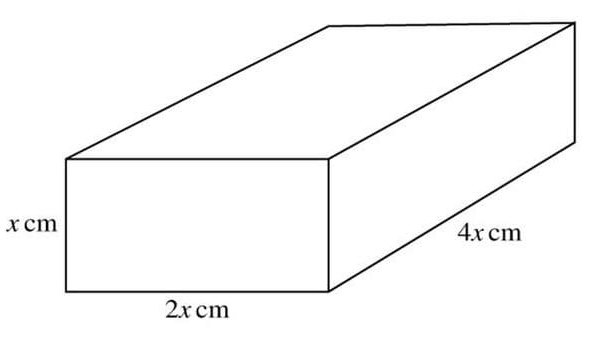
The dimensions of a cuboid are x cm, 2x cm and 4x cm, as shown in the diagram.
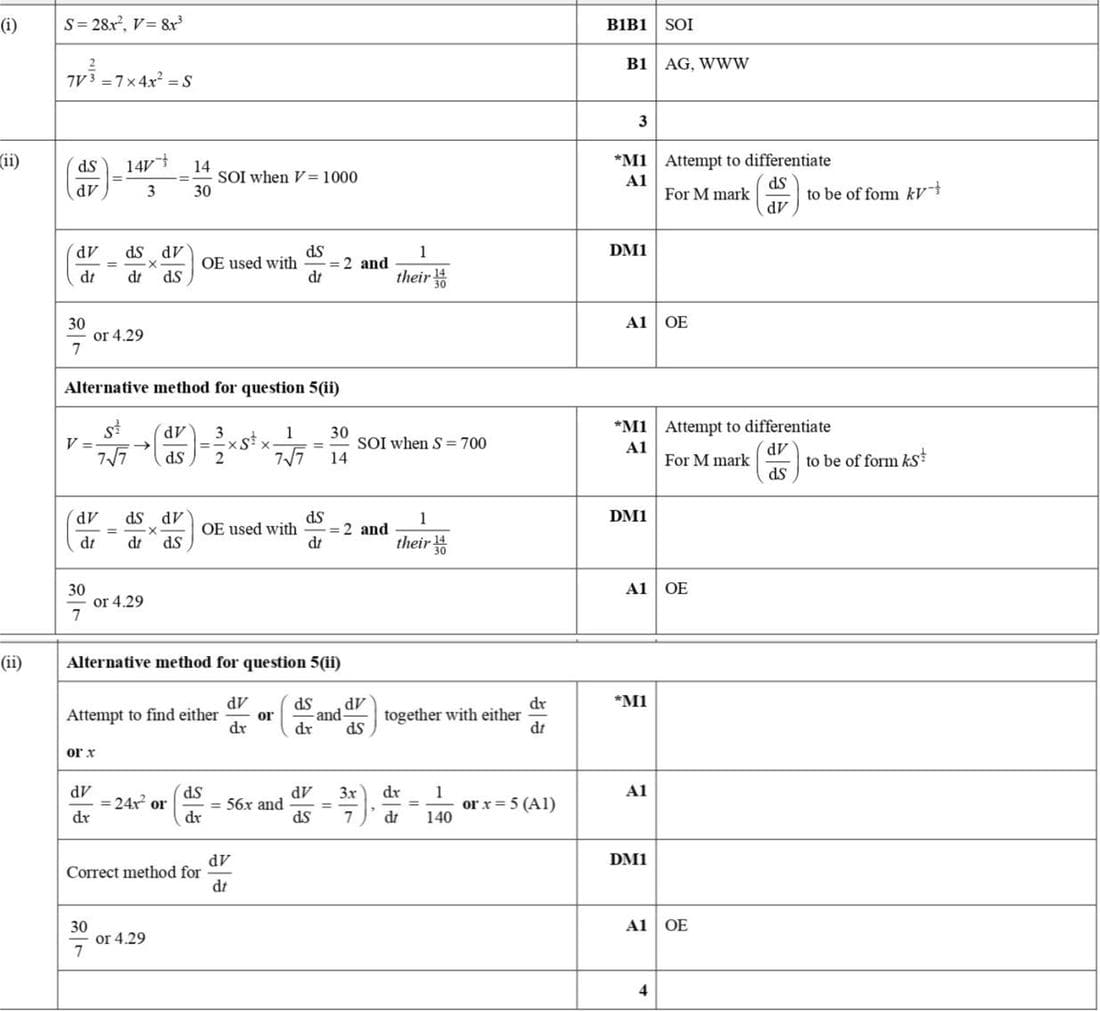
(i) Show that the surface area S cm2 and the volume V cm3 are connected by the relation
\(S = 7V^{\frac{2}{3}}\).
(ii) When the volume of the cuboid is 1000 cm3 the surface area is increasing at 2 cm2 s−1. Find the rate of increase of the volume at this instant.
June 2019 p12 q3
1106
A curve is such that \(\frac{dy}{dx} = x^3 - \frac{4}{x^2}\). The point \(P(2, 9)\) lies on the curve.
A point moves on the curve in such a way that the \(x\)-coordinate is decreasing at a constant rate of 0.05 units per second. Find the rate of change of the \(y\)-coordinate when the point is at \(P\).

Nov 2018 p11 q10
1107
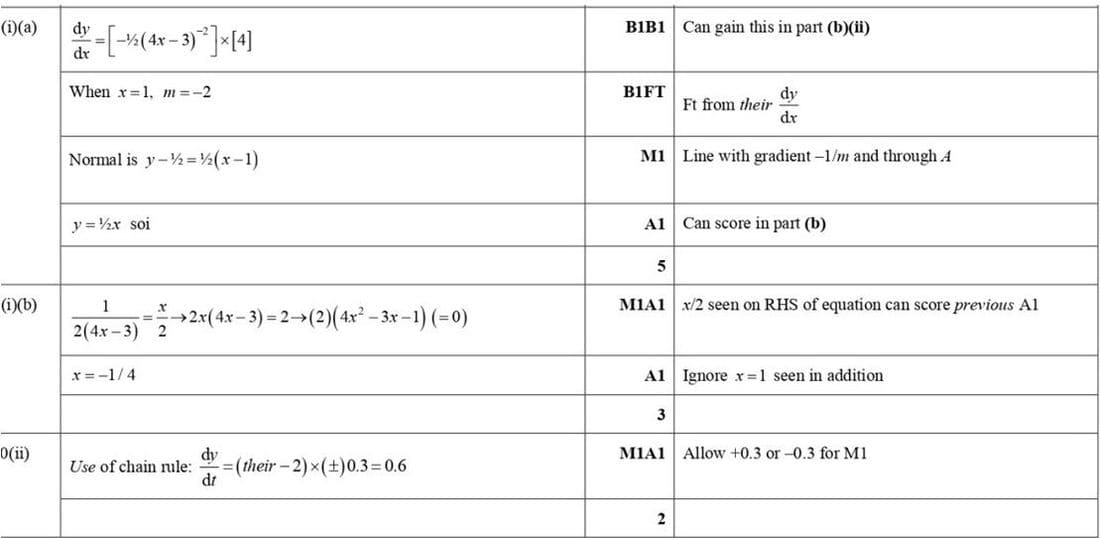
A curve has equation \(y = \frac{1}{2}(4x - 3)^{-1}\). The point \(A\) on the curve has coordinates \((1, \frac{1}{2})\).
(i) (a) Find and simplify the equation of the normal through \(A\). [5]
(b) Find the \(x\)-coordinate of the point where this normal meets the curve again. [3]
(ii) A point is moving along the curve in such a way that as it passes through \(A\) its \(x\)-coordinate is decreasing at the rate of 0.3 units per second. Find the rate of change of its \(y\)-coordinate at \(A\). [2]
June 2018 p11 q2
1108
A point is moving along the curve \(y = 2x + \frac{5}{x}\) in such a way that the \(x\)-coordinate is increasing at a constant rate of 0.02 units per second. Find the rate of change of the \(y\)-coordinate when \(x = 1\).
