Exam-Style Problems
⬅ Back to SubchapterNov 2019 p11 q3
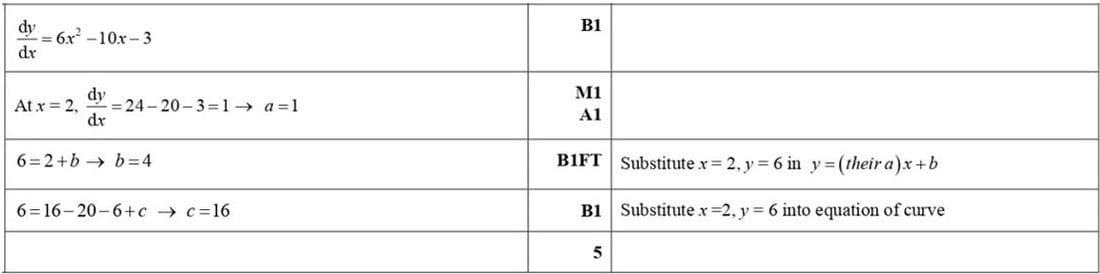
The line \(y = ax + b\) is a tangent to the curve \(y = 2x^3 - 5x^2 - 3x + c\) at the point \((2, 6)\). Find the values of the constants \(a, b\) and \(c\).
Feb/Mar 2019 p12 q4
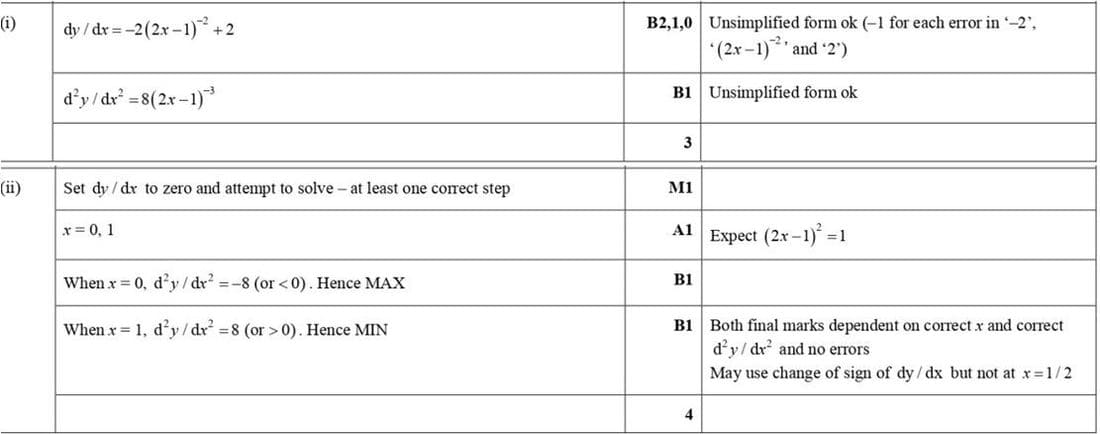
A curve has equation \(y = (2x - 1)^{-1} + 2x\).
(i) Find \(\frac{dy}{dx}\) and \(\frac{d^2y}{dx^2}\).
(ii) Find the \(x\)-coordinates of the stationary points and, showing all necessary working, determine the nature of each stationary point.
June 2018 p11 q10
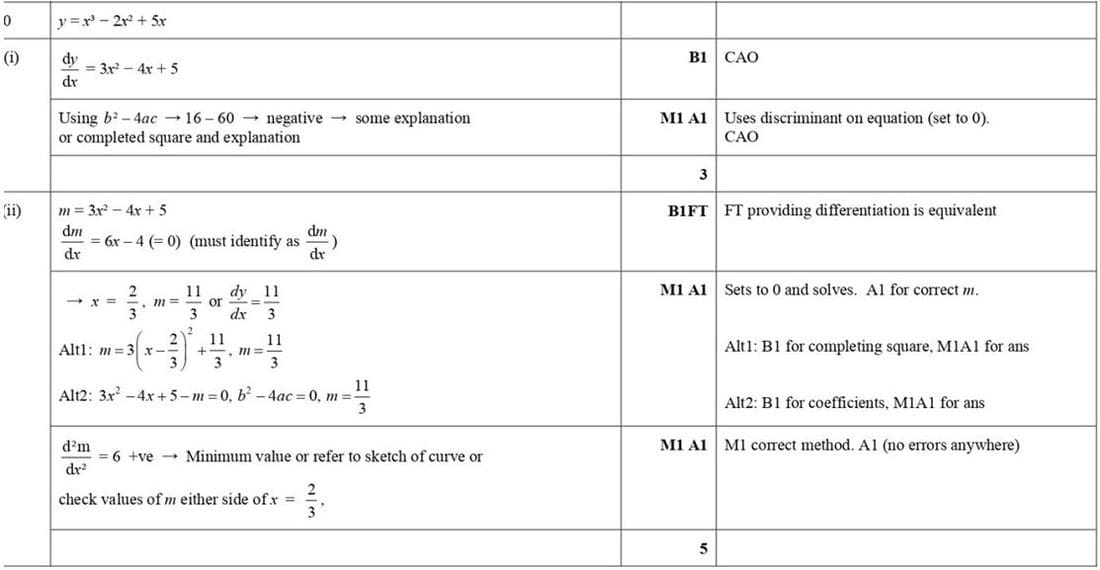
The curve with equation \(y = x^3 - 2x^2 + 5x\) passes through the origin.
(i) Show that the curve has no stationary points.
(ii) Denoting the gradient of the curve by \(m\), find the stationary value of \(m\) and determine its nature.
Feb/Mar 2018 p12 q10
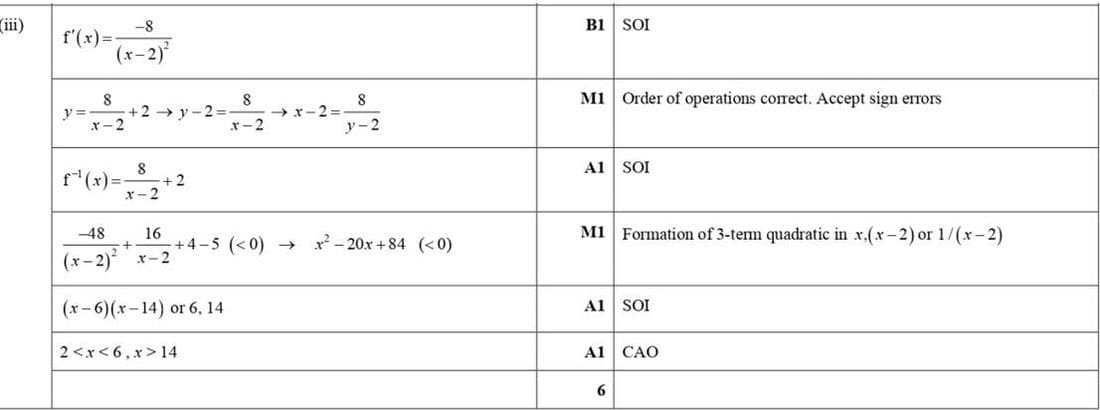
Functions f and g are defined by
\(f(x) = \frac{8}{x-2} + 2\) for \(x > 2\),
Find the set of values of \(x\) satisfying the inequality \(6f'(x) + 2f^{-1}(x) - 5 < 0\).
Feb/Mar 2018 p12 q8
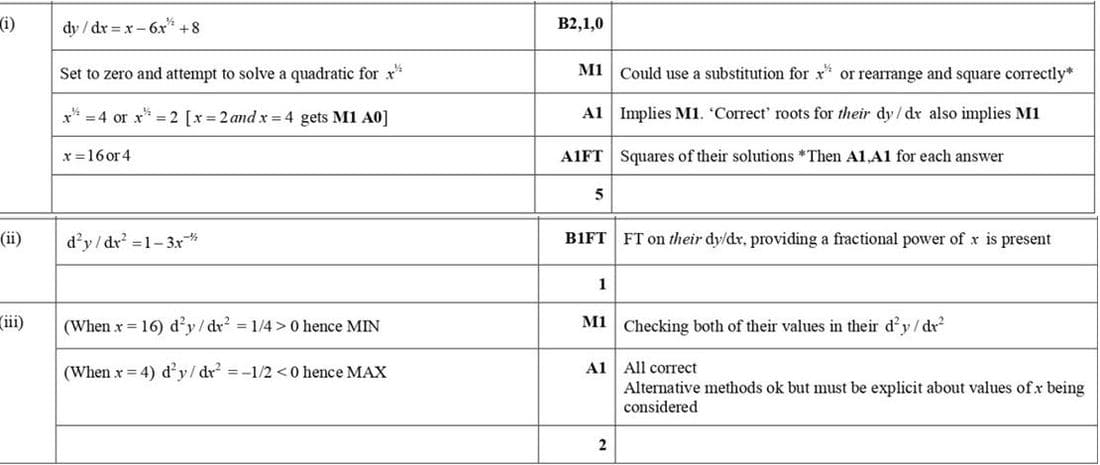
A curve has equation \(y = \frac{1}{2}x^{\frac{1}{2}} - 4x^{\frac{3}{2}} + 8x\).
(i) Find the \(x\)-coordinates of the stationary points.
(ii) Find \(\frac{d^2y}{dx^2}\).
(iii) Find, showing all necessary working, the nature of each stationary point.