Exam-Style Problems
⬅ Back to SubchapterNov 2013 p11 q1
(i) Find the first three terms when \((2 + 3x)^6\) is expanded in ascending powers of \(x\).
(ii) In the expansion of \((1 + ax)(2 + 3x)^6\), the coefficient of \(x^2\) is zero. Find the value of \(a\).

June 2013 p13 q4
(i) Find the first three terms in the expansion of \((2 + ax)^5\) in ascending powers of \(x\).
(ii) Given that the coefficient of \(x^2\) in the expansion of \((1 + 2x)(2 + ax)^5\) is 240, find the possible values of \(a\).

June 2013 p11 q2
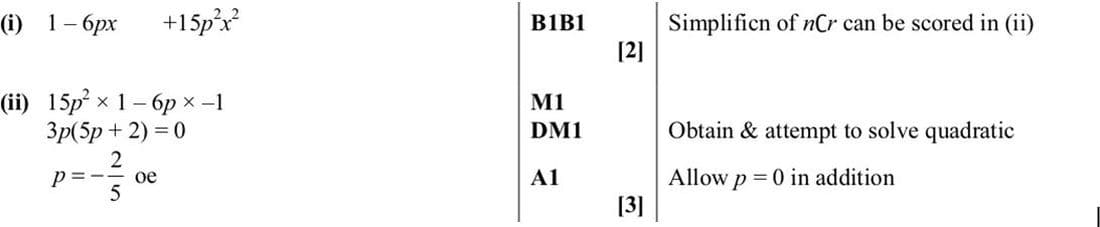
(i) In the expression \((1 - px)^6\), \(p\) is a non-zero constant. Find the first three terms when \((1 - px)^6\) is expanded in ascending powers of \(x\).
(ii) It is given that the coefficient of \(x^2\) in the expansion of \((1 - x)(1 - px)^6\) is zero. Find the value of \(p\).
Nov 2012 p11 q4
(i) Find the first 3 terms in the expansion of \((2x - x^2)^6\) in ascending powers of \(x\).
(ii) Hence find the coefficient of \(x^8\) in the expansion of \((2 + x)(2x - x^2)^6\).

June 2012 p13 q3
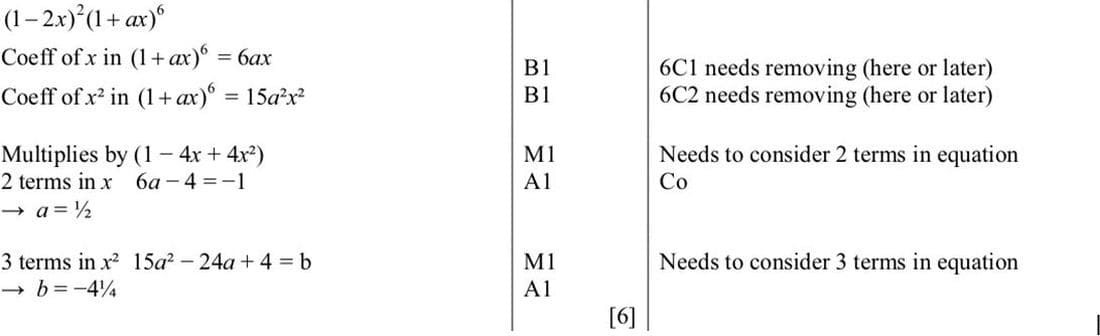
The first three terms in the expansion of \((1 - 2x)^2(1 + ax)^6\), in ascending powers of \(x\), are \(1 - x + bx^2\). Find the values of the constants \(a\) and \(b\).