Exam-Style Problems
⬅ Back to SubchapterJune 2014 p12 q6
801
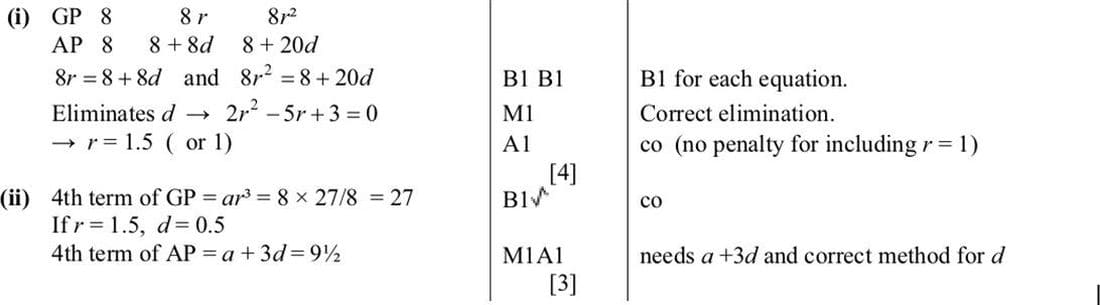
The 1st, 2nd and 3rd terms of a geometric progression are the 1st, 9th and 21st terms respectively of an arithmetic progression. The 1st term of each progression is 8 and the common ratio of the geometric progression is \(r\), where \(r \neq 1\). Find
(i) the value of \(r\),
(ii) the 4th term of each progression.
June 2013 p13 q9
802
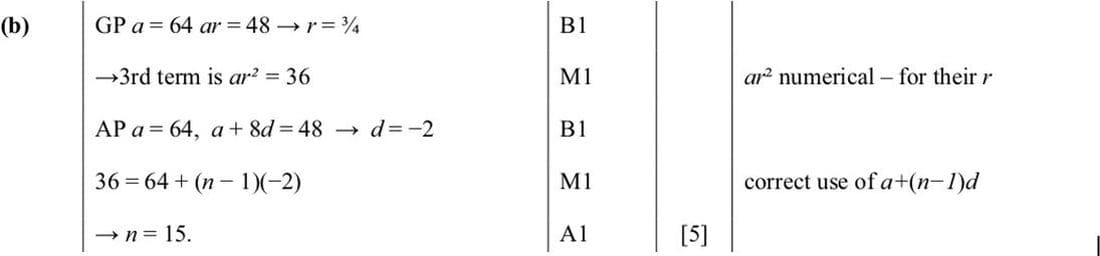
The first 2 terms of a geometric progression are 64 and 48 respectively. The first 3 terms of the geometric progression are also the 1st term, the 9th term and the nth term respectively of an arithmetic progression. Find the value of n.
June 2012 p13 q6
803
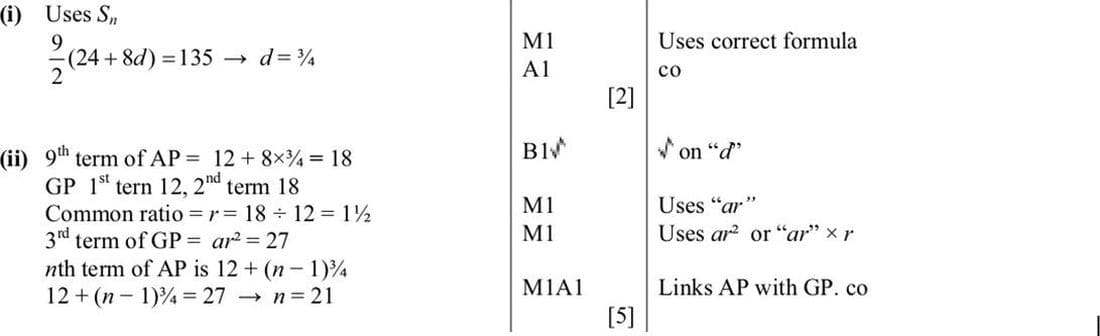
The first term of an arithmetic progression is 12 and the sum of the first 9 terms is 135.
(i) Find the common difference of the progression.
The first term, the ninth term and the nth term of this arithmetic progression are the first term, the second term and the third term respectively of a geometric progression.
(ii) Find the common ratio of the geometric progression and the value of n.
Nov 2011 p13 q2
804
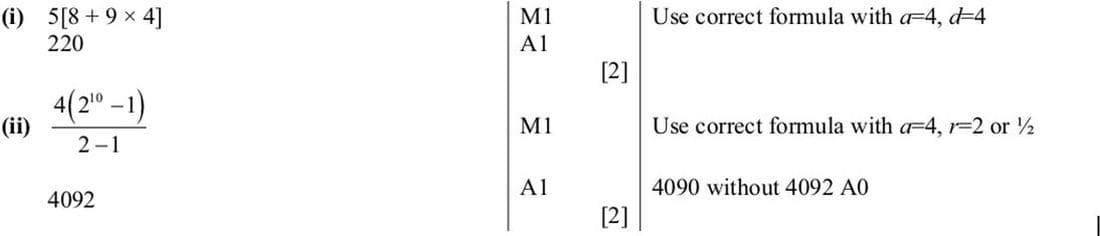
The first and second terms of a progression are 4 and 8 respectively. Find the sum of the first 10 terms given that the progression is
(i) an arithmetic progression,
(ii) a geometric progression.
June 2011 p11 q8
805
A television quiz show takes place every day. On day 1 the prize money is $1000. If this is not won the prize money is increased for day 2. The prize money is increased in a similar way every day until it is won. The television company considered the following two different models for increasing the prize money.
Model 1: Increase the prize money by $1000 each day.
Model 2: Increase the prize money by 10% each day.
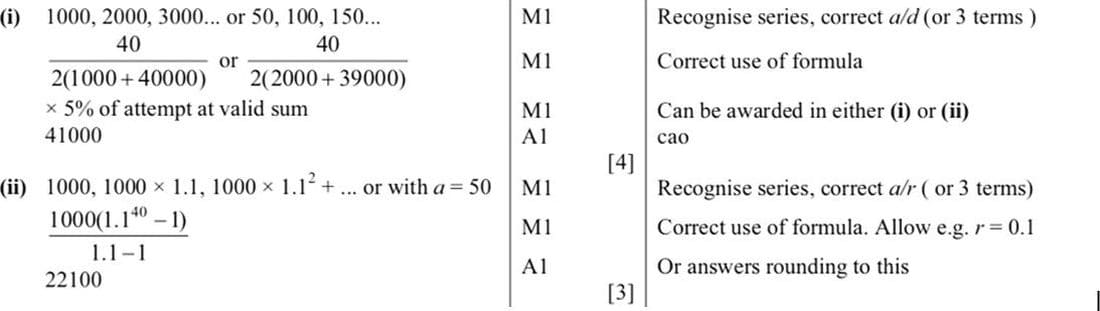
On each day that the prize money is not won the television company makes a donation to charity. The amount donated is 5% of the value of the prize on that day. After 40 days the prize money has still not been won. Calculate the total amount donated to charity
(i) if Model 1 is used,
(ii) if Model 2 is used.