Exam-Style Problems
⬅ Back to SubchapterNov 2020 p12 q2
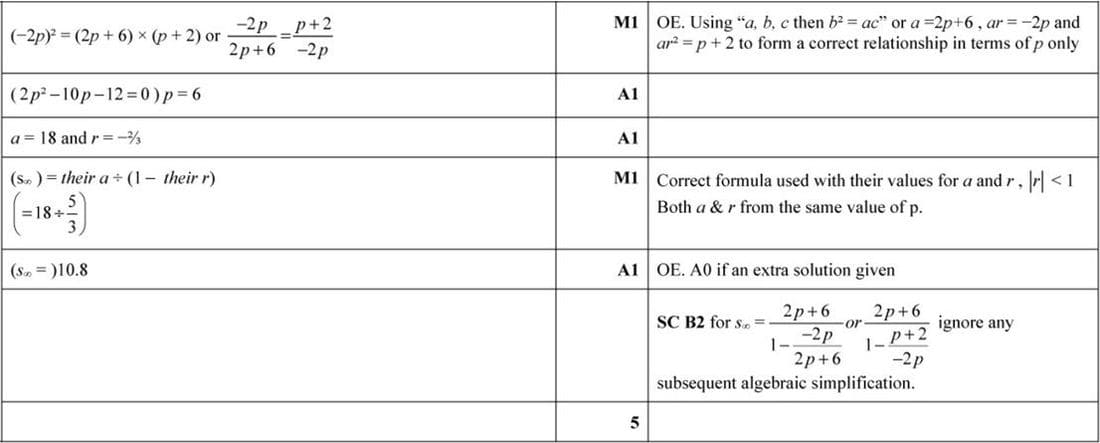
The first, second and third terms of a geometric progression are \(2p + 6\), \(-2p\) and \(p + 2\) respectively, where \(p\) is positive.
Find the sum to infinity of the progression.
Nov 2020 p11 q8
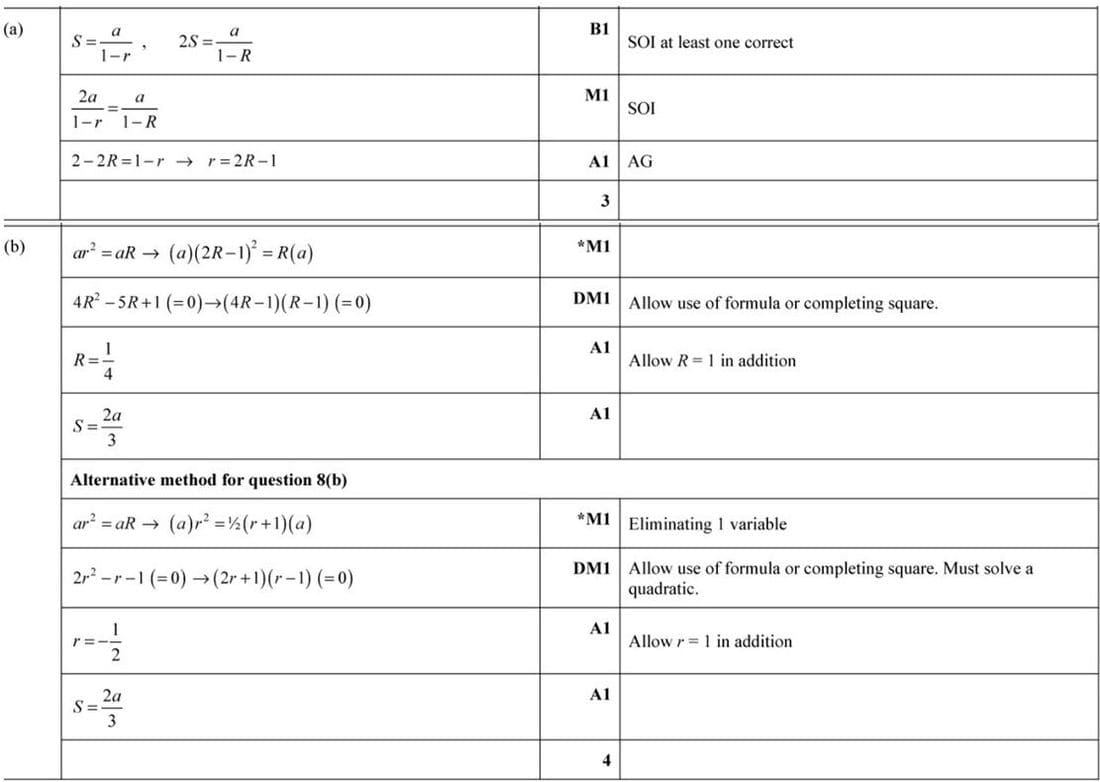
A geometric progression has first term a, common ratio r and sum to infinity S. A second geometric progression has first term a, common ratio R and sum to infinity 2S.
\((a) Show that r = 2R - 1.\)
It is now given that the 3rd term of the first progression is equal to the 2nd term of the second progression.
(b) Express S in terms of a.
June 2020 p11 q3
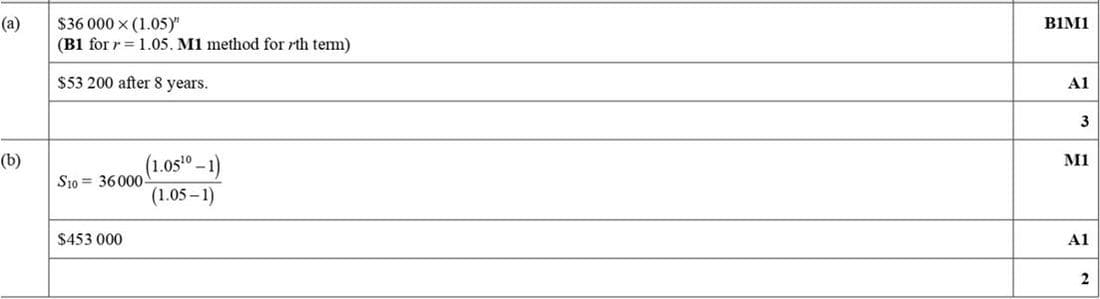
Each year the selling price of a diamond necklace increases by 5% of the price the year before. The selling price of the necklace in the year 2000 was $36,000.
(a) Write down an expression for the selling price of the necklace n years later and hence find the selling price in 2008.
(b) The company that makes the necklace only sells one each year. Find the total amount of money obtained in the ten-year period starting in the year 2000.
Problem 886
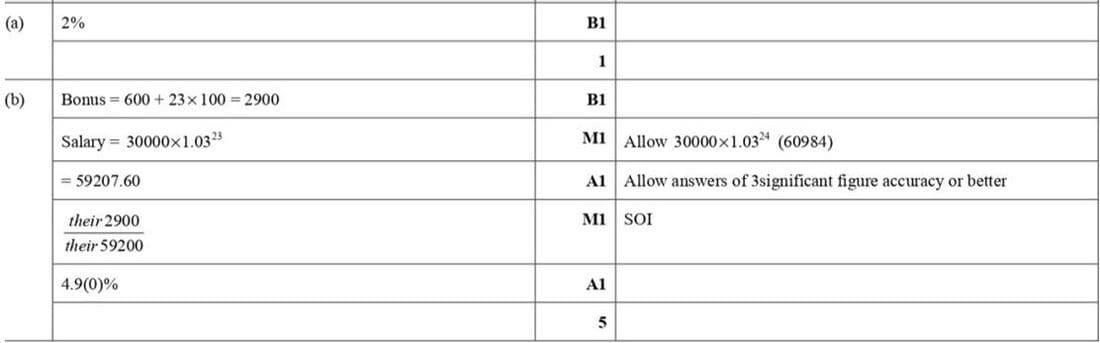
A woman’s basic salary for her first year with a particular company is $30,000 and at the end of the year she also gets a bonus of $600.
(a) For her first year, express her bonus as a percentage of her basic salary.
At the end of each complete year, the woman’s basic salary will increase by 3% and her bonus will increase by $100.
(b) Express the bonus she will be paid at the end of her 24th year as a percentage of the basic salary paid during that year.
Nov 2019 p13 q9
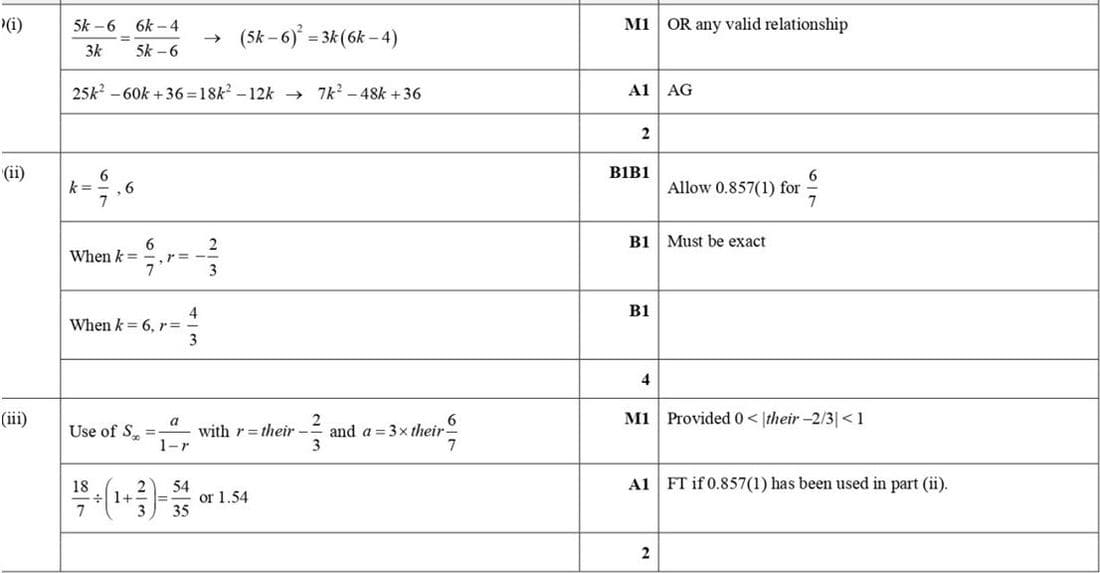
The first, second and third terms of a geometric progression are \(3k\), \(5k - 6\) and \(6k - 4\), respectively.
- Show that \(k\) satisfies the equation \(7k^2 - 48k + 36 = 0\).
- Find, showing all necessary working, the exact values of the common ratio corresponding to each of the possible values of \(k\).
- One of these ratios gives a progression which is convergent. Find the sum to infinity.