Exam-Style Problems
⬅ Back to SubchapterJune 2019 p12 q10
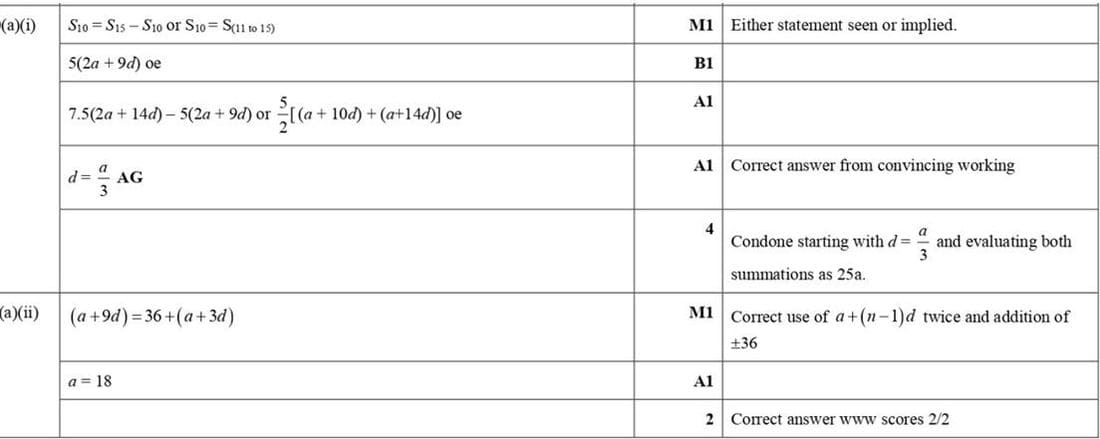
In an arithmetic progression, the sum of the first ten terms is equal to the sum of the next five terms. The first term is \(a\).
(i) Show that the common difference of the progression is \(\frac{1}{3}a\).
(ii) Given that the tenth term is 36 more than the fourth term, find the value of \(a\).
Feb/Mar 2019 p12 q6
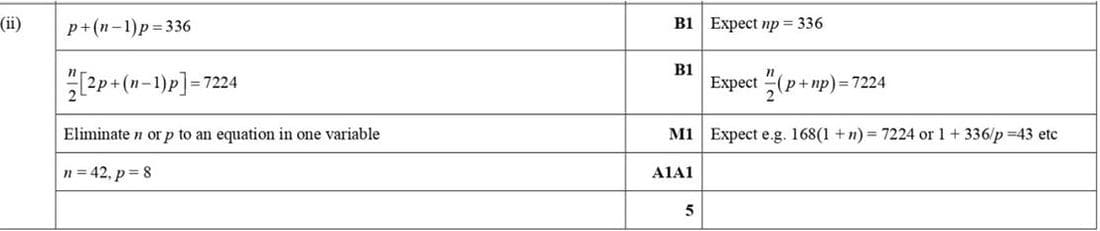
In another case, p and 2p are the first and second terms respectively of an arithmetic progression. The nth term is 336 and the sum of the first n terms is 7224. Write down two equations in n and p and hence find the values of n and p.
Nov 2018 p13 q5
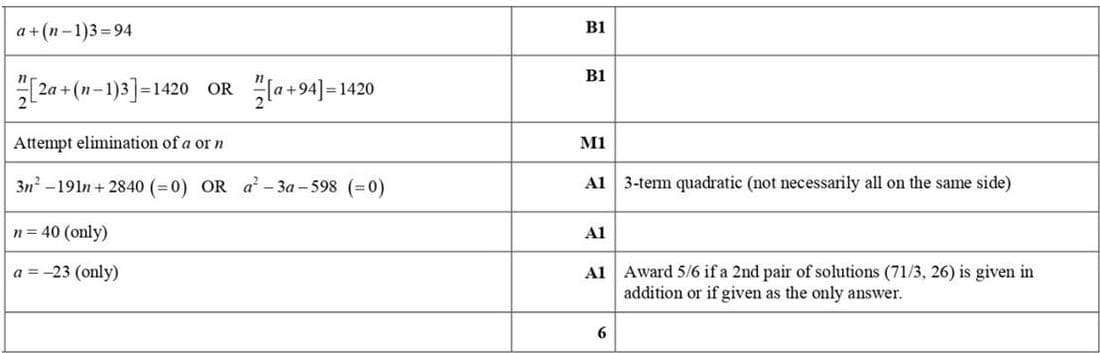
In an arithmetic progression the first term is a and the common difference is 3. The nth term is 94 and the sum of the first n terms is 1420. Find n and a.
Nov 2018 p11 q4
The first term of a series is 6 and the second term is 2.
For the case where the series is an arithmetic progression, find the sum of the first 80 terms.

June 2018 p11 q8
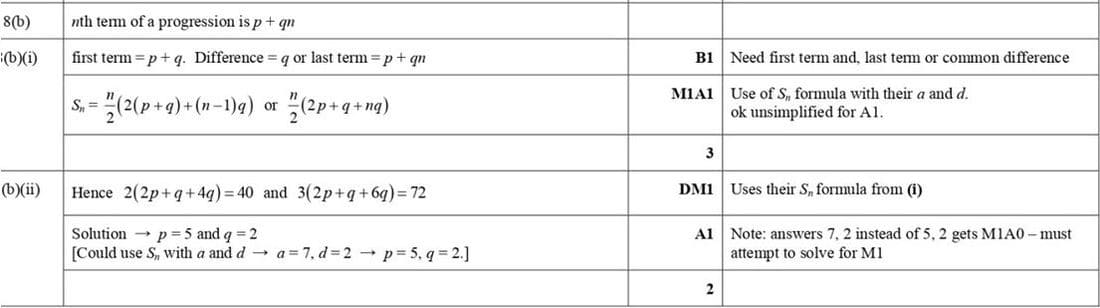
The nth term of a progression is p + qn, where p and q are constants, and Sn is the sum of the first n terms.
- Find an expression, in terms of p, q and n, for Sn.
- Given that S4 = 40 and S6 = 72, find the values of p and q.