Exam-Style Problems
⬅ Back to SubchapterNov 2017 p12 q6
571
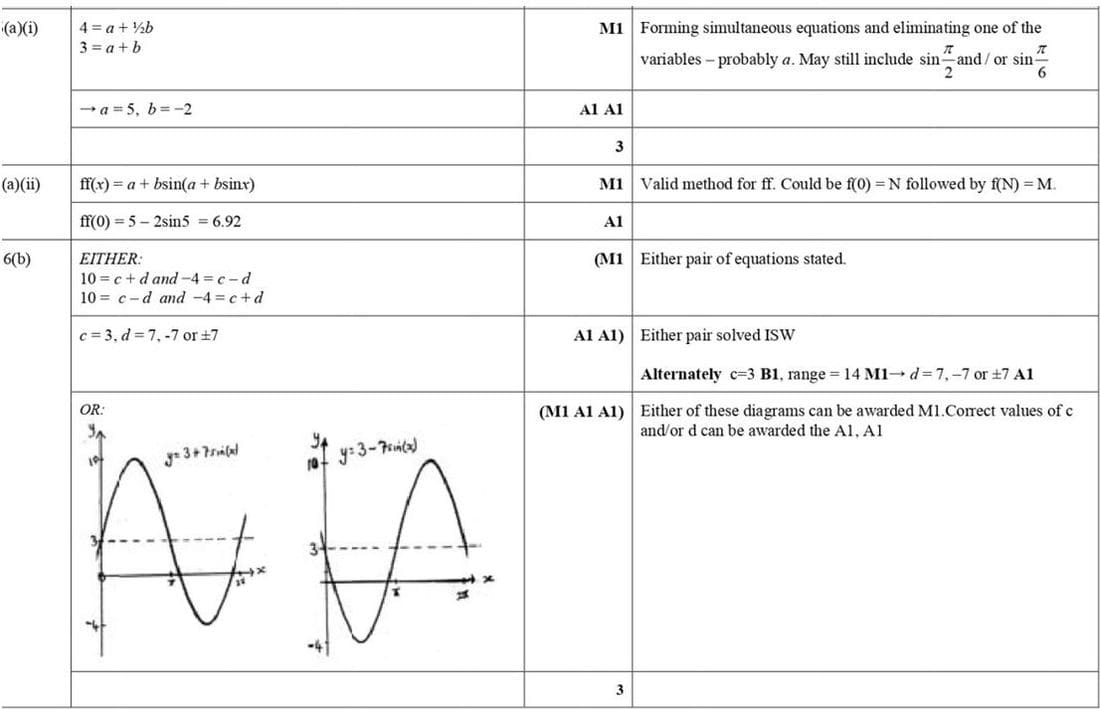
(a) The function f, defined by \(f : x \mapsto a + b \sin x\) for \(x \in \mathbb{R}\), is such that \(f\left(\frac{1}{6}\pi\right) = 4\) and \(f\left(\frac{1}{2}\pi\right) = 3\).
- Find the values of the constants \(a\) and \(b\).
- Evaluate \(ff(0)\).
(b) The function g is defined by \(g : x \mapsto c + d \sin x\) for \(x \in \mathbb{R}\). The range of g is given by \(-4 \leq g(x) \leq 10\). Find the values of the constants \(c\) and \(d\).
June 2017 p11 q5
572
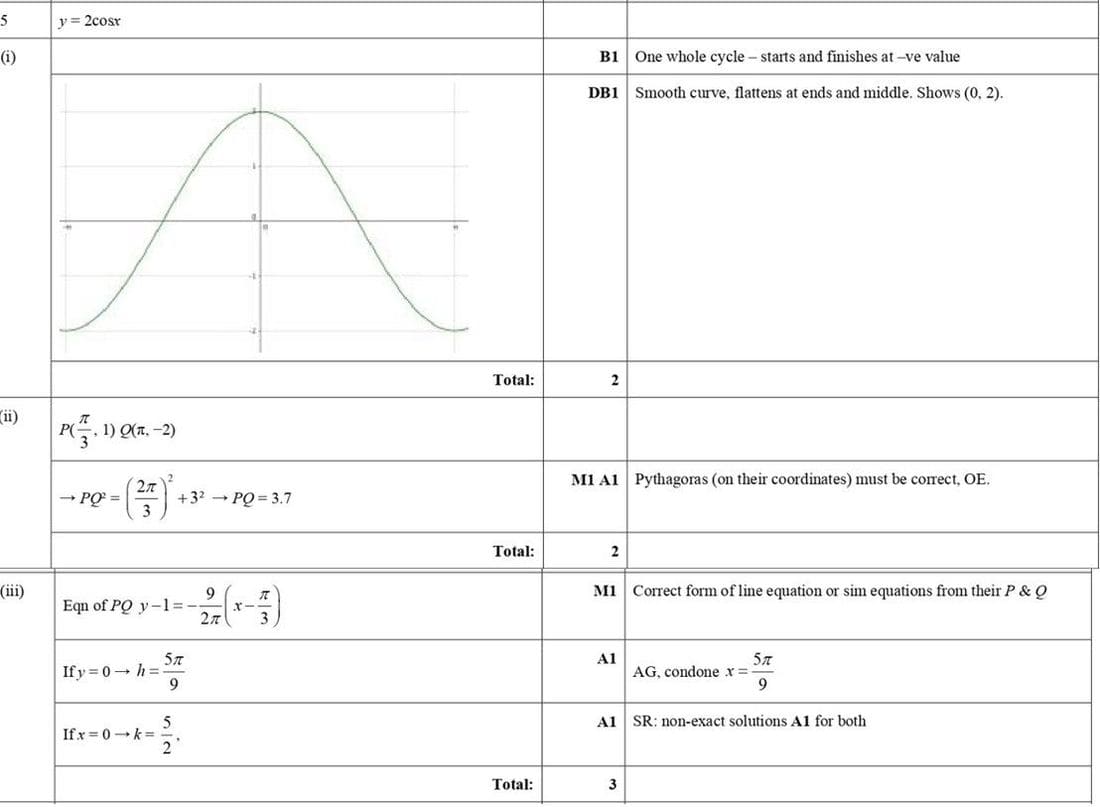
The equation of a curve is \(y = 2 \cos x\).
(i) Sketch the graph of \(y = 2 \cos x\) for \(-\pi \leq x \leq \pi\), stating the coordinates of the point of intersection with the \(y\)-axis.
Points \(P\) and \(Q\) lie on the curve and have \(x\)-coordinates of \(\frac{\pi}{3}\) and \(\pi\) respectively.
(ii) Find the length of \(PQ\) correct to 1 decimal place.
The line through \(P\) and \(Q\) meets the \(x\)-axis at \(H (h, 0)\) and the \(y\)-axis at \(K (0, k)\).
(iii) Show that \(h = \frac{5}{9} \pi\) and find the value of \(k\).
Feb/Mar 2017 p12 q5
573
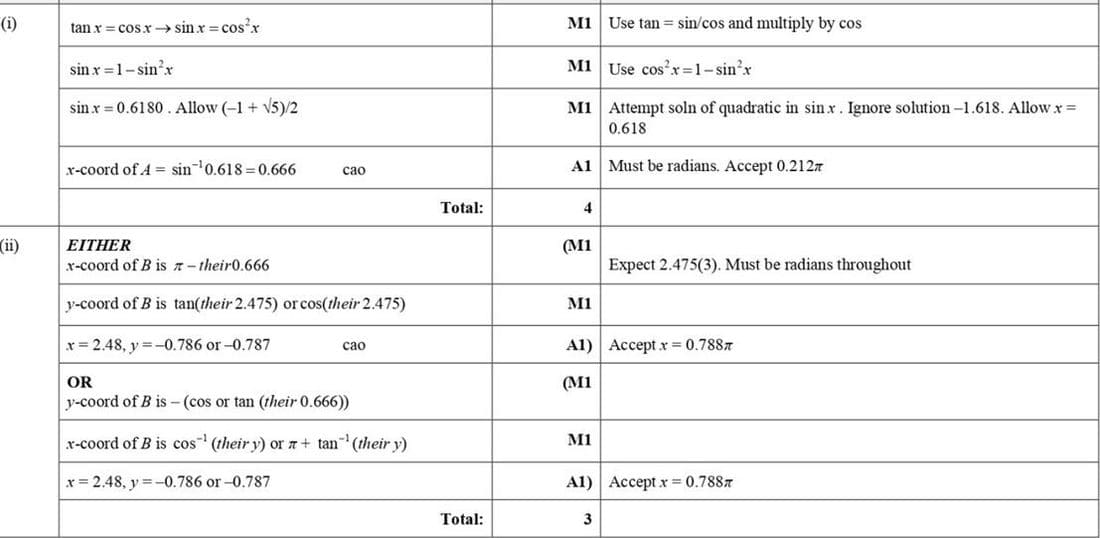
The diagram shows the graphs of \(y = \tan x\) and \(y = \cos x\) for \(0 \leq x \leq \pi\). The graphs intersect at points \(A\) and \(B\).
(i) Find by calculation the \(x\)-coordinate of \(A\).
(ii) Find by calculation the coordinates of \(B\).

Feb/Mar 2016 p12 q4
574
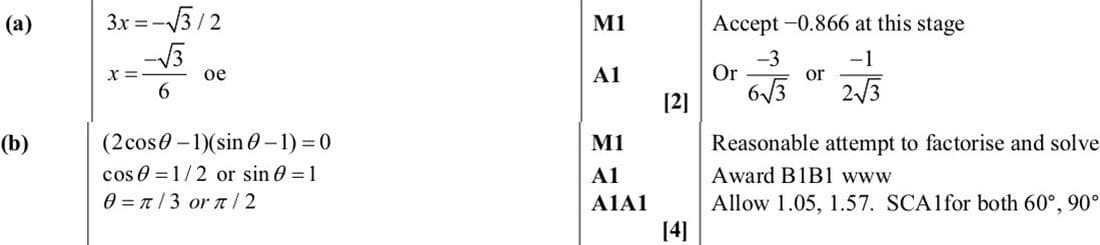
(a) Solve the equation \(\sin^{-1}(3x) = -\frac{1}{3}\pi\), giving the solution in an exact form.
(b) Solve, by factorising, the equation \(2 \cos \theta \sin \theta - 2 \cos \theta - \sin \theta + 1 = 0\) for \(0 \leq \theta \leq \pi\).
Nov 2015 p13 q7
575
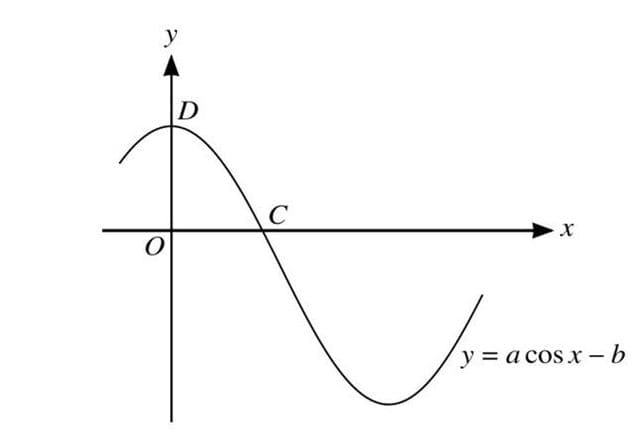
The diagram shows part of the graph of \(y = a \, \cos x - b\), where \(a\) and \(b\) are constants. The graph crosses the \(x\)-axis at the point \(C(\cos^{-1} c, 0)\) and the \(y\)-axis at the point \(D(0, d)\). Find \(c\) and \(d\) in terms of \(a\) and \(b\).