Exam-Style Problems
⬅ Back to SubchapterProblem 523
523
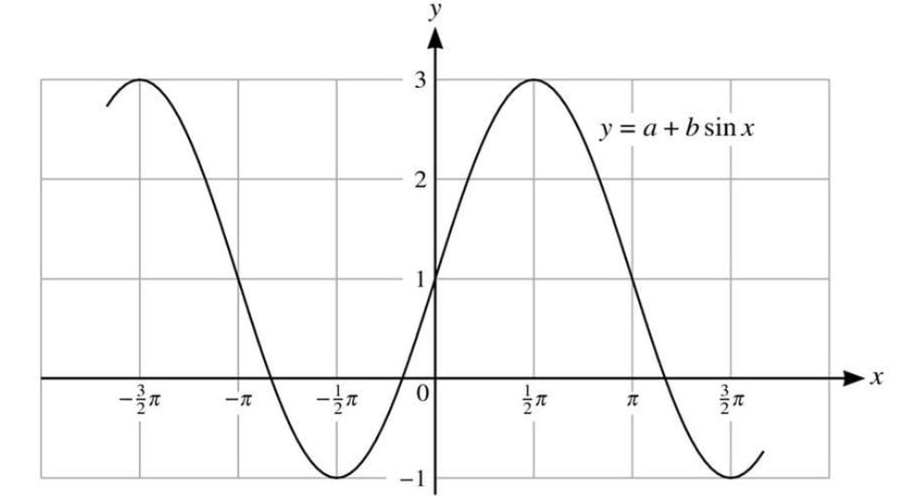
The diagram shows part of the graph of \(y = a + b \sin x\). State the values of the constants \(a\) and \(b\).
Problem 524
524
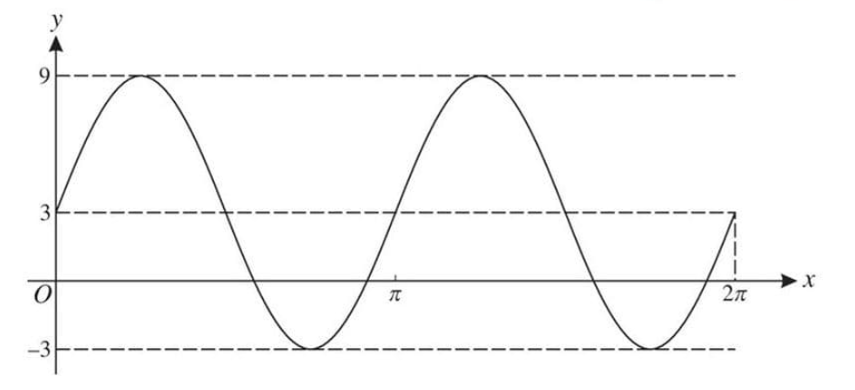
The diagram shows the graph of \(y = a \sin(bx) + c\) for \(0 \leq x \leq 2\pi\).
(i) Find the values of \(a, b\) and \(c\).
(ii) Find the smallest value of \(x\) in the interval \(0 \leq x \leq 2\pi\) for which \(y = 0\).
November 2020 P12 Q11
525
A curve has equation \(y = 3 \cos 2x + 2\) for \(0 \leq x \leq \pi\).
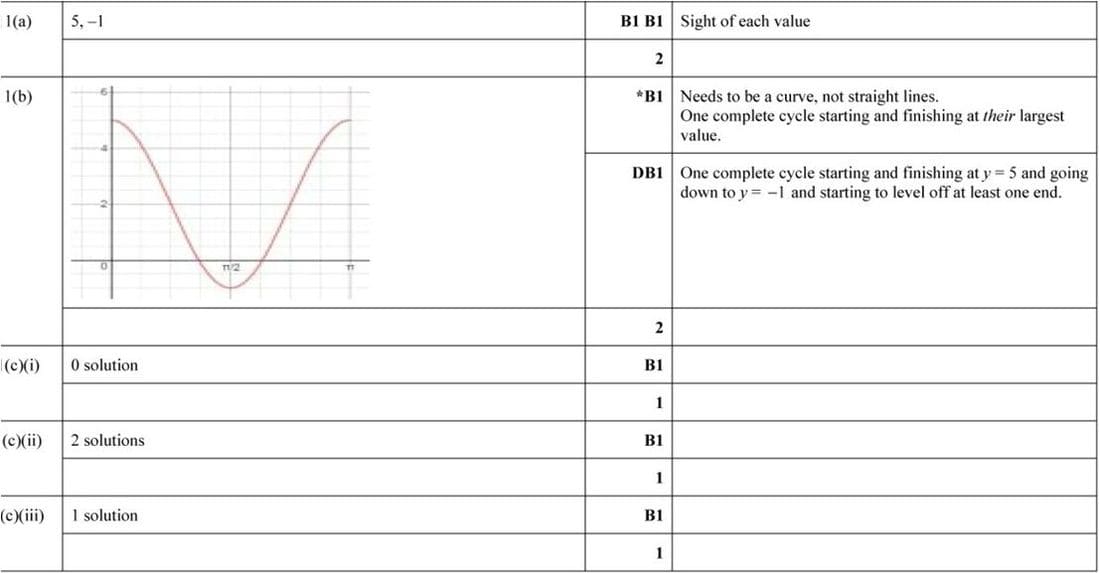
(a) State the greatest and least values of \(y\).
(b) Sketch the graph of \(y = 3 \cos 2x + 2\) for \(0 \leq x \leq \pi\).
(c) By considering the straight line \(y = kx\), where \(k\) is a constant, state the number of solutions of the equation \(3 \cos 2x + 2 = kx\) for \(0 \leq x \leq \pi\) in each of the following cases.
(i) \(k = -3\)
(ii) \(k = 1\)
(iii) \(k = 3\)
Problem 526
526
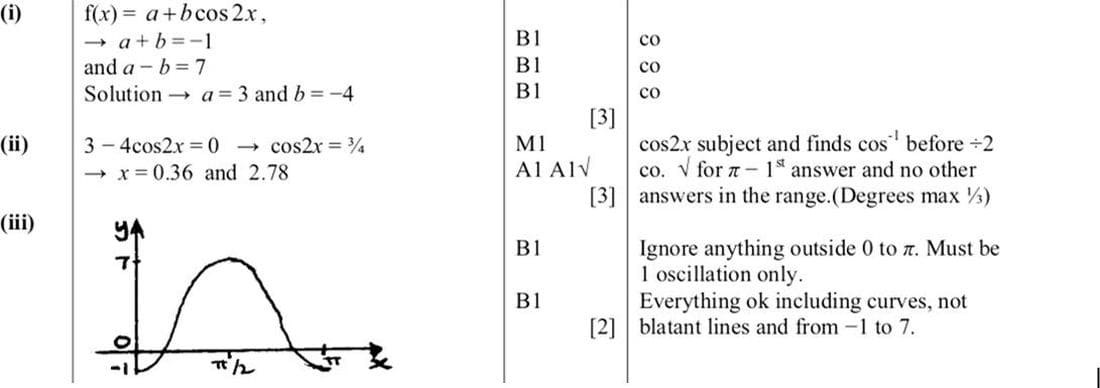
The function f is defined by f(x) = a + b cos 2x, for 0 ≤ x ≤ π. It is given that f(0) = -1 and f(\(\frac{1}{2}\pi\)) = 7.
- Find the values of a and b.
- Find the x-coordinates of the points where the curve y = f(x) intersects the x-axis.
- Sketch the graph of y = f(x).
Problem 527
527
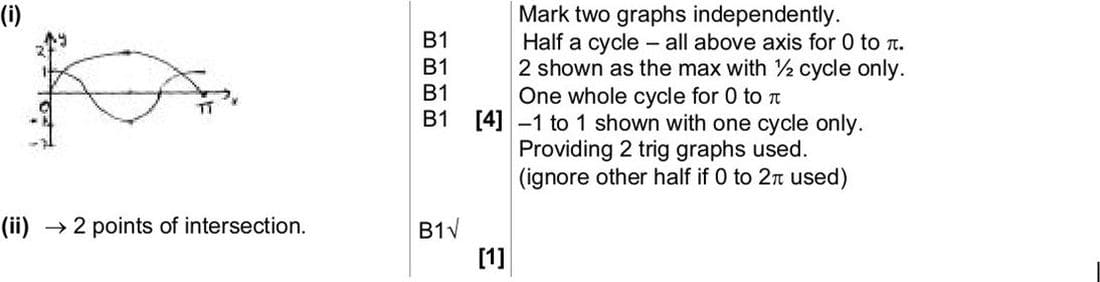
(i) Sketch and label, on the same diagram, the graphs of \(y = 2 \sin x\) and \(y = \cos 2x\), for the interval \(0 \leq x \leq \pi\).
(ii) Hence state the number of solutions of the equation \(2 \sin x = \cos 2x\) in the interval \(0 \leq x \leq \pi\).