Exam-Style Problems
⬅ Back to SubchapterJune 2009 p1 q8
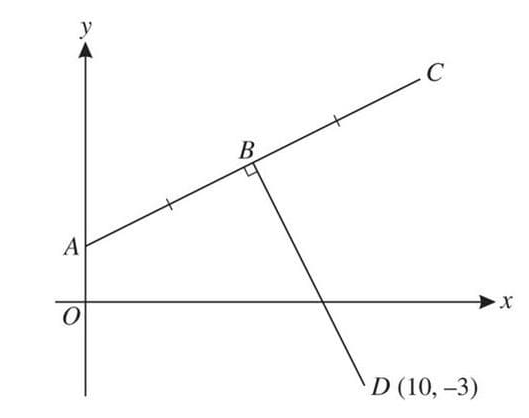
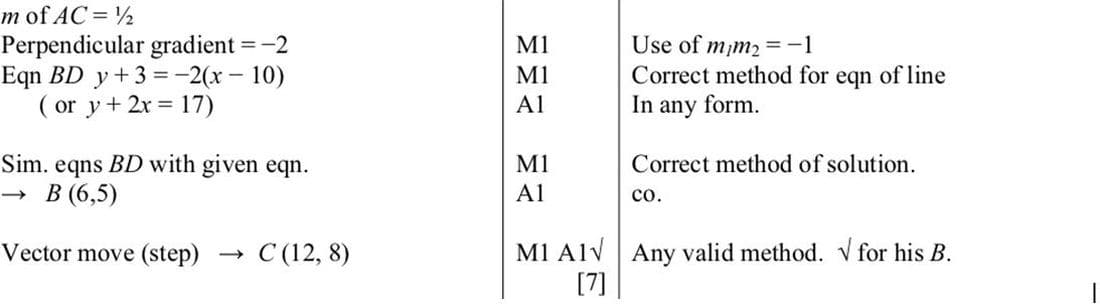
The diagram shows points A, B, and C lying on the line \(2y = x + 4\). The point A lies on the y-axis and \(AB = BC\). The line from D \((10, -3)\) to B is perpendicular to AC. Calculate the coordinates of B and C.
June 2008 p1 q11
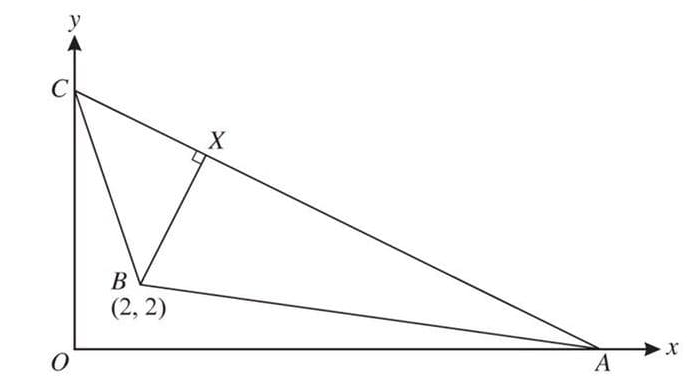
In the diagram, the points A and C lie on the x- and y-axes respectively and the equation of AC is \(2y + x = 16\). The point B has coordinates \((2, 2)\). The perpendicular from B to AC meets AC at the point X.
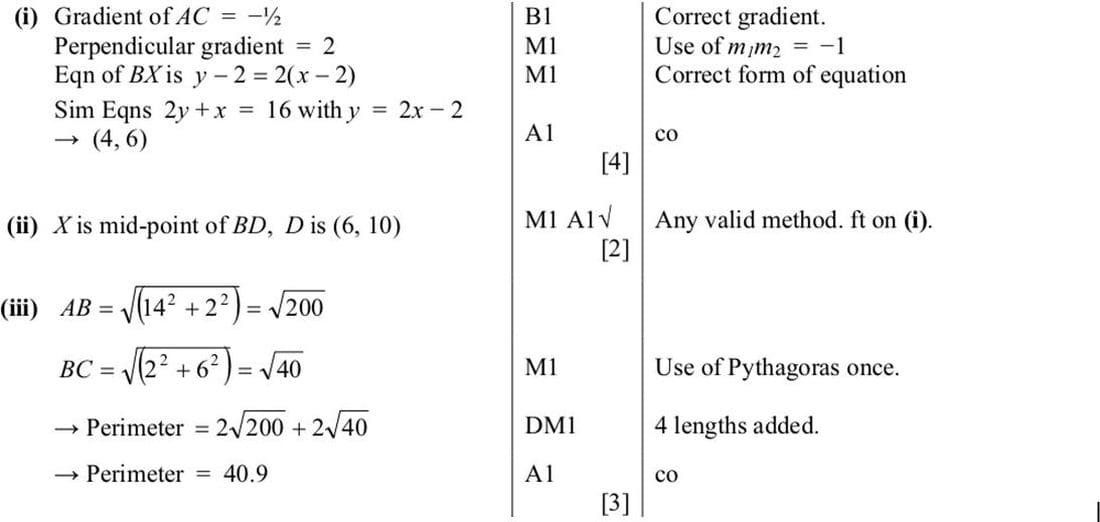
(i) Find the coordinates of X.
The point D is such that the quadrilateral ABCD has AC as a line of symmetry.
(ii) Find the coordinates of D.
(iii) Find, correct to 1 decimal place, the perimeter of ABCD.
Nov 2007 p1 q6
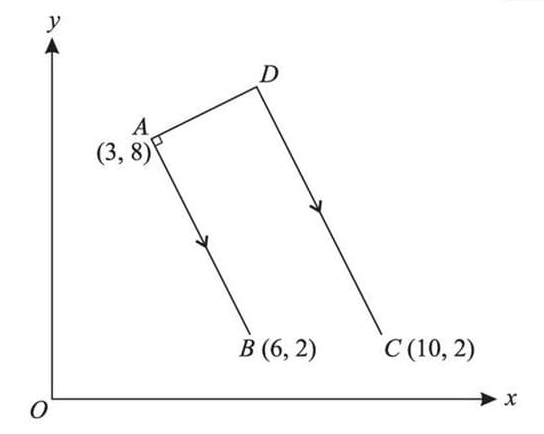
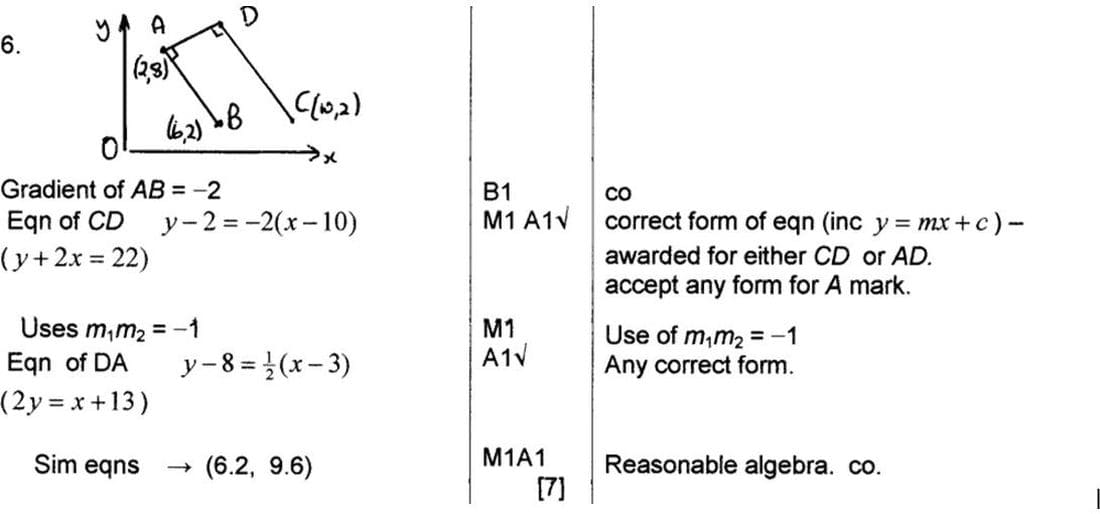
The three points A (3, 8), B (6, 2) and C (10, 2) are shown in the diagram. The point D is such that the line DA is perpendicular to AB and DC is parallel to AB. Calculate the coordinates of D.
June 2007 p1 q6
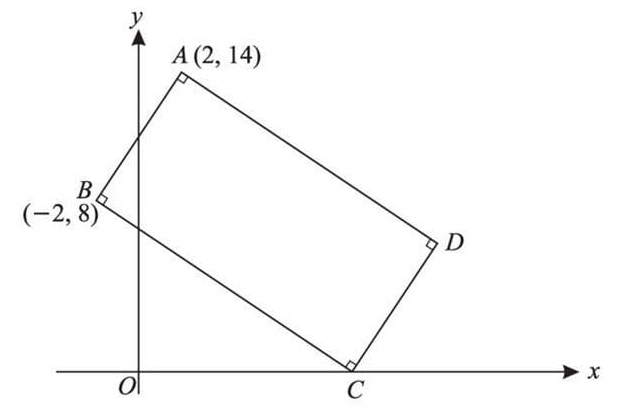
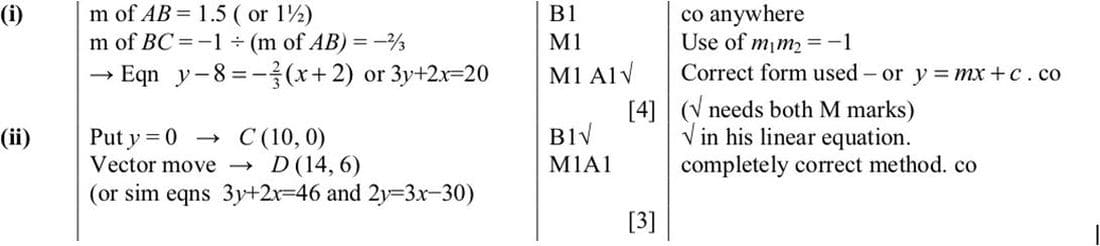
The diagram shows a rectangle ABCD. The point A is (2, 14), B is (-2, 8) and C lies on the x-axis. Find
- the equation of BC,
- the coordinates of C and D.
Nov 2006 p1 q5
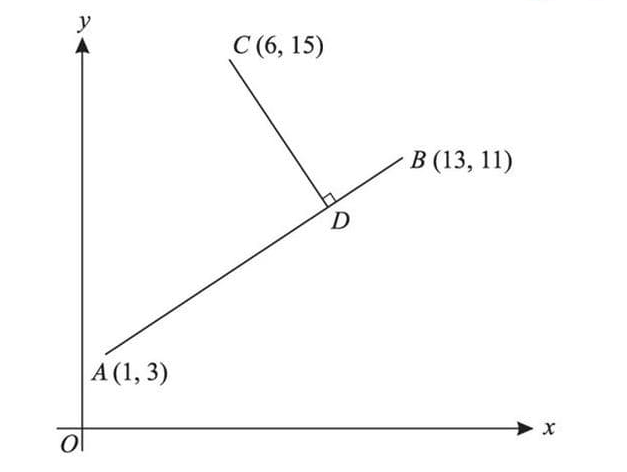
The three points A (1, 3), B (13, 11) and C (6, 15) are shown in the diagram. The perpendicular from C to AB meets AB at the point D. Find
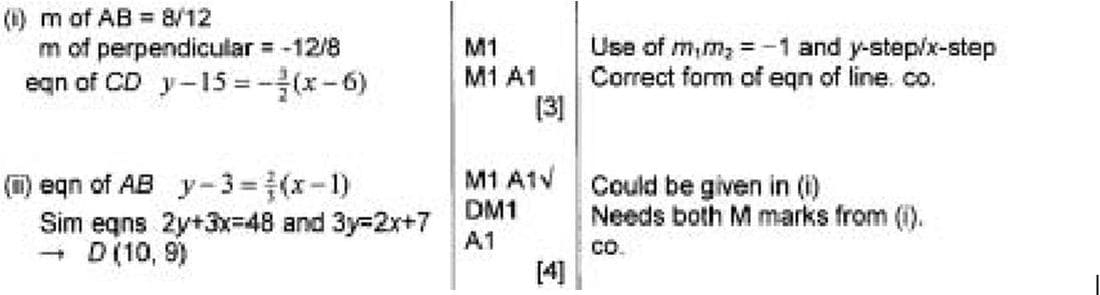
(i) the equation of CD,
(ii) the coordinates of D.