Exam-Style Problems
⬅ Back to SubchapterJune 2021 p13 q6
Functions f and g are both defined for \(x \in \mathbb{R}\) and are given by
\(f(x) = x^2 - 2x + 5\),
\(g(x) = x^2 + 4x + 13\).
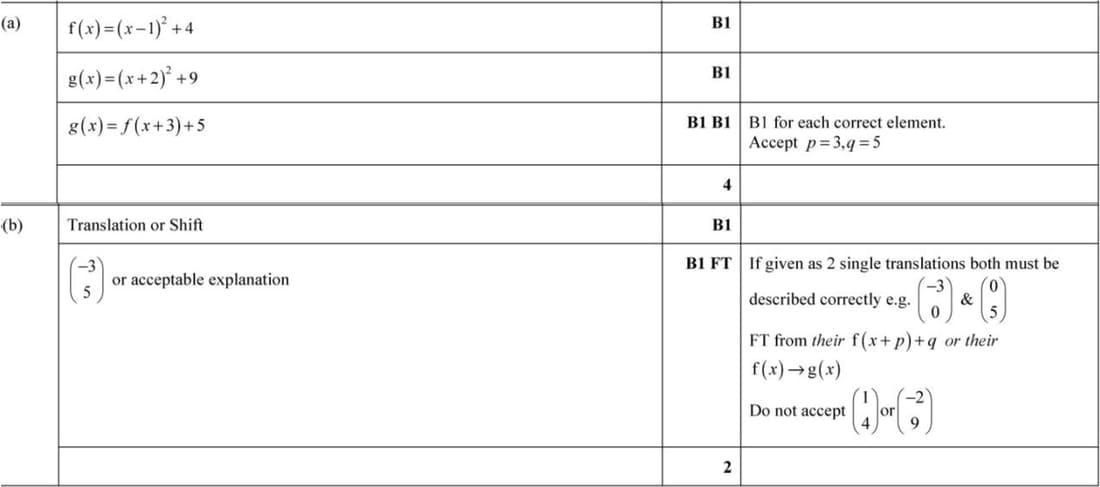
(a) By first expressing each of \(f(x)\) and \(g(x)\) in completed square form, express \(g(x)\) in the form \(f(x + p) + q\), where \(p\) and \(q\) are constants.
(b) Describe fully the transformation which transforms the graph of \(y = f(x)\) to the graph of \(y = g(x)\).
June 2021 p12 q2
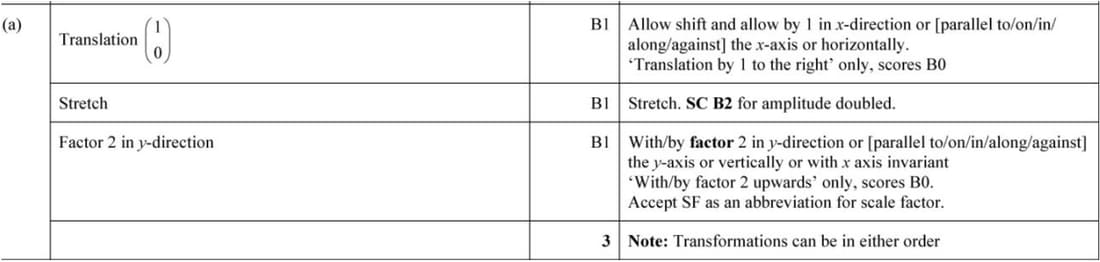
The graph of \(y = f(x)\) is transformed to the graph of \(y = 2f(x - 1)\).
Describe fully the two single transformations which have been combined to give the resulting transformation.
Problem 655
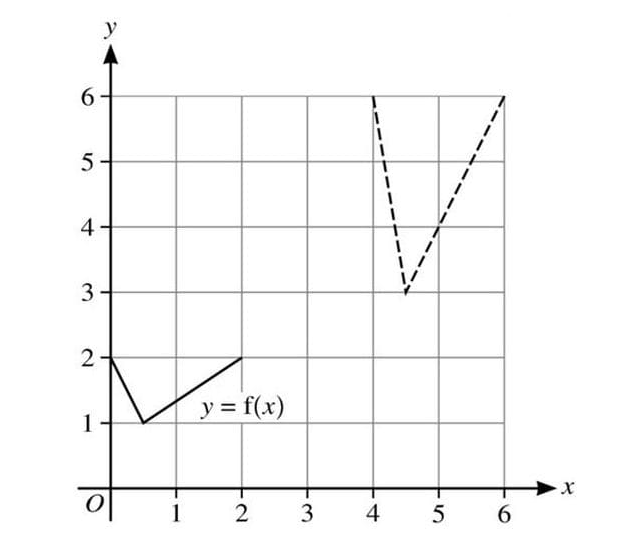
In the diagram, the graph of \(y = f(x)\) is shown with solid lines. The graph shown with broken lines is a transformation of \(y = f(x)\).
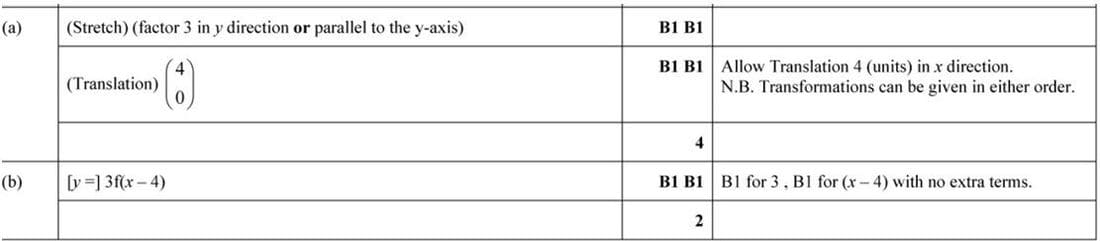
(a) Describe fully the two single transformations of \(y = f(x)\) that have been combined to give the resulting transformation.
(b) State in terms of \(y, f\) and \(x\), the equation of the graph shown with broken lines.
Nov 2020 p13 q1
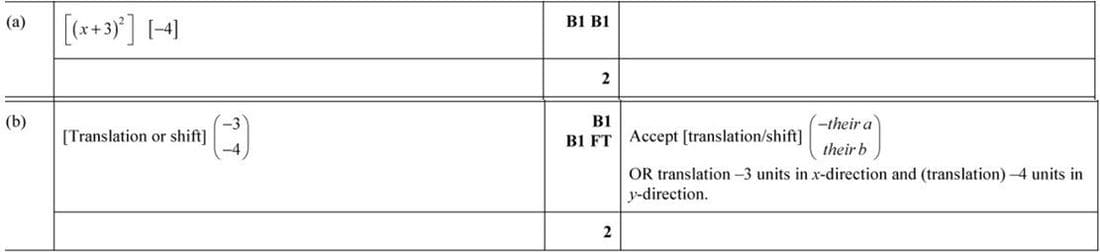
(a) Express \(x^2 + 6x + 5\) in the form \((x + a)^2 + b\), where \(a\) and \(b\) are constants.
(b) The curve with equation \(y = x^2\) is transformed to the curve with equation \(y = x^2 + 6x + 5\). Describe fully the transformation(s) involved.
June 2020 p13 q3
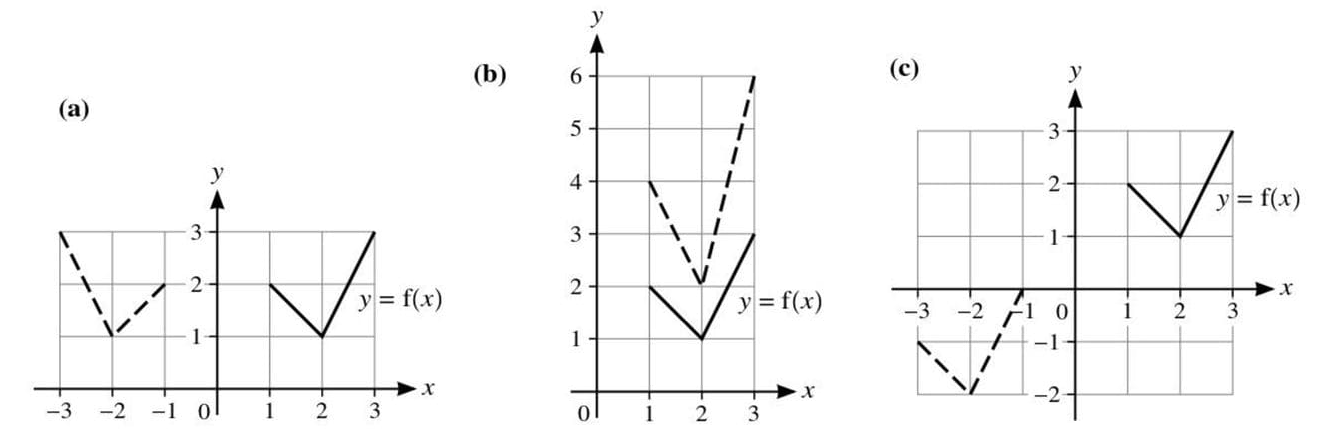
In each of parts (a), (b) and (c), the graph shown with solid lines has equation \(y = f(x)\). The graph shown with broken lines is a transformation of \(y = f(x)\).
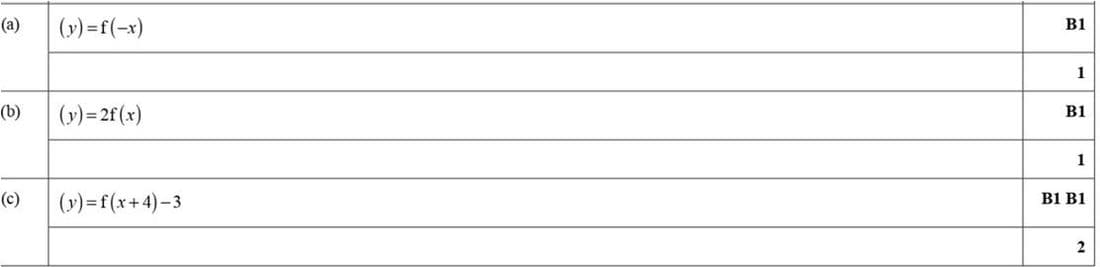
(a) State, in terms of \(f\), the equation of the graph shown with broken lines.
(b) State, in terms of \(f\), the equation of the graph shown with broken lines.
(c) State, in terms of \(f\), the equation of the graph shown with broken lines.