Exam-Style Problems
⬅ Back to SubchapterFM June 2021 p12 q06
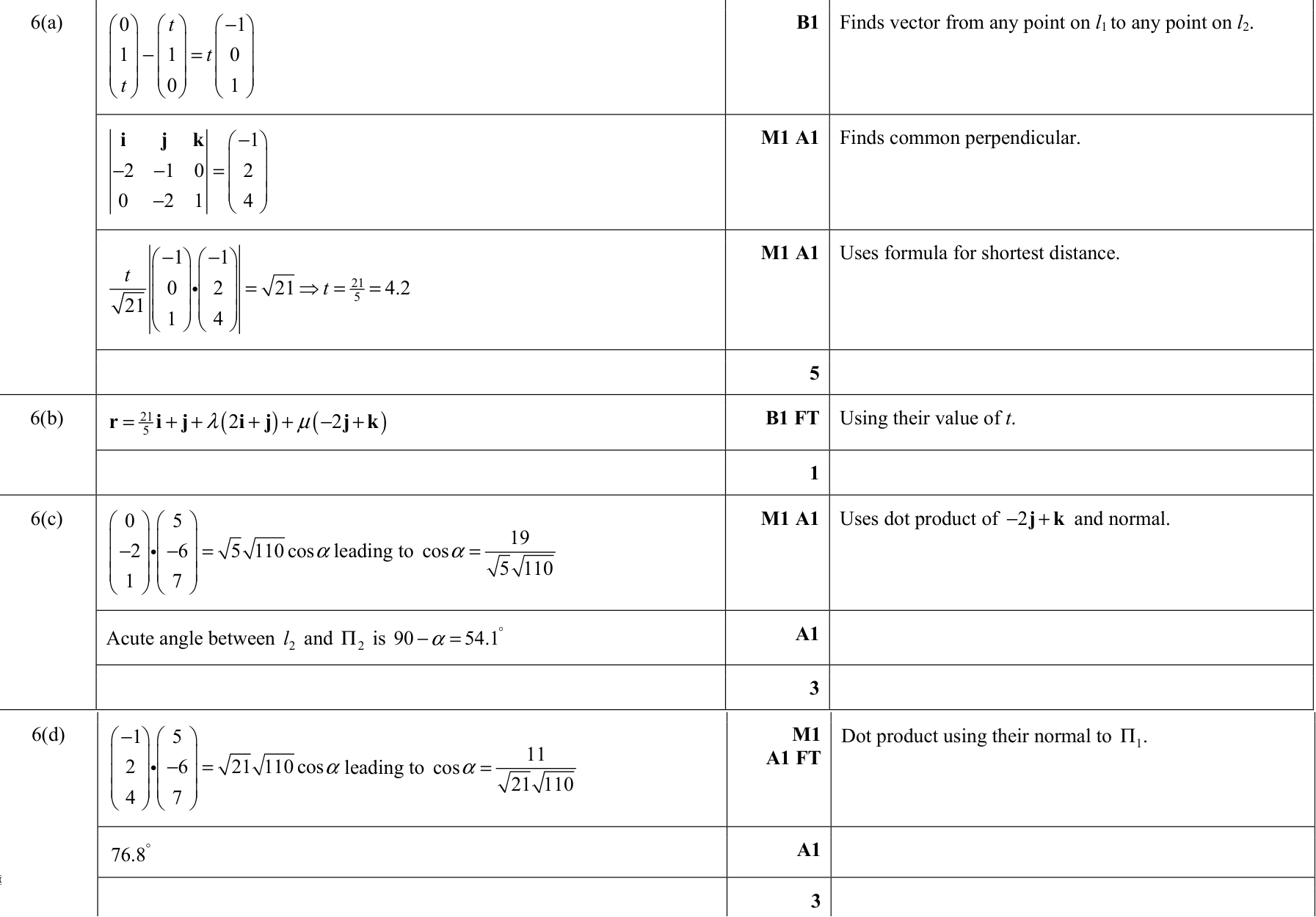
Let \(t\) be a positive constant.
The line \(l_1\) passes through the point with position vector \(t\mathbf{i} + \mathbf{j}\) and is parallel to the vector \(-2\mathbf{i} - \mathbf{j}\).
The line \(l_2\) passes through the point with position vector \(\mathbf{j} + t\mathbf{k}\) and is parallel to the vector \(-2\mathbf{j} + \mathbf{k}\).
It is given that the shortest distance between the lines \(l_1\) and \(l_2\) is \(\sqrt{21}\).
(a) Find the value of \(t\). [5]
The plane \(\Pi_1\) contains \(l_1\) and is parallel to \(l_2\).
(b) Write down an equation of \(\Pi_1\), giving your answer in the form \(\mathbf{r} = \mathbf{a} + \lambda \mathbf{b} + \mu \mathbf{c}\).
The plane \(\Pi_2\) has Cartesian equation \(5x - 6y + 7z = 0\).
(c) Find the acute angle between \(l_2\) and \(\Pi_2\). [3]
(d) Find the acute angle between \(\Pi_1\) and \(\Pi_2\). [3]
FM June 2021 p12 q07
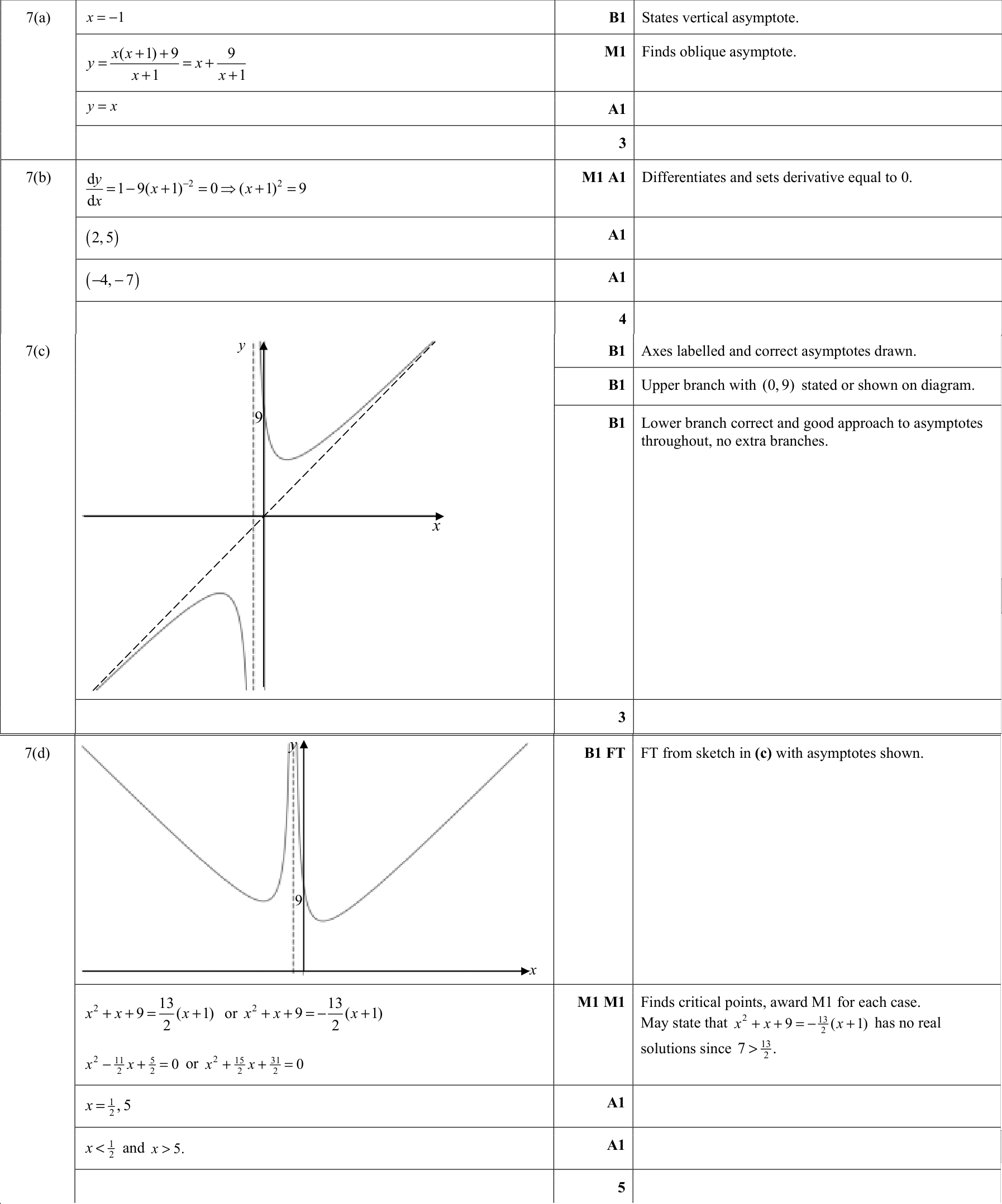
The curve C has equation \(y = \frac{x^2 + x + 9}{x + 1}\).
(a) Find the equations of the asymptotes of C.
(b) Find the coordinates of the stationary points on C.
FM June 2021 p13 q01
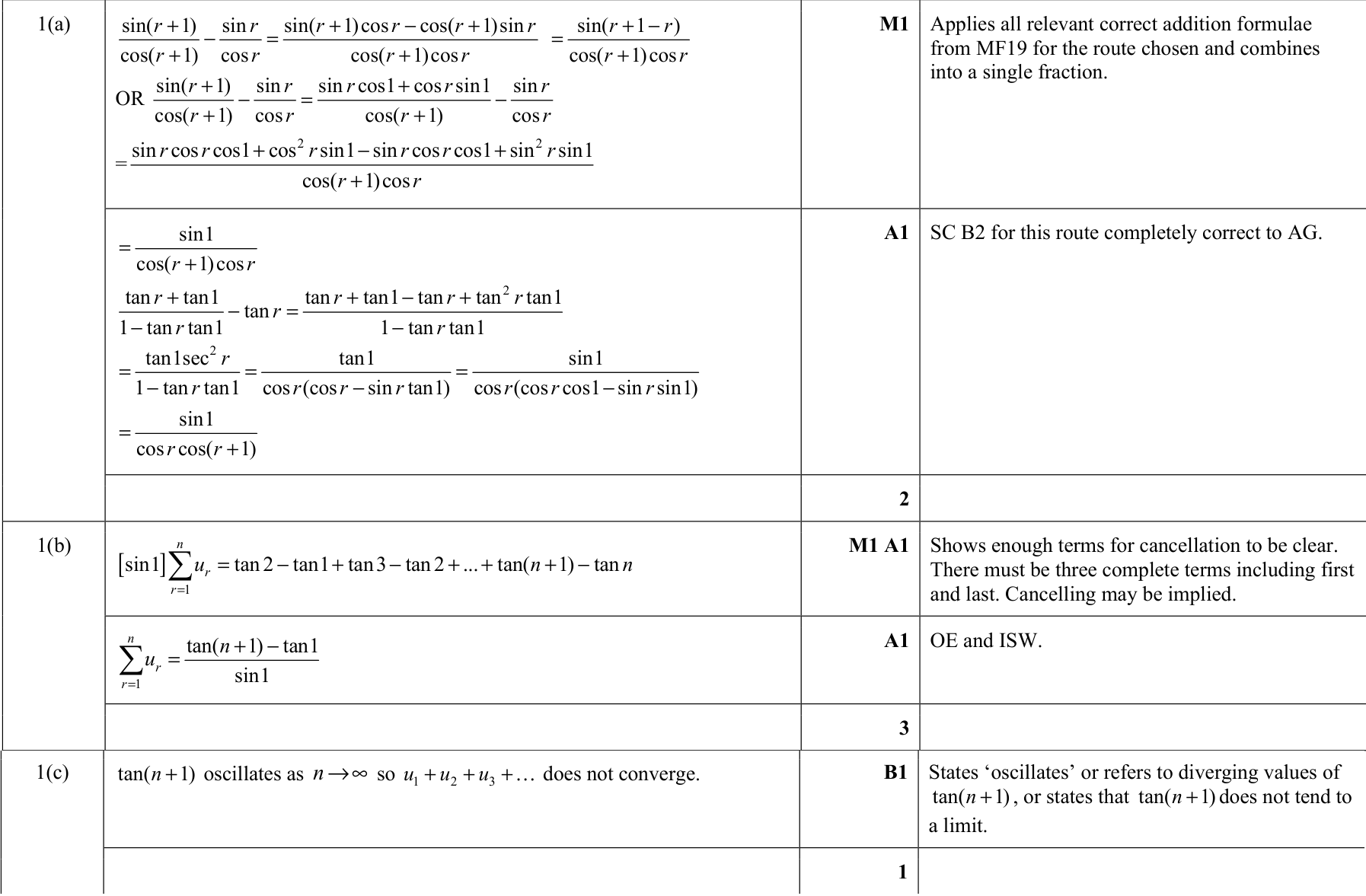
(a) Show that \(\tan(r+1) - \tan r = \frac{\sin 1}{\cos(r+1)\cos r}\).
Let \(u_r = \frac{1}{\cos(r+1)\cos r}\).
(b) Use the method of differences to find \(\sum_{r=1}^{n} u_r\).
(c) Explain why the infinite series \(u_1 + u_2 + u_3 + \ldots\) does not converge.
FM June 2021 p13 q02
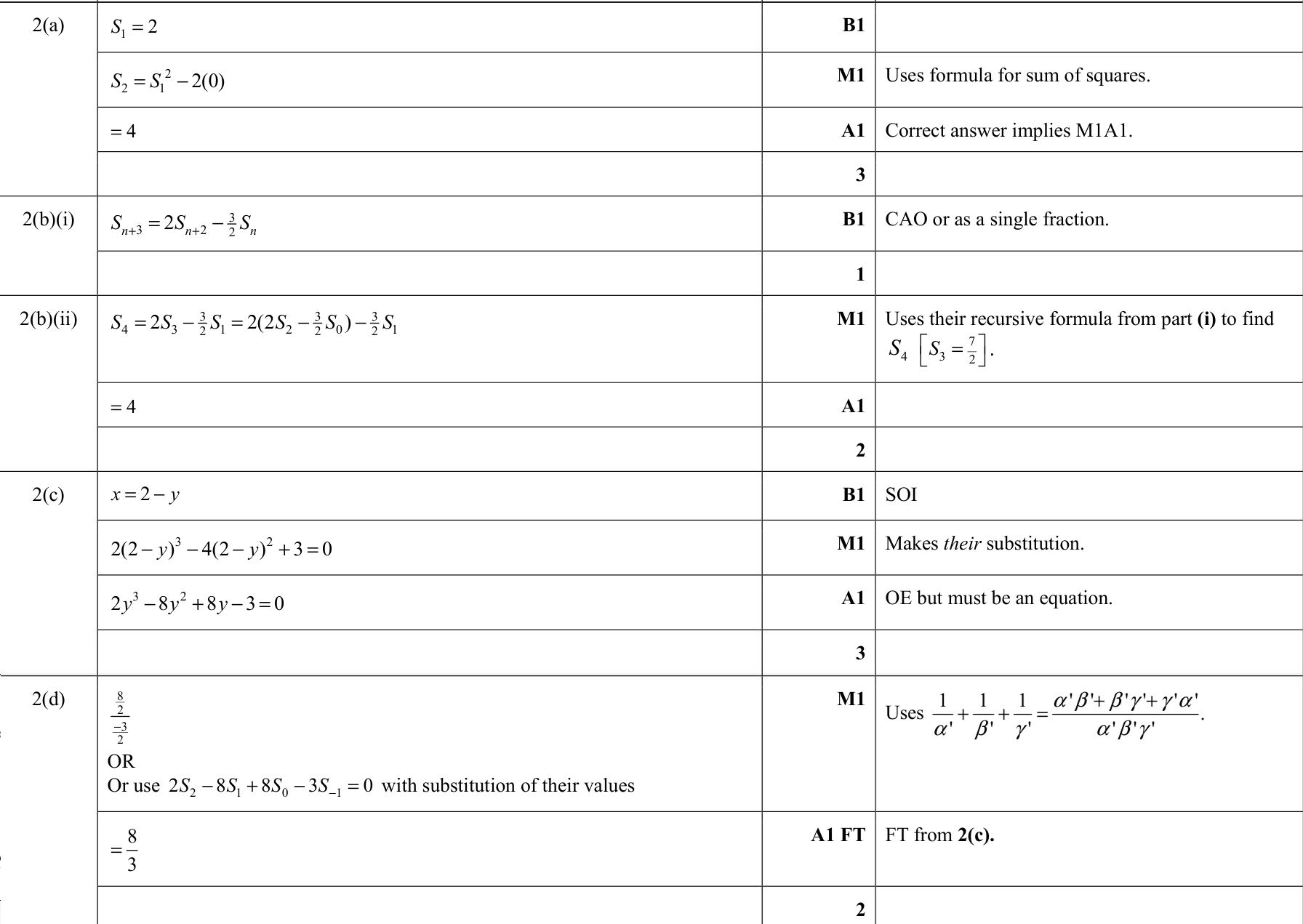
The cubic equation \(2x^3 - 4x^2 + 3 = 0\) has roots \(\alpha, \beta, \gamma\). Let \(S_n = \alpha^n + \beta^n + \gamma^n\).
- (a) State the value of \(S_1\) and find the value of \(S_2\).
- (b)
- Express \(S_{n+3}\) in terms of \(S_{n+2}\) and \(S_n\).
- Hence, or otherwise, find the value of \(S_4\).
- (c) Use the substitution \(y = S_1 - x\), where \(S_1\) is the numerical value found in part (a), to find and simplify an equation whose roots are \(\alpha + \beta, \beta + \gamma, \gamma + \alpha\).
- (d) Find the value of \(\frac{1}{\alpha + \beta} + \frac{1}{\beta + \gamma} + \frac{1}{\gamma + \alpha}\).
FM June 2021 p13 q03
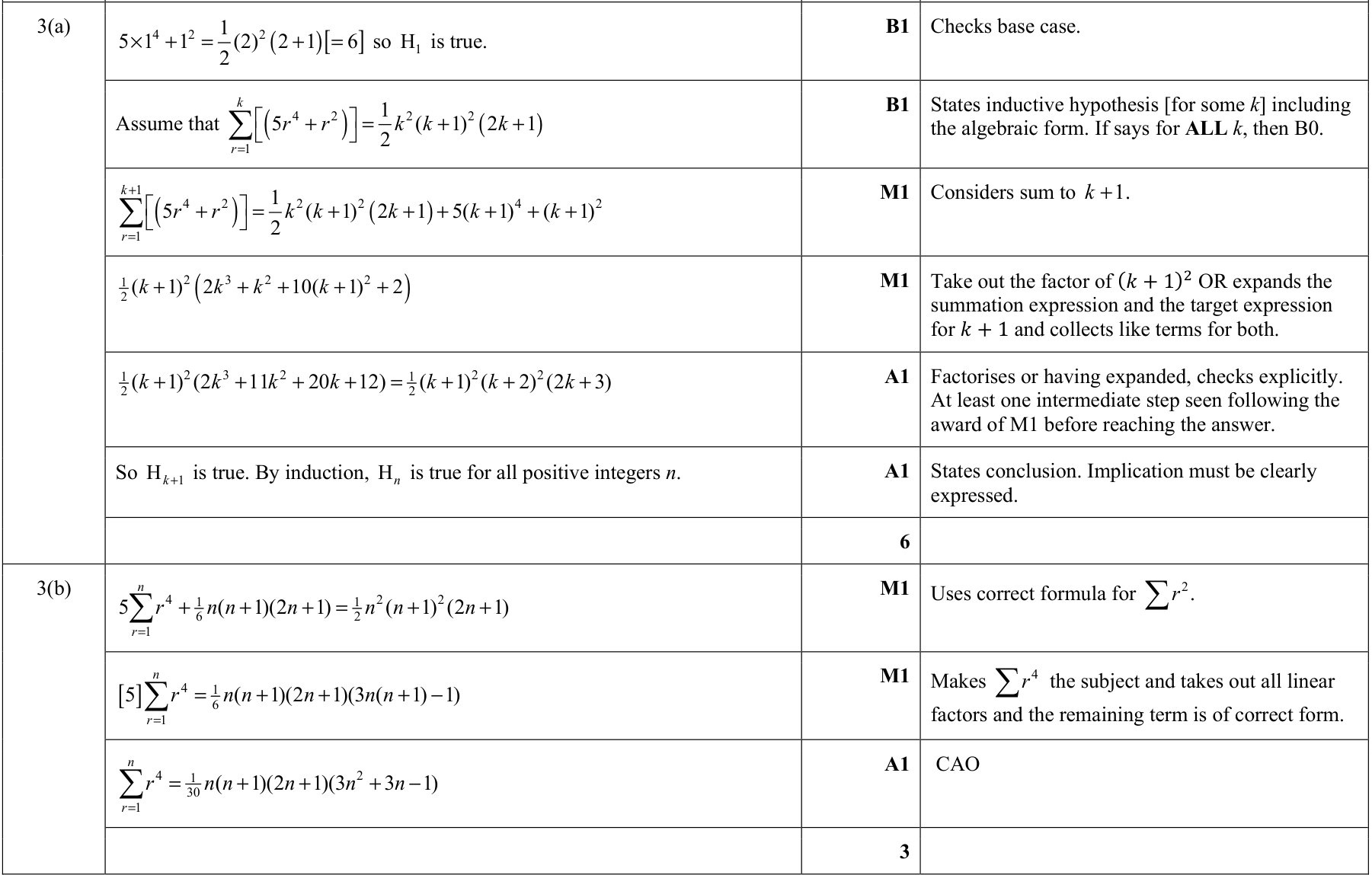
(a) Prove by mathematical induction that, for all positive integers \(n\),
\(\sum_{r=1}^{n} (5r^4 + r^2) = \frac{1}{2} n^2 (n+1)^2 (2n+1).\)
(b) Use the result given in part (a) together with the List of formulae (MF19) to find \(\sum_{r=1}^{n} r^4\) in terms of \(n\), fully factorising your answer.