Exam-Style Problems
⬅ Back to SubchapterFM June 2022 p12 q06
4237
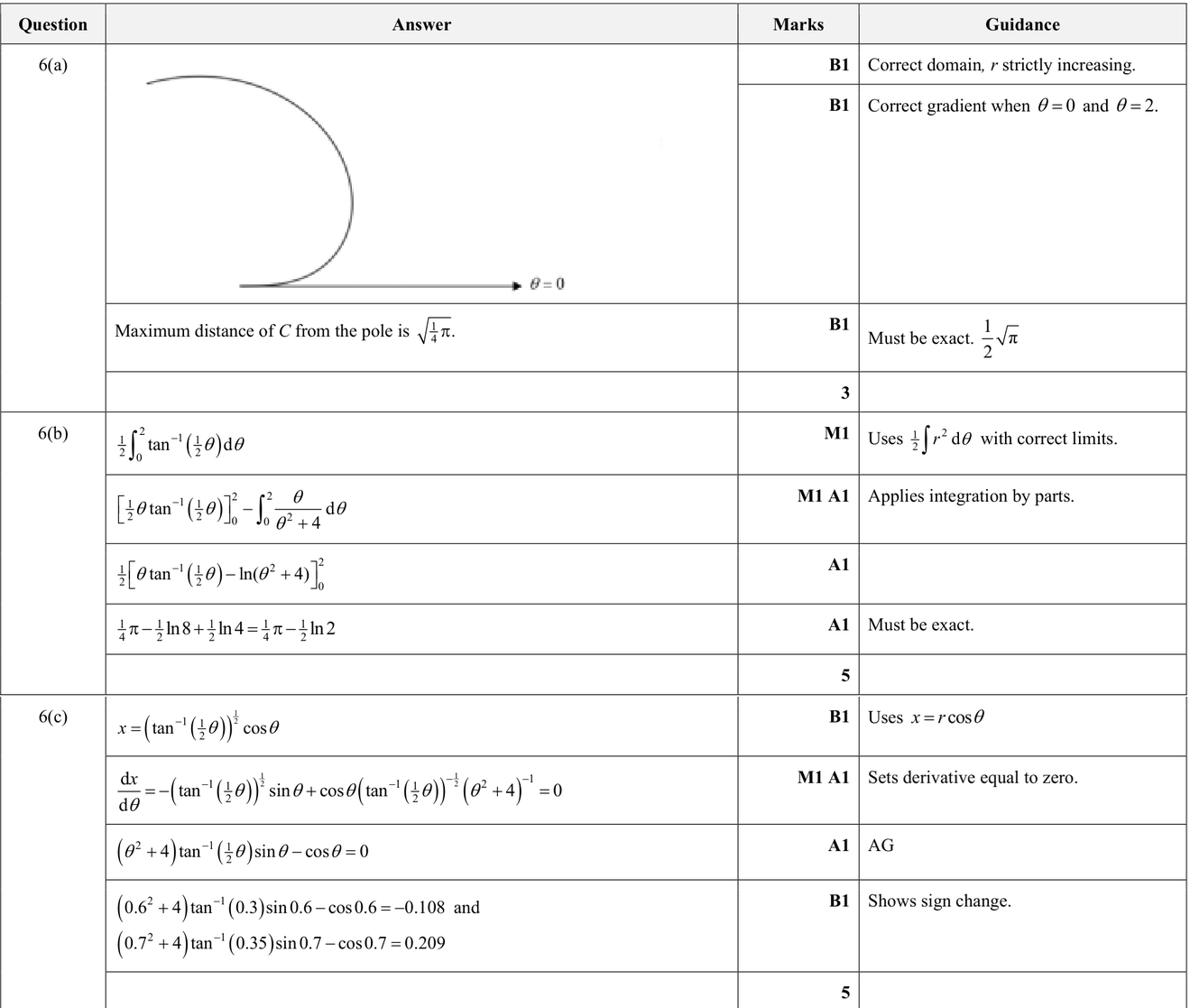
The curve C has polar equation \(r^2 = \arctan\left(\frac{1}{2}\theta\right)\), where \(0 \leq \theta \leq 2\).
(a) Sketch C and state, in exact form, the greatest distance of a point on C from the pole.
(b) Find the exact value of the area of the region bounded by C and the half-line \(\theta = 2\).
Now consider the part of C where \(0 \leq \theta \leq \frac{1}{2}\pi\).
(c) Show that, at the point furthest from the half-line \(\theta = \frac{1}{2}\pi\),
\((\theta^2 + 4)\arctan\left(\frac{1}{2}\theta\right)\sin\theta - \cos\theta = 0\)
and verify that this equation has a root between 0.6 and 0.7.
FM June 2022 p12 q07
4238
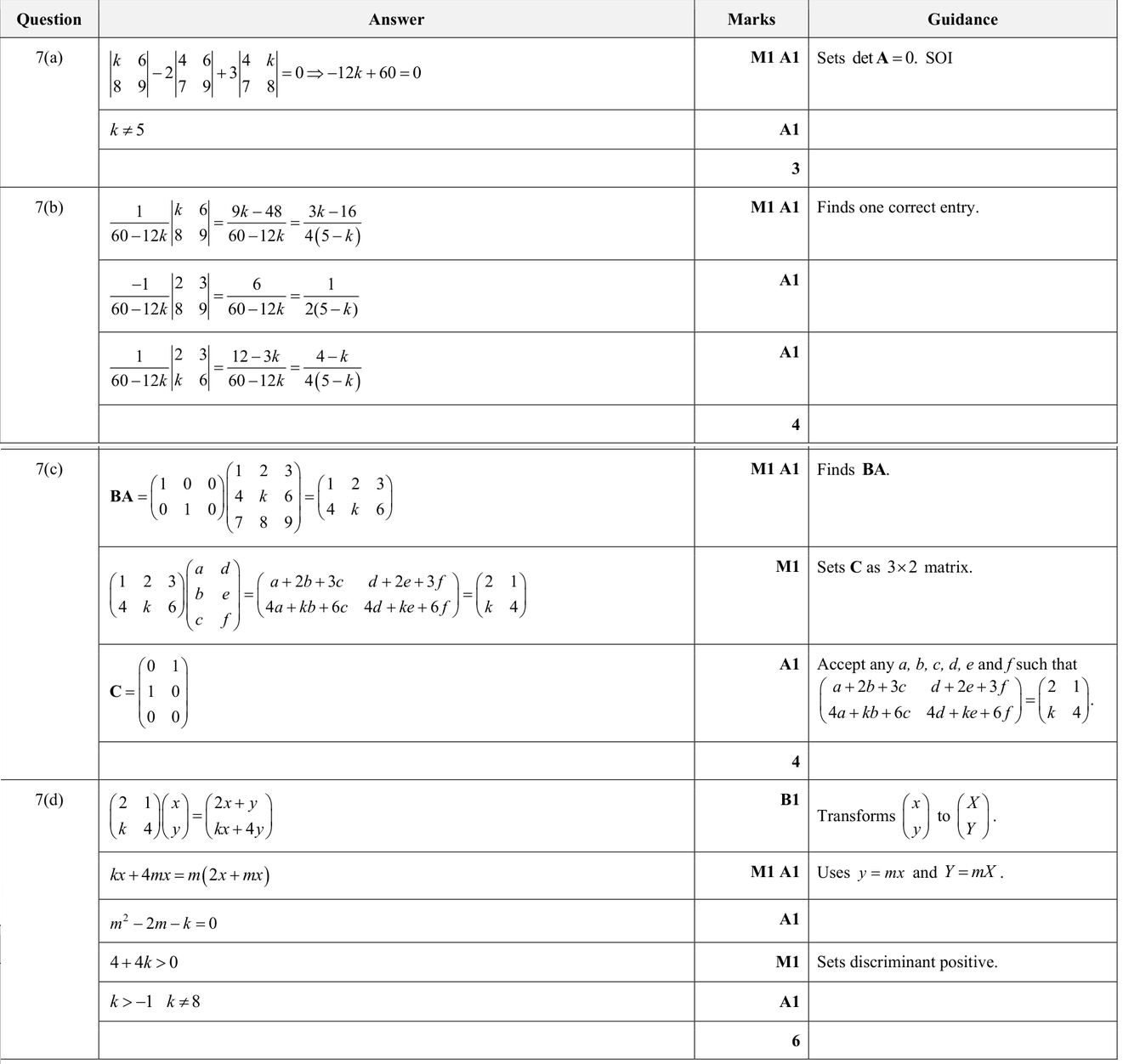
The matrix \(A\) is given by \(A = \begin{pmatrix} 1 & 2 & 3 \\ 4 & k & 6 \\ 7 & 8 & 9 \end{pmatrix}\).
- Find the set of values of \(k\) for which \(A\) is non-singular.
- Given that \(A\) is non-singular, find, in terms of \(k\), the entries in the top row of \(A^{-1}\).
- Given that \(B = \begin{pmatrix} 1 & 0 & 0 \\ 0 & 1 & 0 \end{pmatrix}\), give an example of a matrix \(C\) such that \(BAC = \begin{pmatrix} 2 & 1 \\ k & 4 \end{pmatrix}\).
- Find the set of values of \(k\) for which the transformation in the \(x-y\) plane represented by \(\begin{pmatrix} 2 & 1 \\ k & 4 \end{pmatrix}\) has two distinct invariant lines through the origin.
FM June 2022 p13 q01
4239
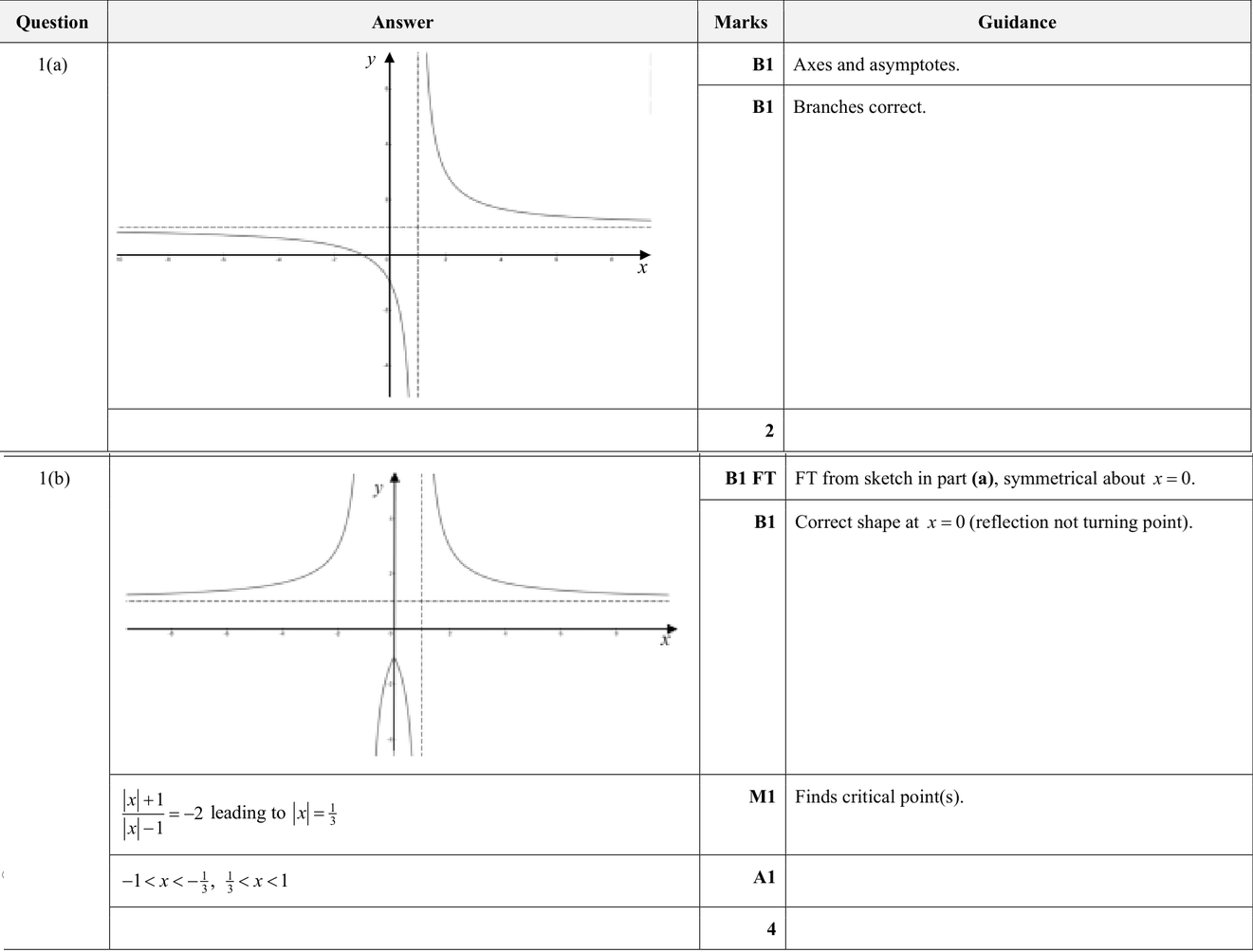
(a) Sketch the curve with equation \(y = \frac{x+1}{x-1}\).
(b) Sketch the curve with equation \(y = \frac{|x|+1}{|x|-1}\) and find the set of values of \(x\) for which \(\frac{|x|+1}{|x|-1} < -2\).
FM June 2022 p13 q02
4240
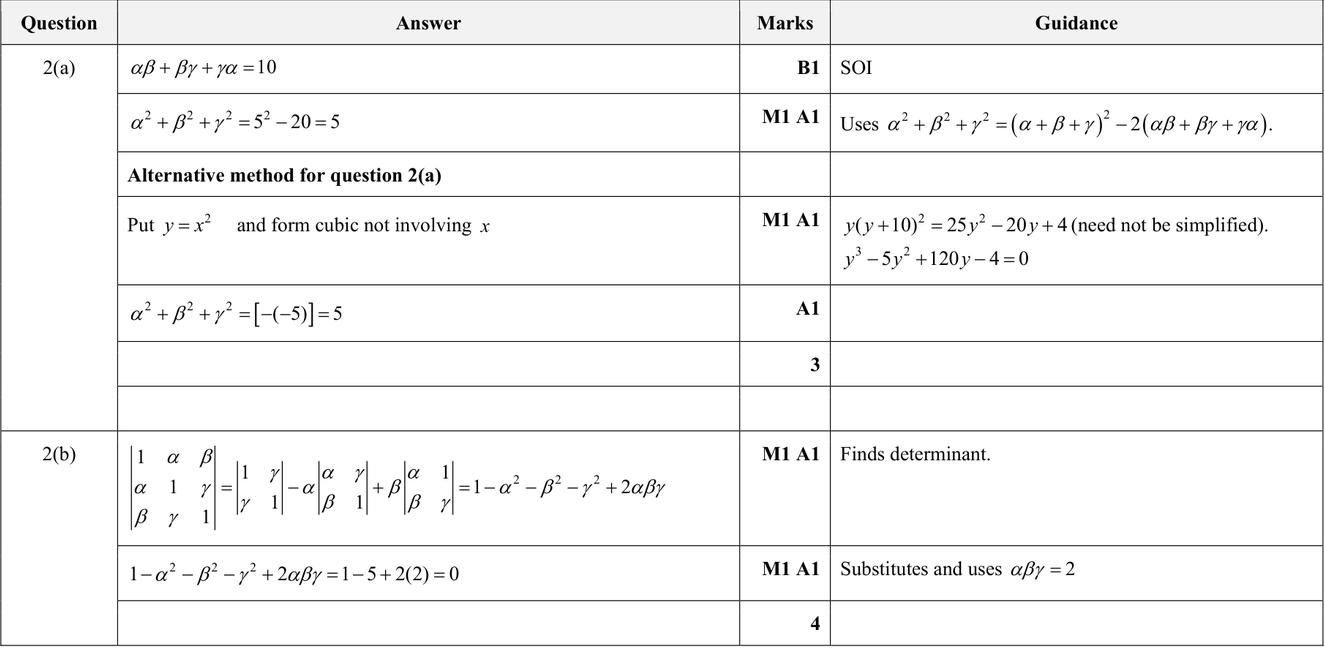
The cubic equation \(x^3 + 5x^2 + 10x - 2 = 0\) has roots \(\alpha, \beta, \gamma\).
(a) Find the value of \(\alpha^2 + \beta^2 + \gamma^2\).
(b) Show that the matrix \(\begin{pmatrix} 1 & \alpha & \beta \\ \alpha & 1 & \gamma \\ \beta & \gamma & 1 \end{pmatrix}\) is singular.
FM June 2022 p13 q03
4241
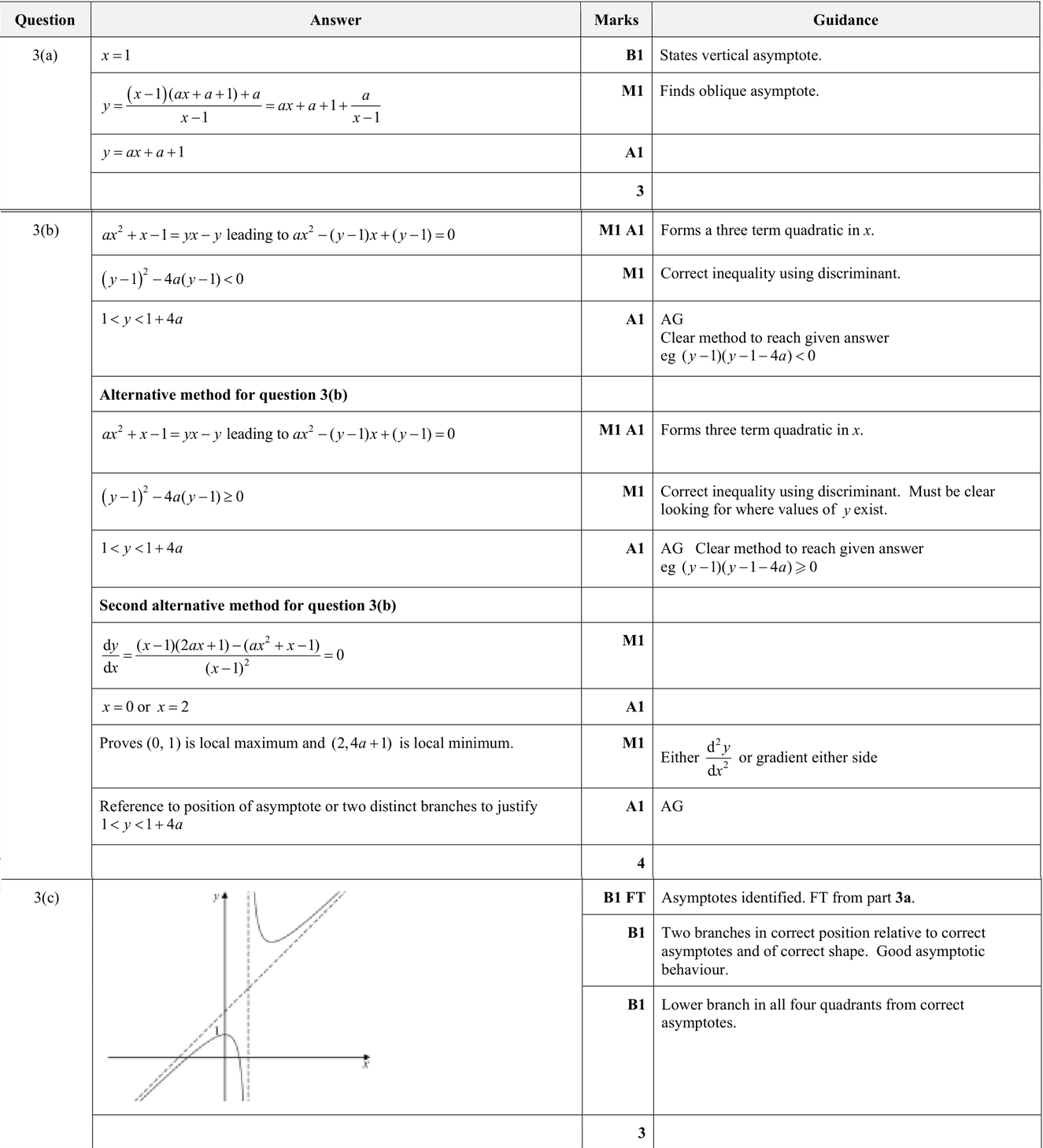
A curve \(C\) has equation \(y = \frac{ax^2 + x - 1}{x - 1}\), where \(a\) is a positive constant.
- Find the equations of the asymptotes of \(C\).
- Show that there is no point on \(C\) for which \(1 < y < 1 + 4a\).
- Sketch \(C\). You do not need to find the coordinates of the intersections with the axes.