Exam-Style Problems
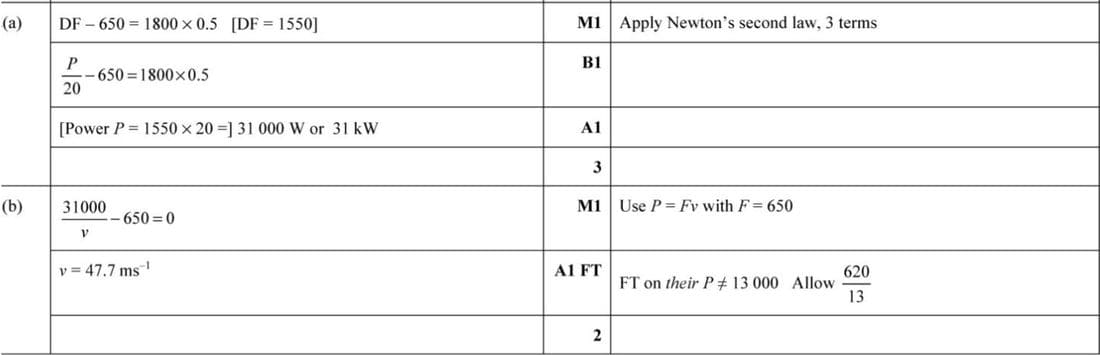
⬅ Back to SubchapterNov 2020 p42 q2
A car of mass 1800 kg is travelling along a straight horizontal road. The power of the car’s engine is constant. There is a constant resistance to motion of 650 N.
(a) Find the power of the car’s engine, given that the car’s acceleration is 0.5 m s-2 when its speed is 20 m s-1.
(b) Find the steady speed which the car can maintain with the engine working at this power.
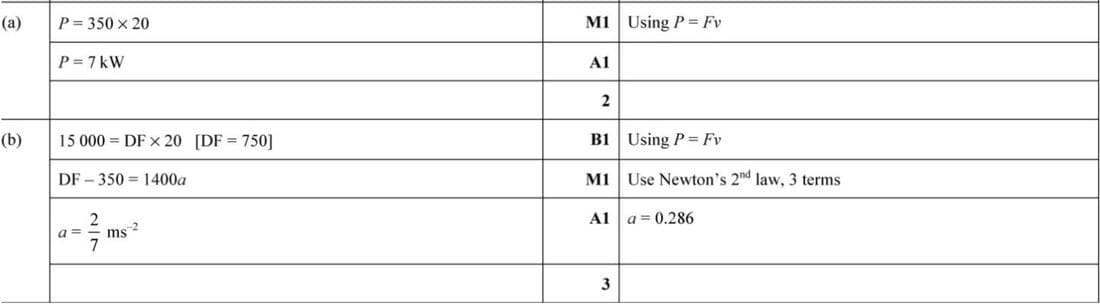
Nov 2020 p41 q2
A car of mass 1400 kg is moving along a straight horizontal road against a resistance of magnitude 350 N.
(a) Find, in kW, the rate at which the engine of the car is working when it is travelling at a constant speed of 20 m s-1.
(b) Find the acceleration of the car when its speed is 20 m s-1 and the engine is working at 15 kW.
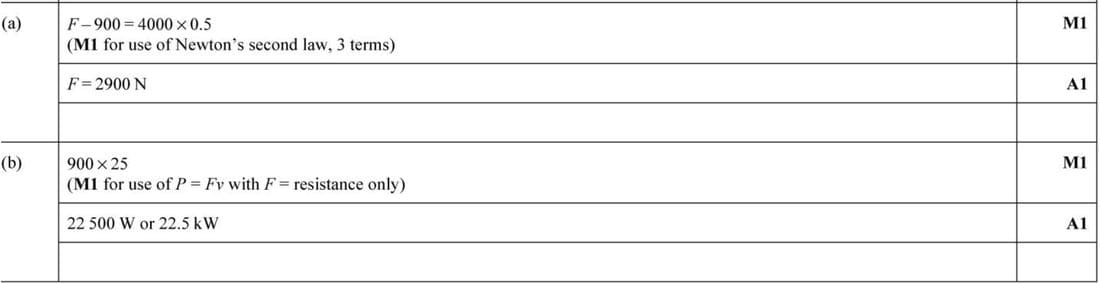
June 2020 p43 q2
A minibus of mass 4000 kg is travelling along a straight horizontal road. The resistance to motion is 900 N.
(a) Find the driving force when the acceleration of the minibus is 0.5 m s-2.
(b) Find the power required for the minibus to maintain a constant speed of 25 m s-1.
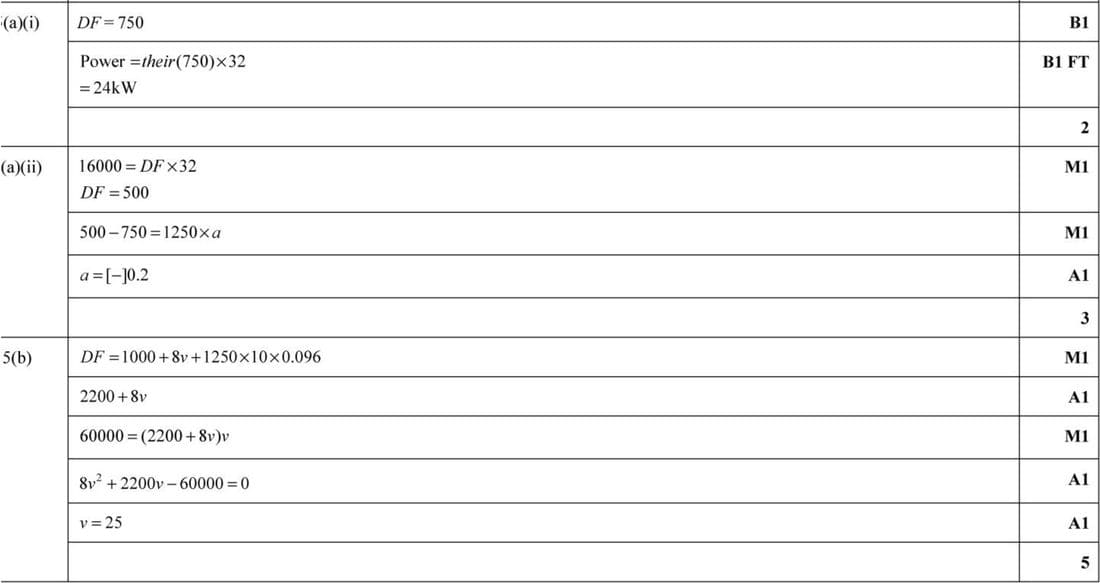
June 2020 p42 q5
A car of mass 1250 kg is moving on a straight road.
(a) On a horizontal section of the road, the car has a constant speed of 32 m s-1 and there is a constant force of 750 N resisting the motion.
- Calculate, in kW, the power developed by the engine of the car. [2]
- Given that this power is suddenly decreased by 8 kW, find the instantaneous deceleration of the car. [3]
(b) On a section of the road inclined at sin-1 0.096 to the horizontal, the resistance to the motion of the car is (1000 + 8v) N when the speed of the car is v m s-1. The car travels up this section of the road at constant speed with the engine working at 60 kW.
Find this constant speed. [5]
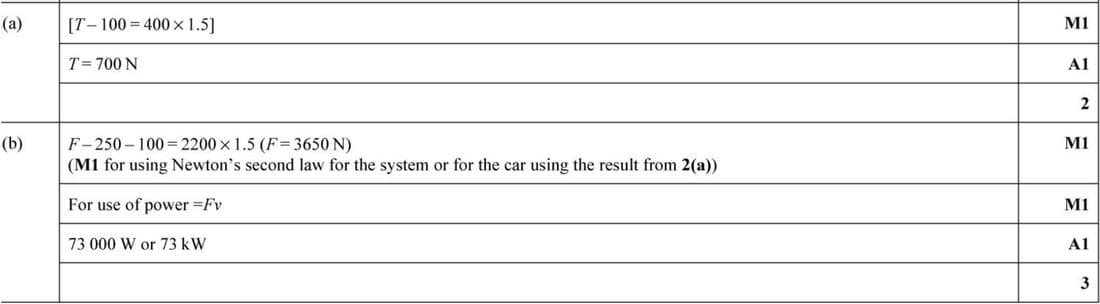
June 2020 p41 q2
A car of mass 1800 kg is towing a trailer of mass 400 kg along a straight horizontal road. The car and trailer are connected by a light rigid tow-bar. The car is accelerating at 1.5 \(\text{ms}^{-2}\). There are constant resistance forces of 250 N on the car and 100 N on the trailer.
(a) Find the tension in the tow-bar.
(b) Find the power of the engine of the car at the instant when the speed is 20 \(\text{ms}^{-1}\).