Exam-Style Problems
⬅ Back to SubchapterNov 2016 p42 q4
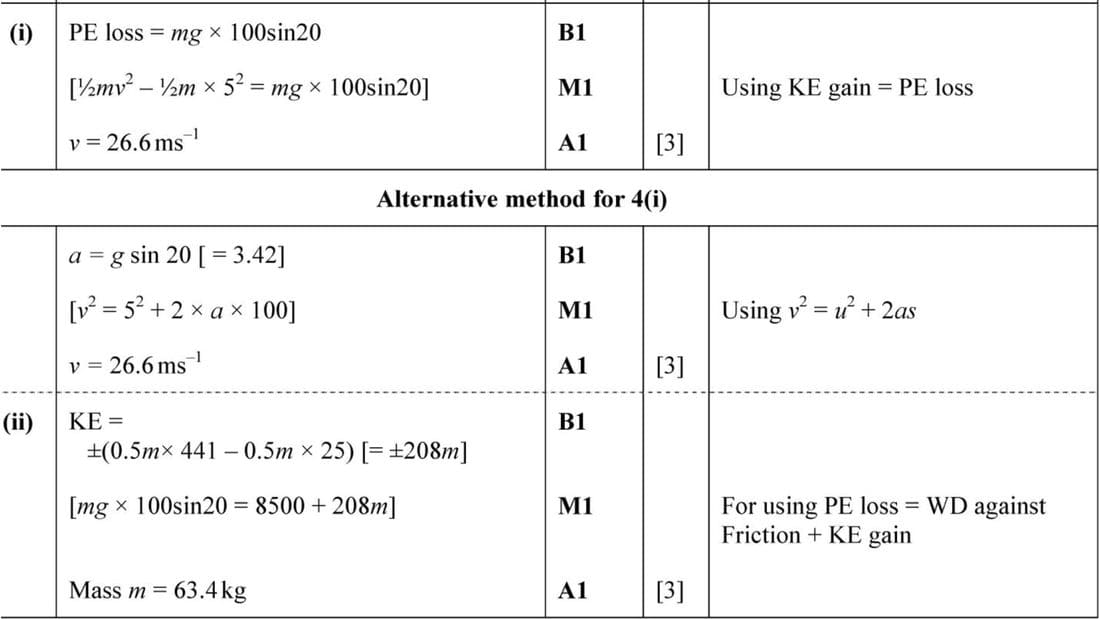
A girl on a sledge starts, with a speed of 5 m/s, at the top of a slope of length 100 m which is at an angle of 20° to the horizontal. The sledge slides directly down the slope.
- Given that there is no resistance to the sledge’s motion, find the speed of the sledge at the bottom of the slope.
- It is given instead that the sledge experiences a resistance to motion such that the total work done against the resistance is 8500 J, and the speed of the sledge at the bottom of the slope is 21 m/s. Find the total mass of the girl and the sledge.
Feb/Mar 2016 p42 q1
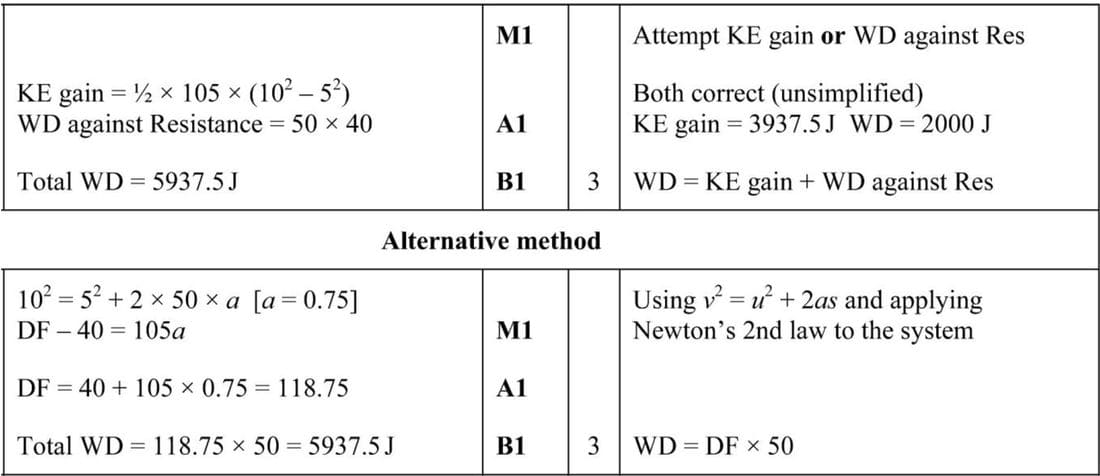
A cyclist has mass 85 kg and rides a bicycle of mass 20 kg. The cyclist rides along a horizontal road against a total resistance force of 40 N. Find the total work done by the cyclist in increasing his speed from 5 m s-1 to 10 m s-1 while travelling a distance of 50 m.
June 2015 p42 q1
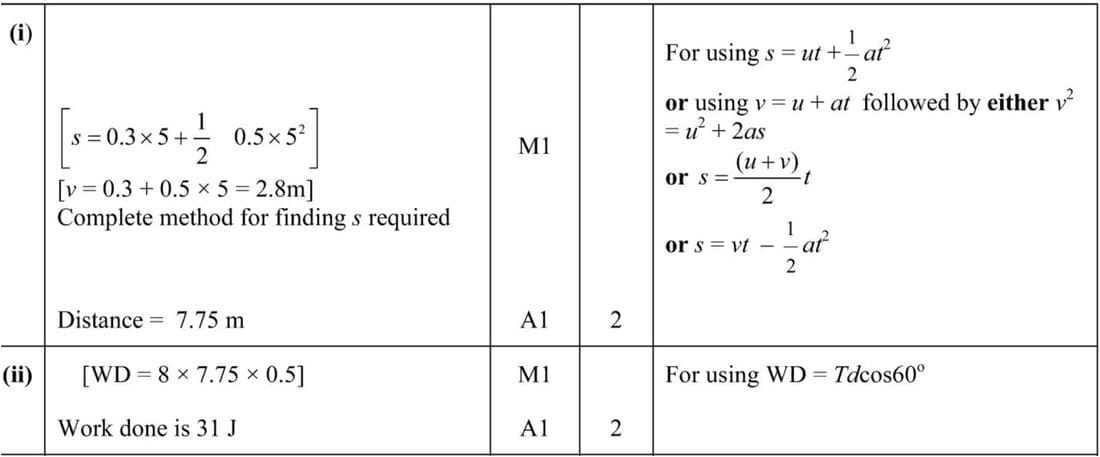
One end of a light inextensible string is attached to a block. The string makes an angle of 60° above the horizontal and is used to pull the block in a straight line on a horizontal floor with acceleration 0.5 m/s². The tension in the string is 8 N. The block starts to move with speed 0.3 m/s. For the first 5 s of the block’s motion, find
- the distance travelled,
- the work done by the tension in the string.
June 2015 p41 q1
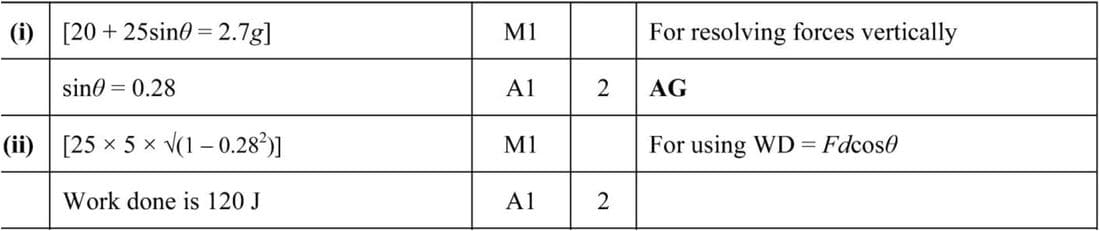
A block B of mass 2.7 kg is pulled at constant speed along a straight line on a rough horizontal floor. The pulling force has magnitude 25 N and acts at an angle of \(\theta\) above the horizontal. The normal component of the contact force acting on B has magnitude 20 N.
(i) Show that \(\sin \theta = 0.28\).
(ii) Find the work done by the pulling force in moving the block a distance of 5 m.
Nov 2014 p43 q7
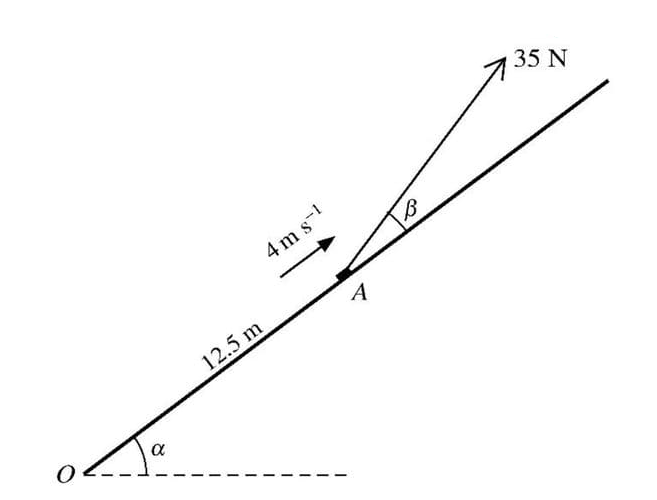
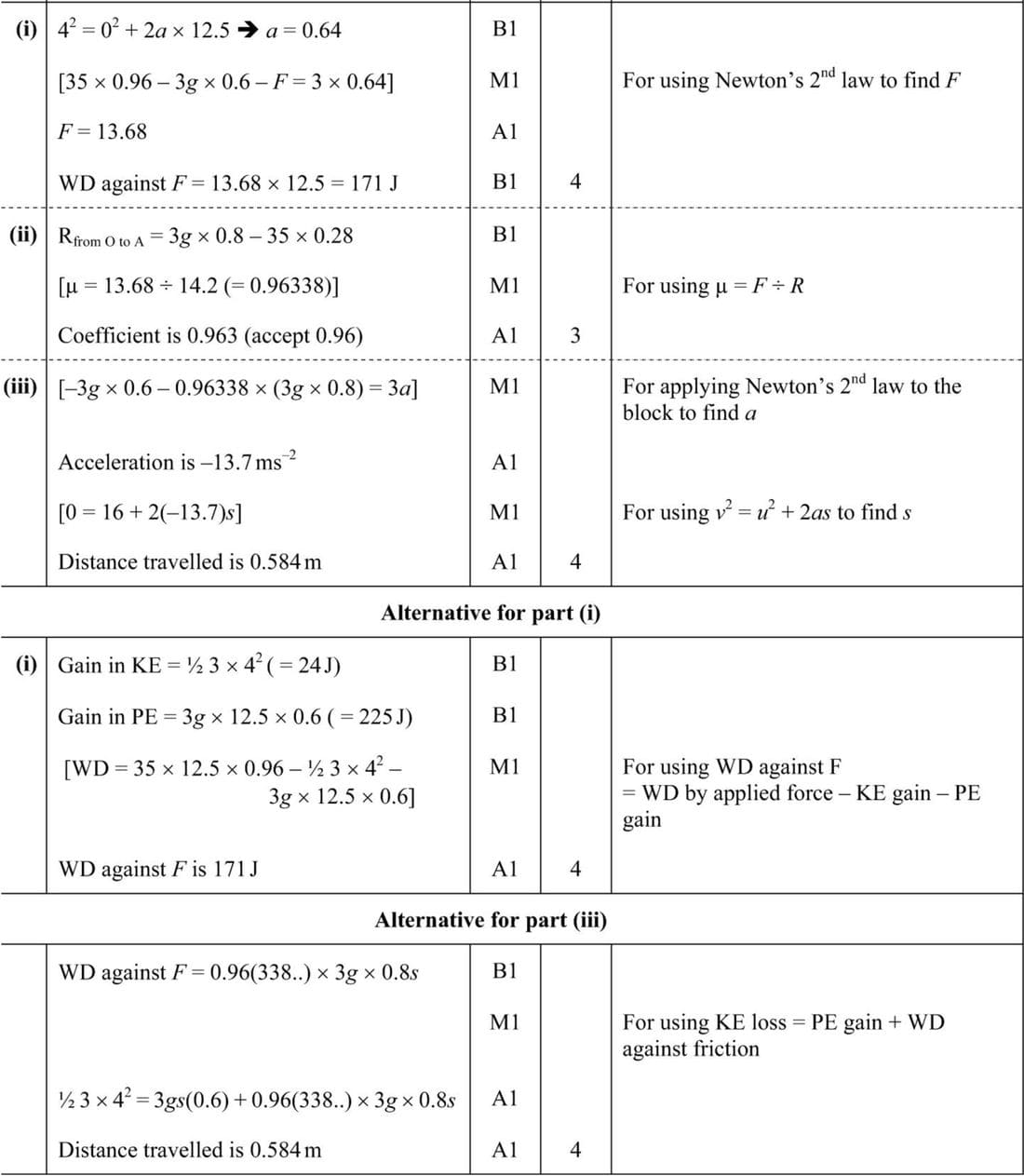
A small block of mass 3 kg is initially at rest at the bottom O of a rough plane inclined at an angle \(\alpha\) to the horizontal, where \(\sin \alpha = 0.6\) and \(\cos \alpha = 0.8\). A force of magnitude 35 N acts on the block at an angle \(\beta\) above the plane, where \(\sin \beta = 0.28\) and \(\cos \beta = 0.96\). The block starts to move up a line of greatest slope of the plane and passes through a point A with speed 4 m s\(^{-1}\). The distance \(OA\) is 12.5 m (see diagram).
(i) For the motion of the block from \(O\) to \(A\), find the work done against the frictional force acting on the block.
(ii) Find the coefficient of friction between the block and the plane.
At the instant that the block passes through \(A\) the force of magnitude 35 N ceases to act.
(iii) Find the distance the block travels up the plane after passing through \(A\).