Exam-Style Problems
⬅ Back to SubchapterNov 2021 p43 q3
3498
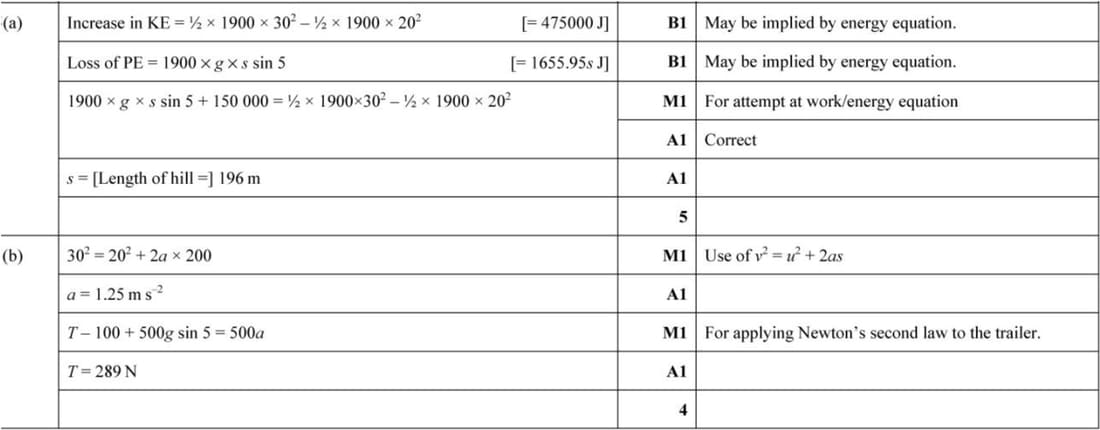
A ball of mass 1.6 kg is released from rest at a point 5 m above horizontal ground. When the ball hits the ground it instantaneously loses 8 J of kinetic energy and starts to move upwards.
(a) Use an energy method to find the greatest height that the ball reaches after hitting the ground.
(b) Find the total time taken, from the initial release of the ball until it reaches this greatest height.
Nov 2021 p42 q5
3499
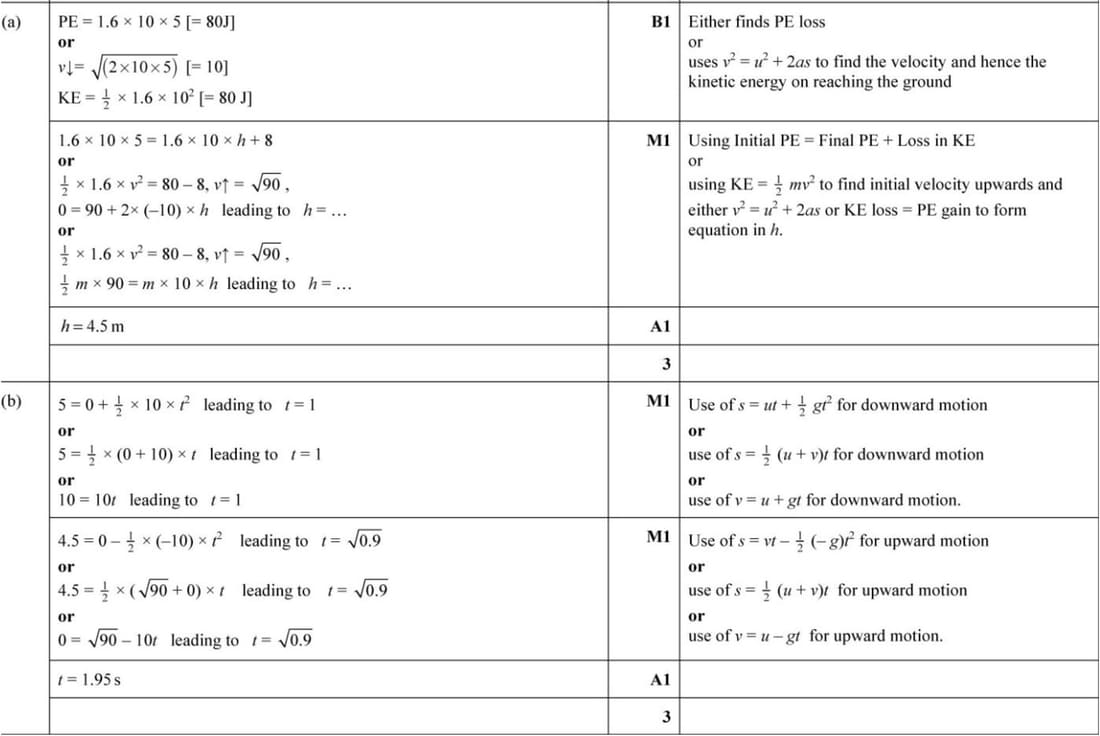
A railway engine of mass 75,000 kg is moving up a straight hill inclined at an angle \(\alpha\) to the horizontal, where \(\sin \alpha = 0.01\). The engine is travelling at a constant speed of 30 m s\(^{-1}\). The engine is working at 960 kW. There is a constant force resisting the motion of the engine.
(a) Find the resistance force.
The engine comes to a section of track which is horizontal. At the start of the section the engine is travelling at 30 m s\(^{-1}\) and the power of the engine is now reduced to 900 kW. The resistance to motion is no longer constant, but in the next 60 s the work done against the resistance force is 46,500 kJ.
(b) Find the speed of the engine at the end of the 60 s.
Nov 2021 p42 q3
3500
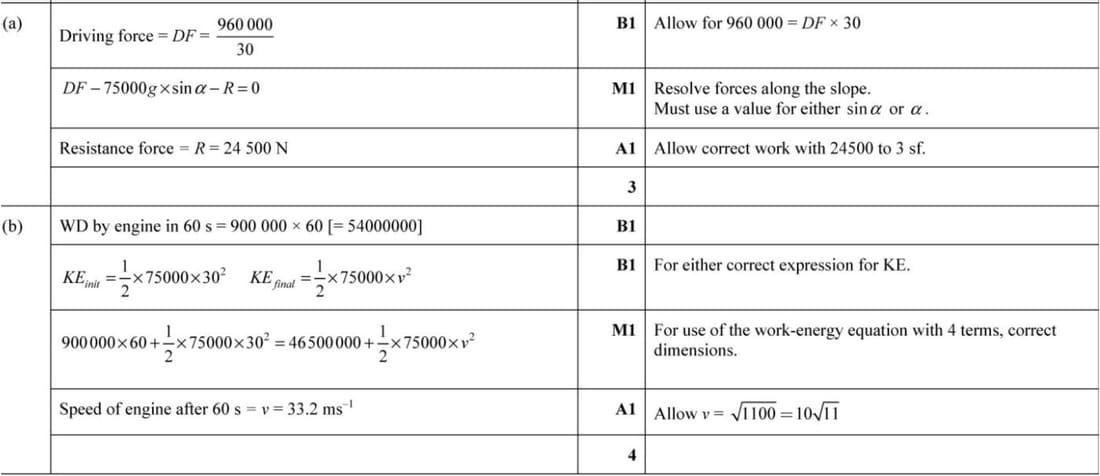
The diagram shows a semi-circular track ABC of radius 1.8 m which is fixed in a vertical plane. The points A and C are at the same horizontal level and the point B is at the bottom of the track. The section AB is smooth and the section BC is rough. A small block is released from rest at A.
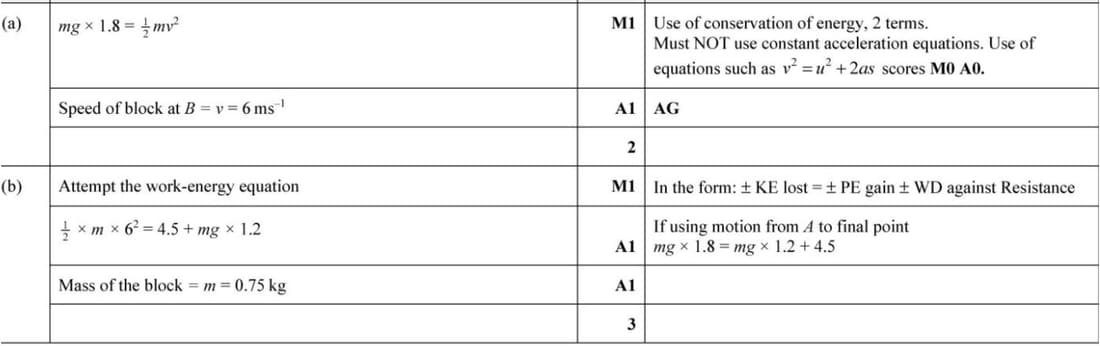
(a) Show that the speed of the block at B is 6 m s-1.
The block comes to instantaneous rest for the first time at a height of 1.2 m above the level of B. The work done against the resistance force during the motion of the block from B to this point is 4.5 J.
(b) Find the mass of the block.
Nov 2021 p41 q5
3501
A car of mass 1600 kg travels at constant speed 20 m s-1 up a straight road inclined at an angle of \(\sin^{-1} 0.12\) to the horizontal.
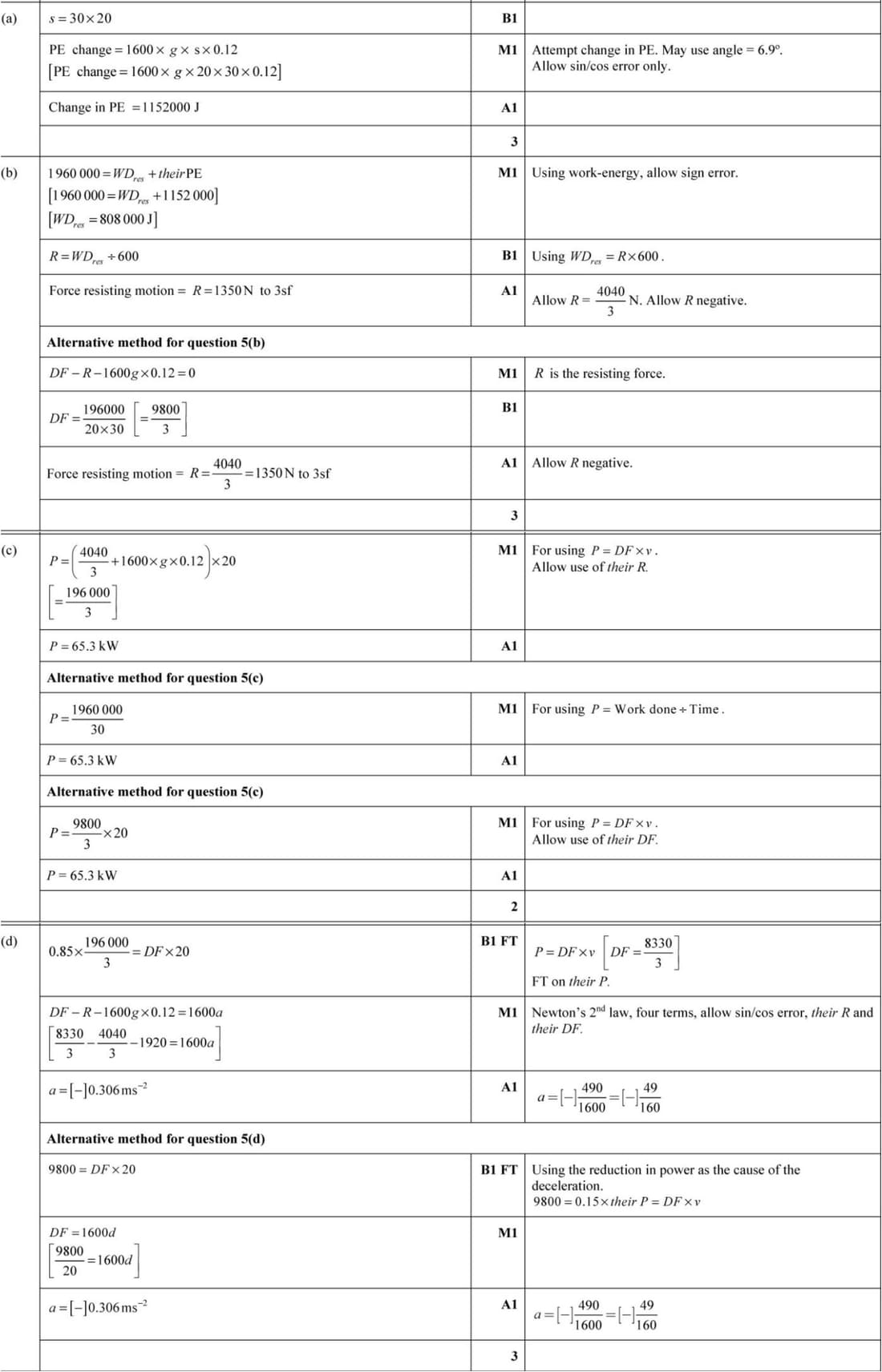
(a) Find the change in potential energy of the car in 30 s.
(b) Given that the total work done by the engine of the car in this time is 1960 kJ, find the constant force resisting the motion.
(c) Calculate, in kW, the power developed by the engine of the car.
(d) Given that this power is suddenly decreased by 15%, find the instantaneous deceleration of the car.
June 2021 p43 q5
3502
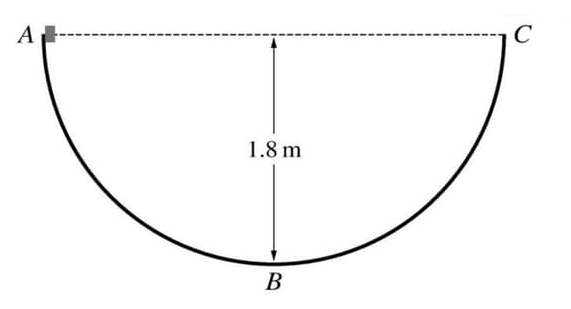
A car of mass 1400 kg is towing a trailer of mass 500 kg down a straight hill inclined at an angle of 5° to the horizontal. The car and trailer are connected by a light rigid tow-bar. At the top of the hill the speed of the car and trailer is 20 m s-1 and at the bottom of the hill their speed is 30 m s-1.
(a) It is given that as the car and trailer descend the hill, the engine of the car does 150,000 J of work, and there are no resistance forces.
Find the length of the hill.
(b) It is given instead that there is a resistance force of 100 N on the trailer, the length of the hill is 200 m, and the acceleration of the car and trailer is constant.
Find the tension in the tow-bar between the car and trailer.