Exam-Style Problems
⬅ Back to SubchapterNov 2021 p43 q1
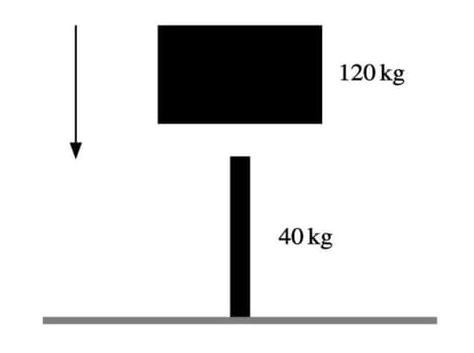
A metal post is driven vertically into the ground by dropping a heavy object onto it from above. The mass of the object is 120 kg and the mass of the post is 40 kg (see diagram). The object hits the post with speed 8 m/s and remains in contact with it after the impact.
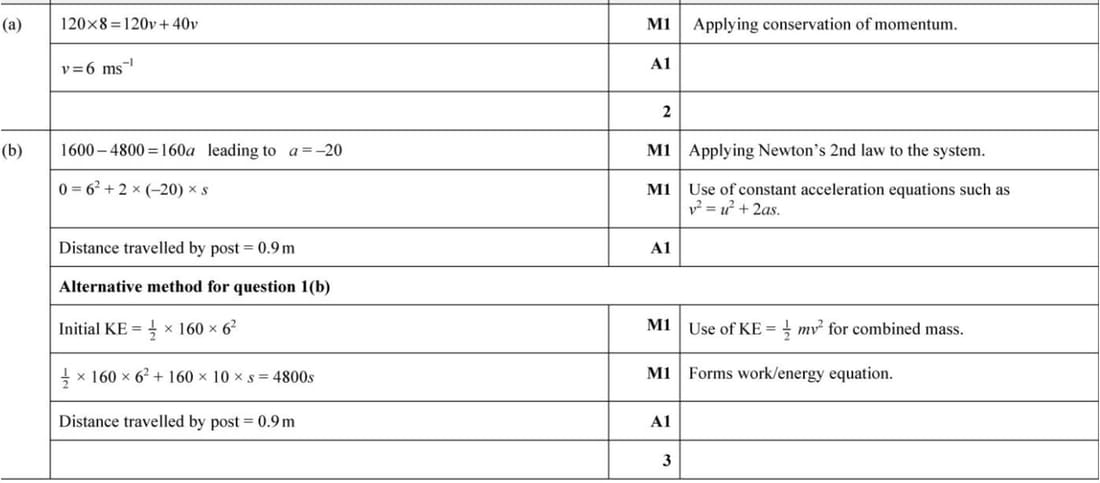
(a) Calculate the speed with which the combined post and object moves immediately after the impact.
(b) There is a constant force resisting the motion of magnitude 4800 N. Calculate the distance the post is driven into the ground.
Nov 2021 p42 q7
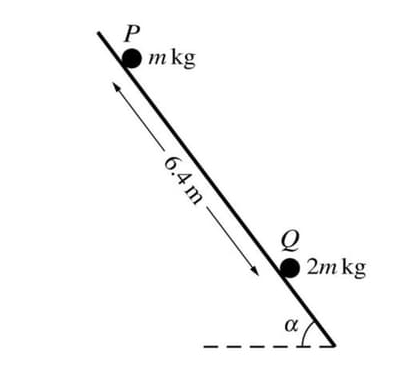
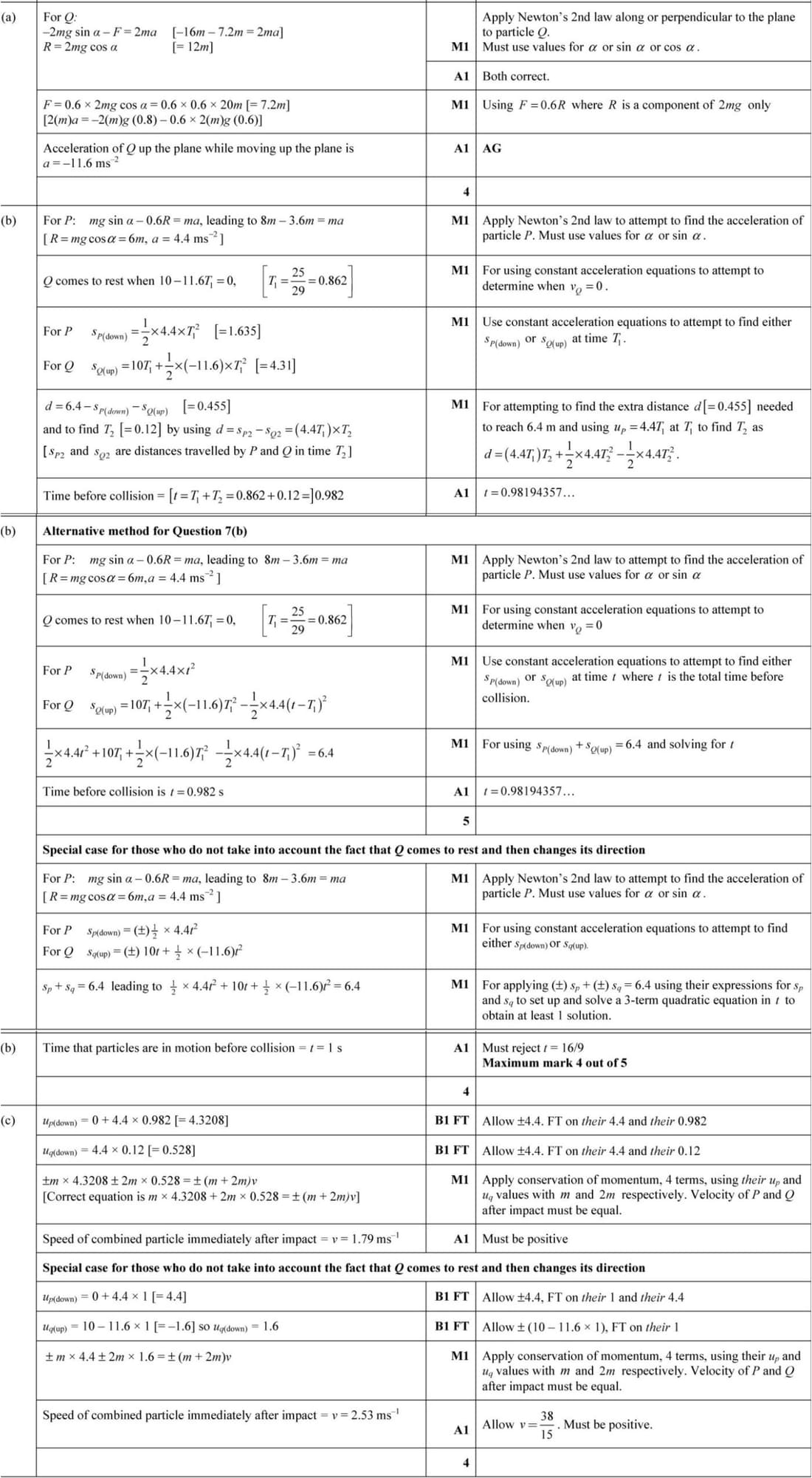
Particles P and Q have masses m kg and 2m kg respectively. The particles are initially held at rest 6.4 m apart on the same line of greatest slope of a rough plane inclined at an angle α to the horizontal, where \\sin α = 0.8\\ (see diagram). Particle P is released from rest and slides down the line of greatest slope. Simultaneously, particle Q is projected up the same line of greatest slope at a speed of 10 m s-1. The coefficient of friction between each particle and the plane is 0.6.
- Show that the acceleration of Q up the plane is \\-11.6\\ m s-2.
- Find the time for which the particles are in motion before they collide.
- The particles coalesce on impact. Find the speed of the combined particle immediately after the impact.
Nov 2021 p41 q2
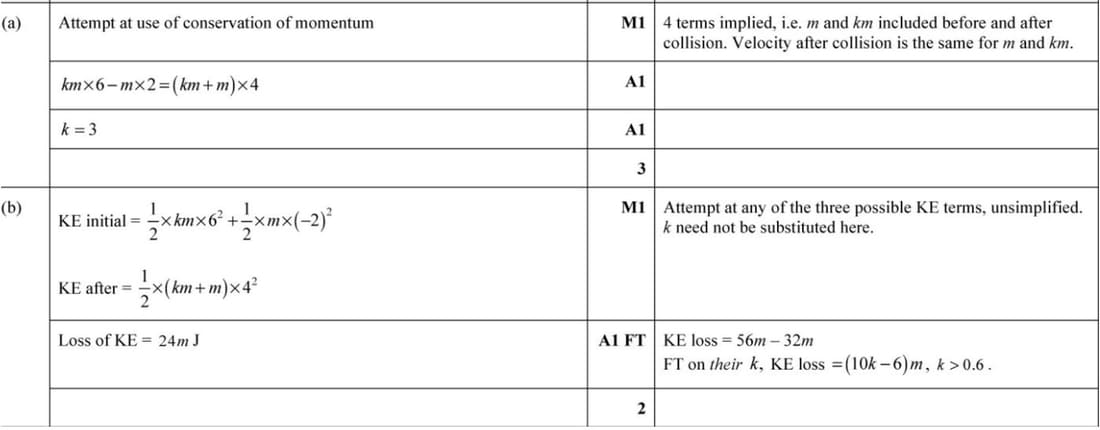
Two small smooth spheres A and B, of equal radii and of masses \(km\) kg and \(m\) kg respectively, where \(k > 1\), are free to move on a smooth horizontal plane. A is moving towards B with speed 6 m s-1 and B is moving towards A with speed 2 m s-1. After the collision A and B coalesce and move with speed 4 m s-1.
- Find \(k\).
- Find, in terms of \(m\), the loss of kinetic energy due to the collision.
June 2021 p43 q1
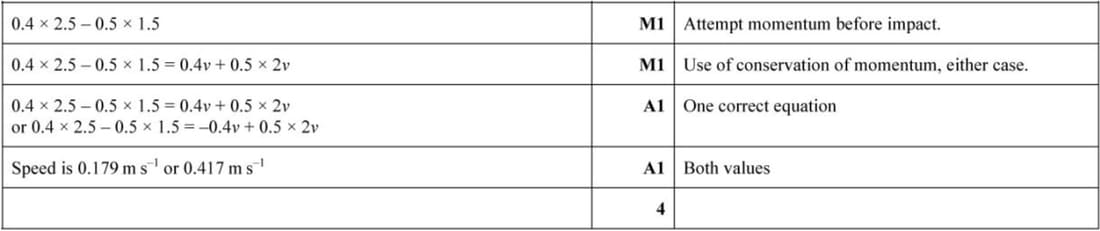
Particles P of mass 0.4 kg and Q of mass 0.5 kg are free to move on a smooth horizontal plane. P and Q are moving directly towards each other with speeds 2.5 m s-1 and 1.5 m s-1 respectively. After P and Q collide, the speed of Q is twice the speed of P.
Find the two possible values of the speed of P after the collision.
June 2021 p42 q6
A particle A is projected vertically upwards from level ground with an initial speed of 30 m s-1. At the same instant a particle B is released from rest 15 m vertically above A. The mass of one of the particles is twice the mass of the other particle. During the subsequent motion A and B collide and coalesce to form particle C.
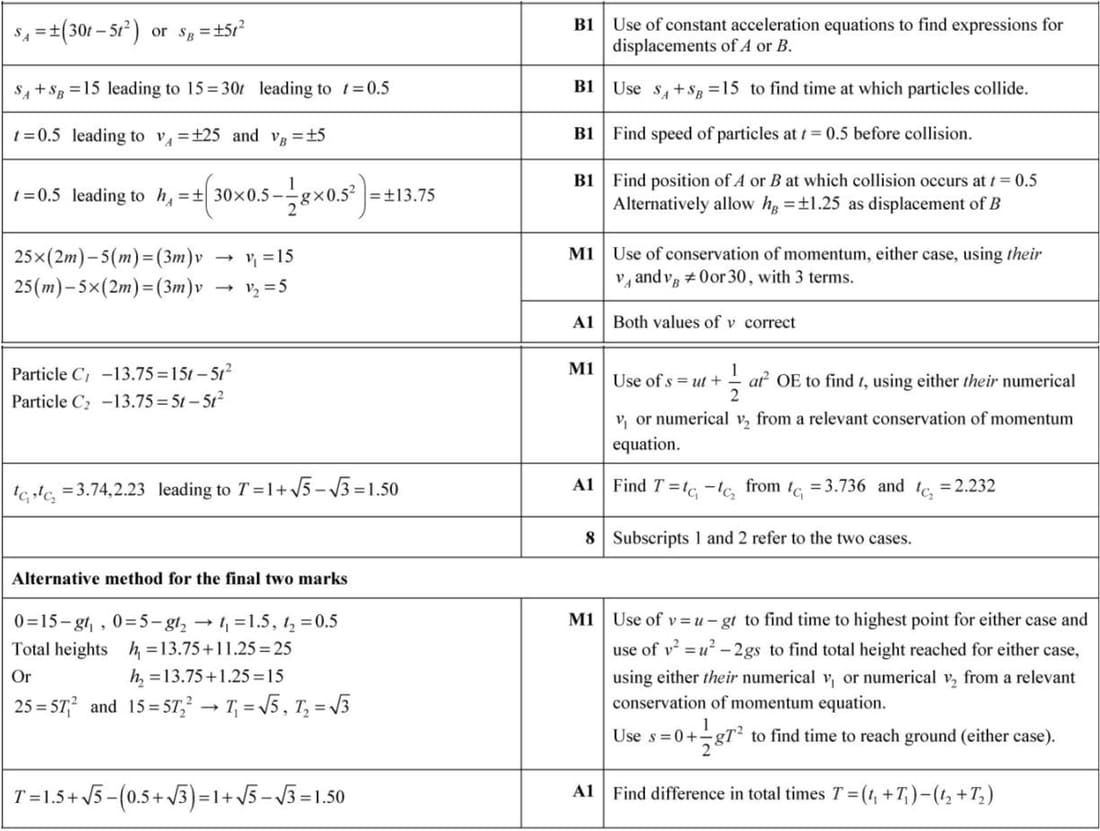
Find the difference between the two possible times at which C hits the ground.