Exam-Style Problems
⬅ Back to SubchapterNov 2012 p41 q5
Particle P travels along a straight line from A to B with constant acceleration 0.05 m s-2. Its speed at A is 2 m s-1 and its speed at B is 5 m s-1.
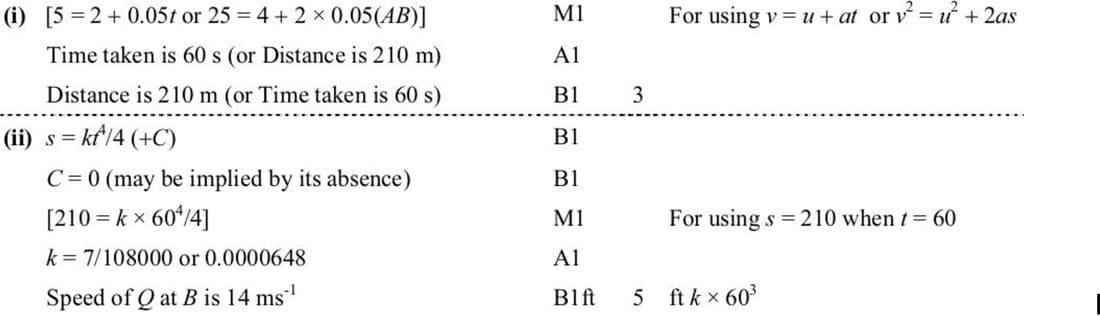
(i) Find the time taken for P to travel from A to B, and find also the distance AB.
Particle Q also travels along the same straight line from A to B, starting from rest at A. At time t s after leaving A, the speed of Q is kt3 m s-1, where k is a constant. Q takes the same time to travel from A to B as P does.
(ii) Find the value of k and find Q's speed at B.
June 2011 p42 q7
A walker travels along a straight road passing through the points A and B on the road with speeds 0.9 m s-1 and 1.3 m s-1 respectively. The walker’s acceleration between A and B is constant and equal to 0.004 m s-2.
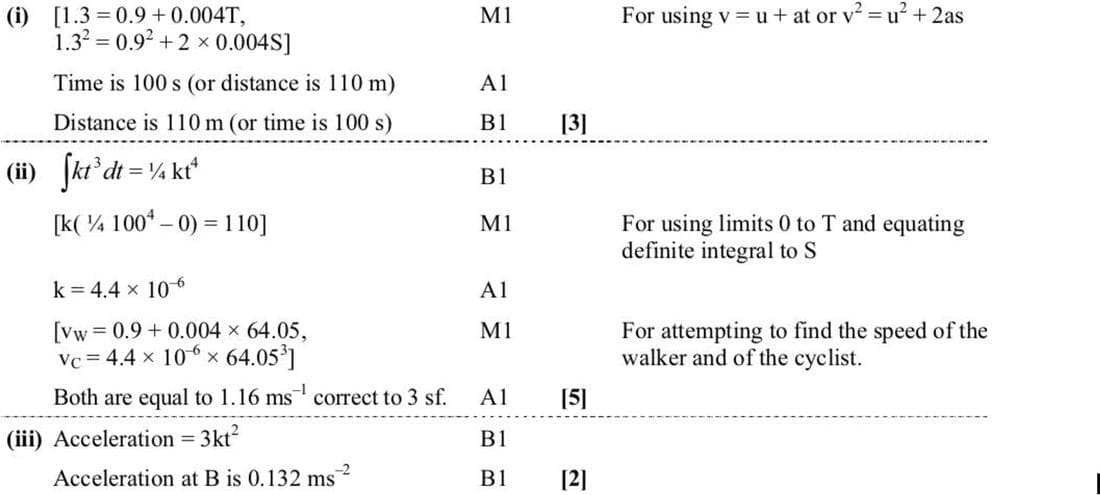
- Find the time taken by the walker to travel from A to B, and find the distance AB.
A cyclist leaves A at the same instant as the walker. She starts from rest and travels along the straight road, passing through B at the same instant as the walker. At time t s after leaving A the cyclist’s speed is kt3 m s-1, where k is a constant.
- Show that when t = 64.05 the speed of the walker and the speed of the cyclist are the same, correct to 3 significant figures.
- Find the cyclist’s acceleration at the instant she passes through B.
Nov 2010 p41 q4
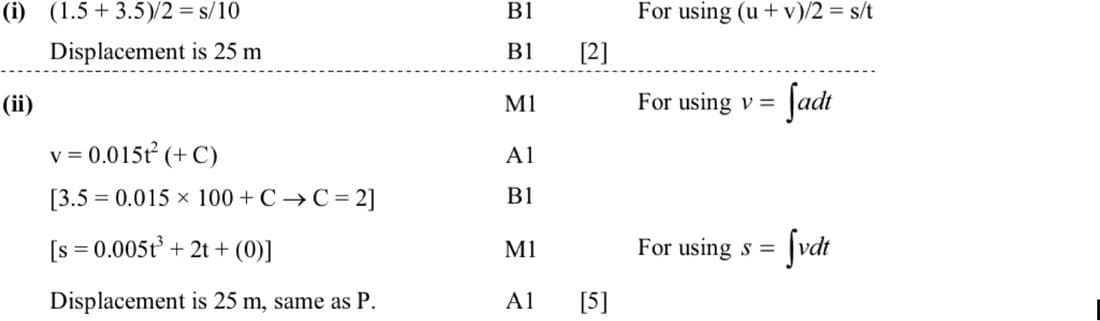
A particle P starts from a fixed point O at time t = 0, where t is in seconds, and moves with constant acceleration in a straight line. The initial velocity of P is 1.5 m s-1 and its velocity when t = 10 is 3.5 m s-1.
- Find the displacement of P from O when t = 10.
Another particle Q also starts from O when t = 0 and moves along the same straight line as P. The acceleration of Q at time t is 0.03t m s-2.
- Given that Q has the same velocity as P when t = 10, show that it also has the same displacement from O as P when t = 10.
Nov 2007 p4 q6
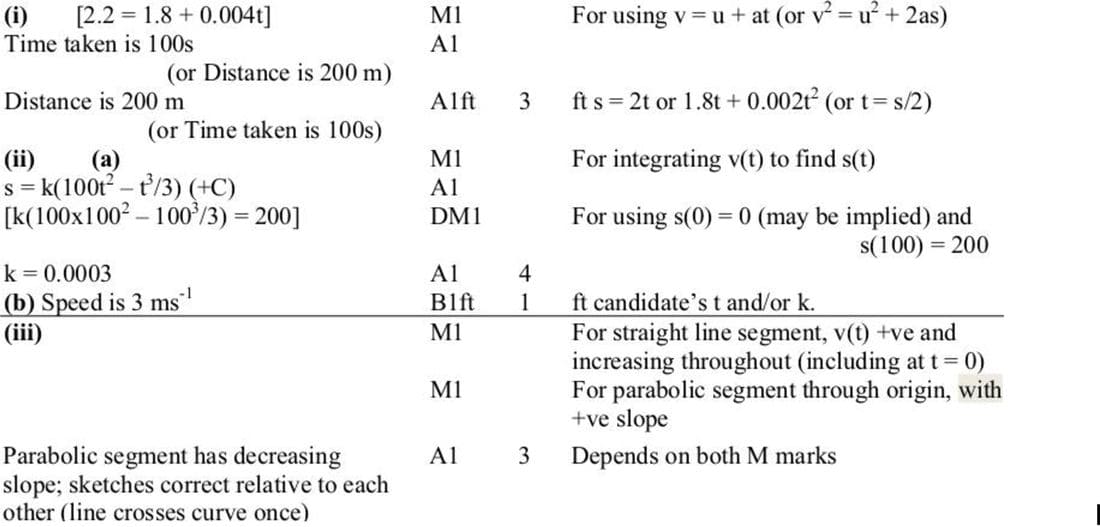
(i) A man walks in a straight line from A to B with constant acceleration 0.004 m s-2. His speed at A is 1.8 m s-1 and his speed at B is 2.2 m s-1. Find the time taken for the man to walk from A to B, and find the distance AB.
(ii) A woman cyclist leaves A at the same instant as the man. She starts from rest and travels in a straight line to B, reaching B at the same instant as the man. At time t s after leaving A the cyclist’s speed is k(200t − t2) m s-1, where k is a constant. Find
- the value of k,
- the cyclist’s speed at B.
(iii) Sketch, using the same axes, the velocity-time graphs for the man’s motion and the woman’s motion from A to B.
June 2007 p4 q6
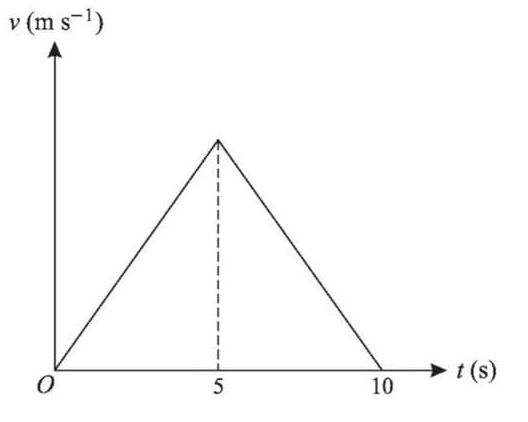
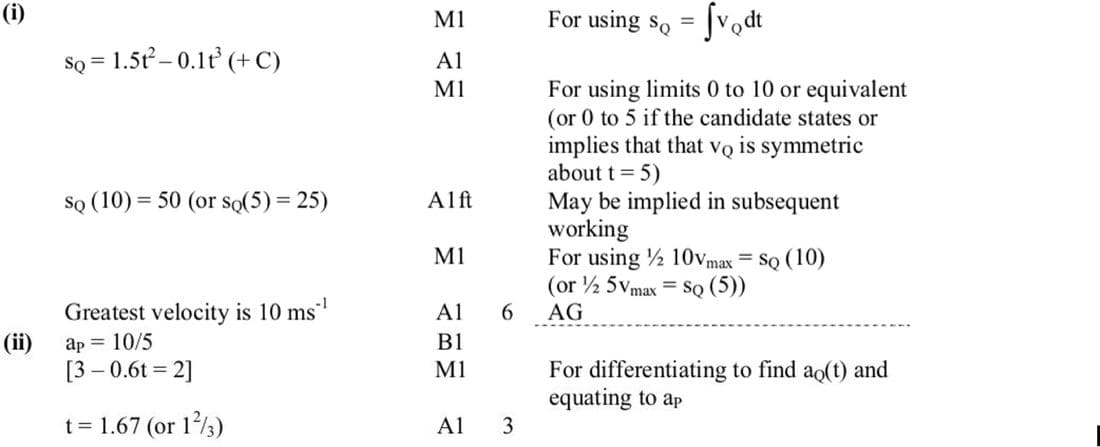
A particle P starts from rest at the point A and travels in a straight line, coming to rest again after 10 s. The velocity-time graph for P consists of two straight line segments (see diagram). A particle Q starts from rest at A at the same instant as P and travels along the same straight line as P. The velocity of Q is given by \(v = 3t - 0.3t^2\) for \(0 \leq t \leq 10\). The displacements from A of P and Q are the same when \(t = 10\).
- Show that the greatest velocity of P during its motion is 10 m s-1.
- Find the value of \(t\), in the interval \(0 < t < 5\), for which the acceleration of Q is the same as the acceleration of P.