Exam-Style Problems
⬅ Back to SubchapterJune 2018 p41 q7
3889
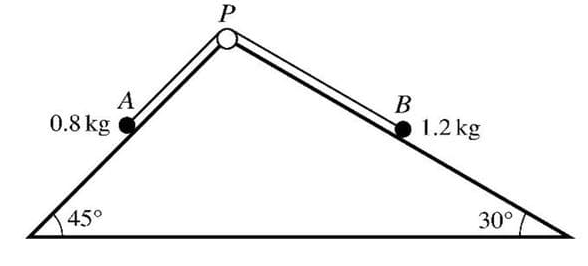
The diagram shows a triangular block with sloping faces inclined to the horizontal at 45° and 30°. Particle A of mass 0.8 kg lies on the face inclined at 45° and particle B of mass 1.2 kg lies on the face inclined at 30°. The particles are connected by a light inextensible string which passes over a small smooth pulley P fixed at the top of the faces. The parts AP and BP of the string are parallel to lines of greatest slope of the respective faces. The particles are released from rest with both parts of the string taut. In the subsequent motion neither particle reaches the pulley and neither particle reaches the bottom of a face.
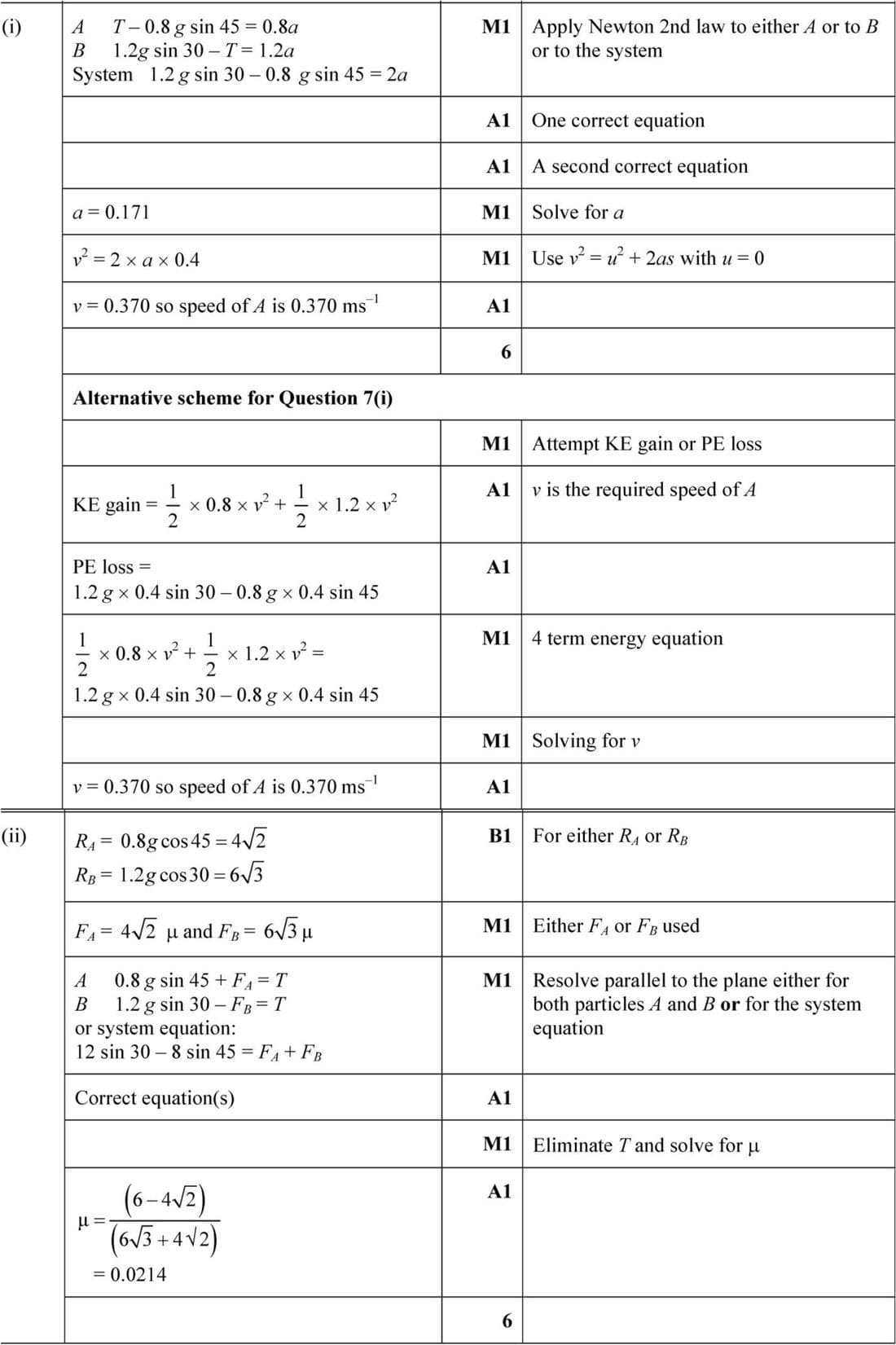
- Given that both faces are smooth, find the speed of A after each particle has travelled a distance of 0.4 m.
- It is given instead that both faces are rough. The coefficient of friction between each particle and a face of the block is \(\mu\). Find the value of \(\mu\) for which the system is in limiting equilibrium.
Nov 2017 p41 q7
3890
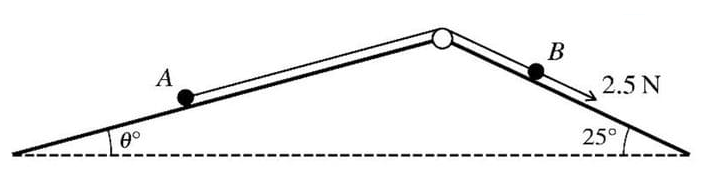
Two particles A and B of masses 0.9 kg and 0.4 kg respectively are attached to the ends of a light inextensible string. The string passes over a fixed smooth pulley which is attached to the top of two inclined planes. The particles are initially at rest with A on a smooth plane inclined at angle θ° to the horizontal and B on a plane inclined at angle 25° to the horizontal. The string is taut and the particles can move on lines of greatest slope of the two planes. A force of magnitude 2.5 N is applied to B acting down the plane (see diagram).
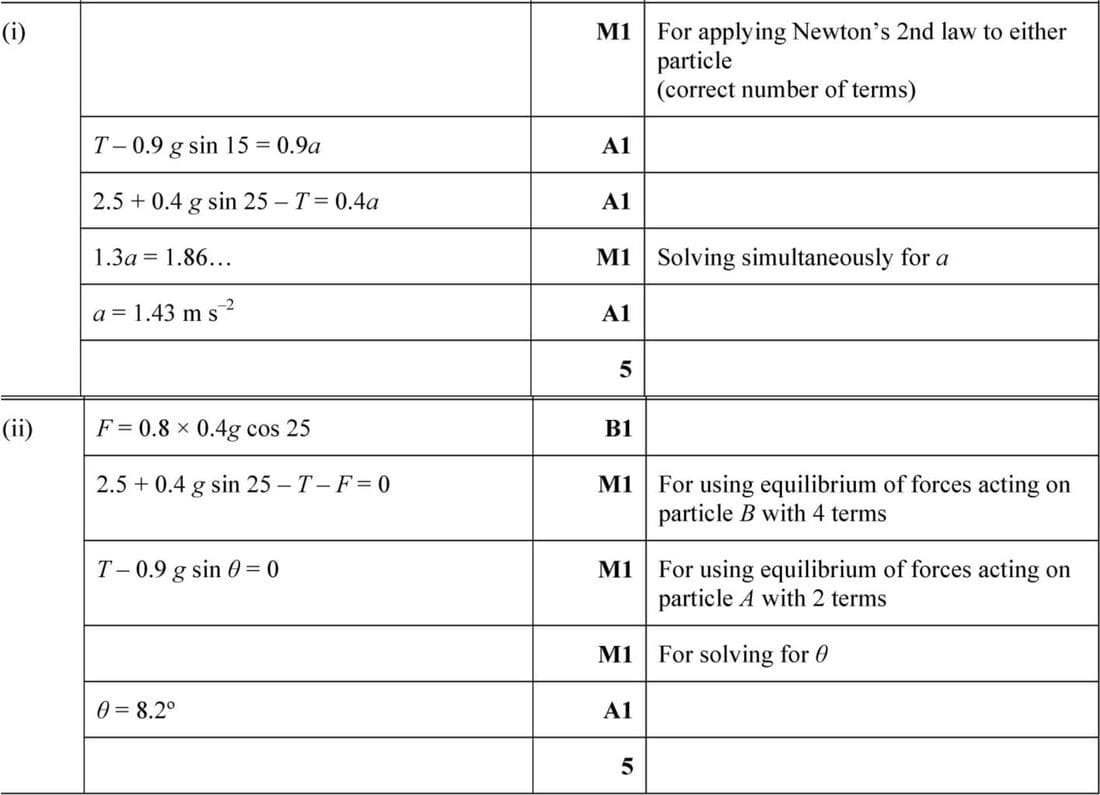
- For the case where θ = 15 and the plane on which B rests is smooth, find the acceleration of B.
- For a different value of θ, the plane on which B rests is rough with coefficient of friction between the plane and B of 0.8. The system is in limiting equilibrium with B on the point of moving in the direction of the 2.5 N force. Find the value of θ.
June 2017 p41 q7
3891
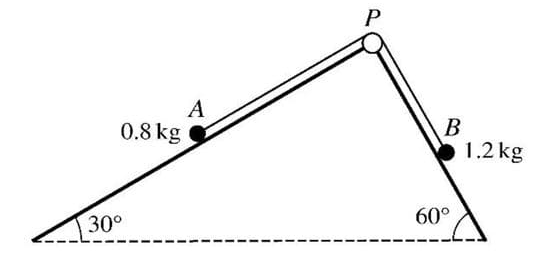
As shown in the diagram, a particle A of mass 0.8 kg lies on a plane inclined at an angle of 30° to the horizontal and a particle B of mass 1.2 kg lies on a plane inclined at an angle of 60° to the horizontal. The particles are connected by a light inextensible string which passes over a small smooth pulley P fixed at the top of the planes. The parts AP and BP of the string are parallel to lines of greatest slope of the respective planes. The particles are released from rest with both parts of the string taut.
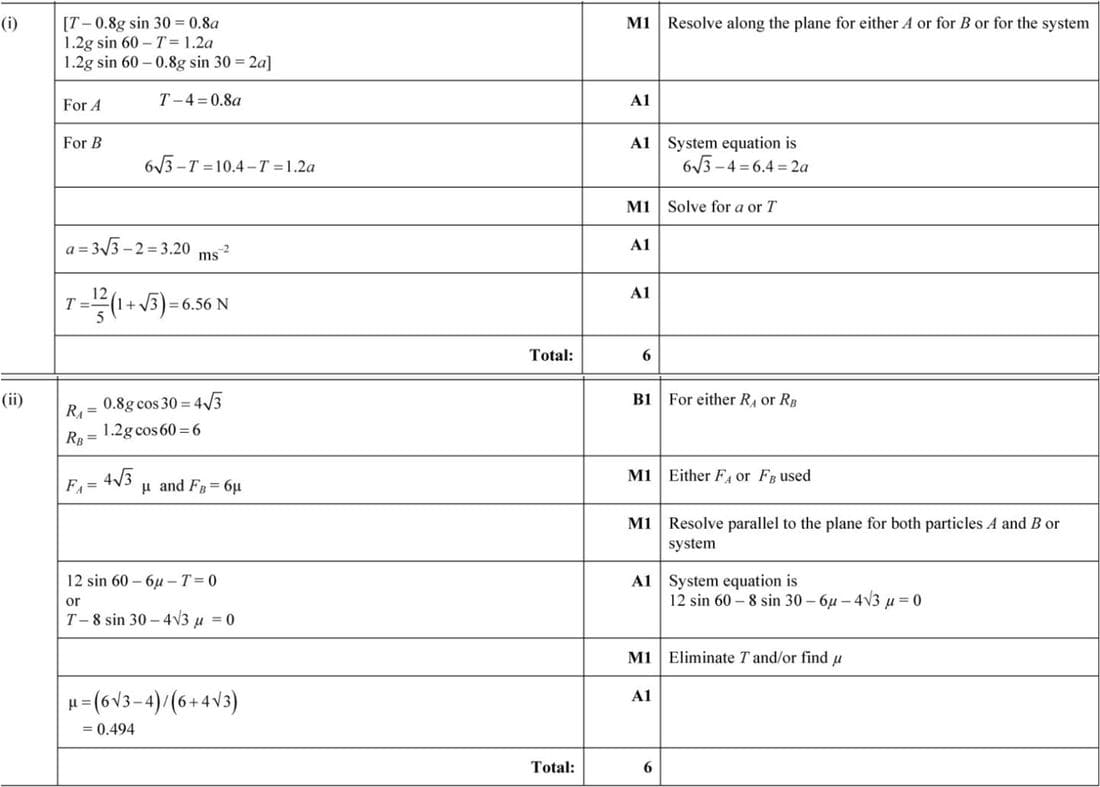
- Given that both planes are smooth, find the acceleration of A and the tension in the string. [6]
- It is given instead that both planes are rough, with the same coefficient of friction, μ, for both particles. Find the value of μ for which the system is in limiting equilibrium. [6]
Nov 2014 p43 q2
3892
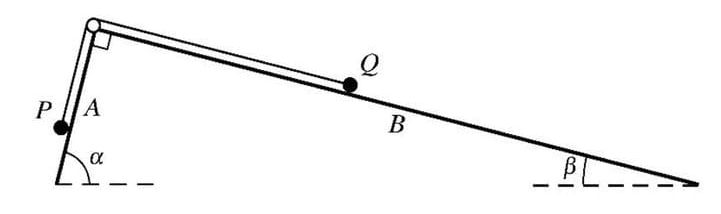
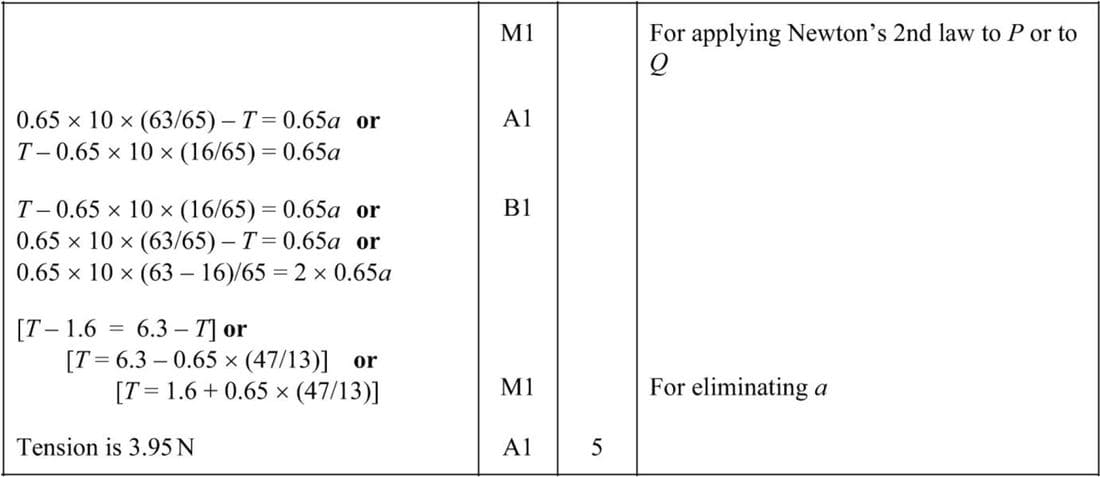
The tops of each of two smooth inclined planes A and B meet at a right angle. Plane A is inclined at angle \(\alpha\) to the horizontal and plane B is inclined at angle \(\beta\) to the horizontal, where \(\sin \alpha = \frac{63}{65}\) and \(\sin \beta = \frac{16}{65}\). A small smooth pulley is fixed at the top of the planes and a light inextensible string passes over the pulley. Two particles P and Q, each of mass 0.65 kg, are attached to the string, one at each end. Particle Q is held at rest at a point of the same line of greatest slope of the plane B as the pulley. Particle P rests freely below the pulley in contact with plane A (see diagram). Particle Q is released and the particles start to move with the string taut. Find the tension in the string.
June 2012 p41 q6
3893
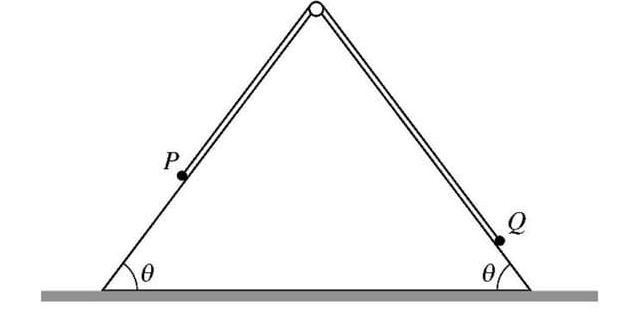
Particles P and Q, of masses 0.6 kg and 0.4 kg respectively, are attached to the ends of a light inextensible string. The string passes over a small smooth pulley which is fixed at the top of a vertical cross-section of a triangular prism. The base of the prism is fixed on horizontal ground and each of the sloping sides is smooth. Each sloping side makes an angle θ with the ground, where \\sin θ = 0.8\\. Initially the particles are held at rest on the sloping sides, with the string taut (see diagram). The particles are released and move along lines of greatest slope.
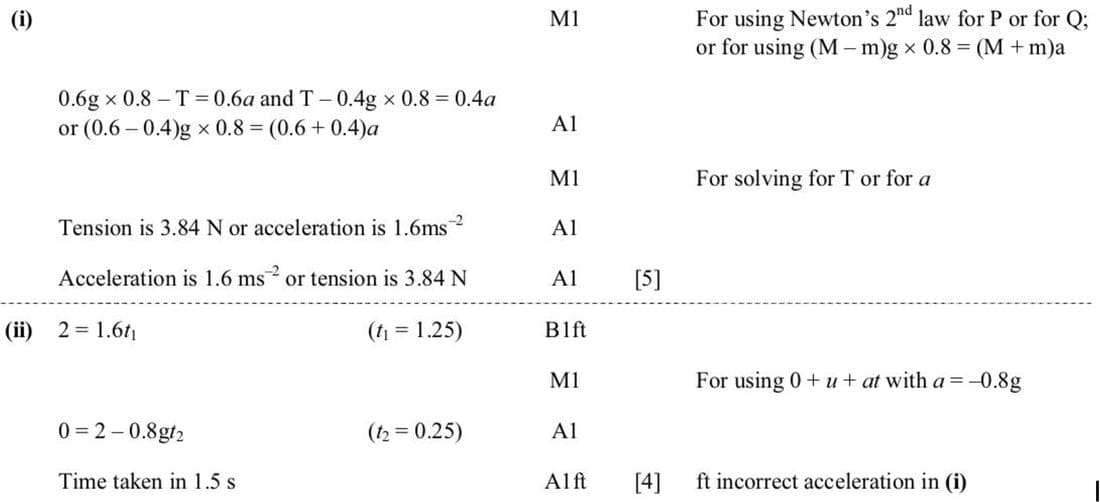
- Find the tension in the string and the acceleration of the particles while both are moving. [5]
The speed of P when it reaches the ground is 2 m s-1. On reaching the ground P comes to rest and remains at rest. Q continues to move up the slope but does not reach the pulley.
- Find the time taken from the instant that the particles are released until Q reaches its greatest height above the ground. [4]