Exam-Style Problems
⬅ Back to SubchapterNov 2010 p42 q1
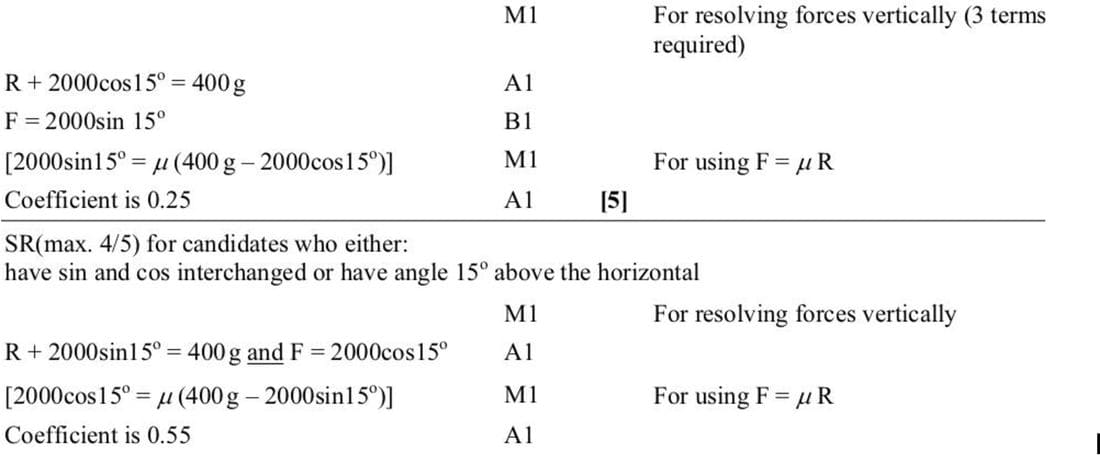
A block of mass 400 kg rests in limiting equilibrium on horizontal ground. A force of magnitude 2000 N acts on the block at an angle of 15° to the upwards vertical. Find the coefficient of friction between the block and the ground, correct to 2 significant figures.
June 2007 p4 q7
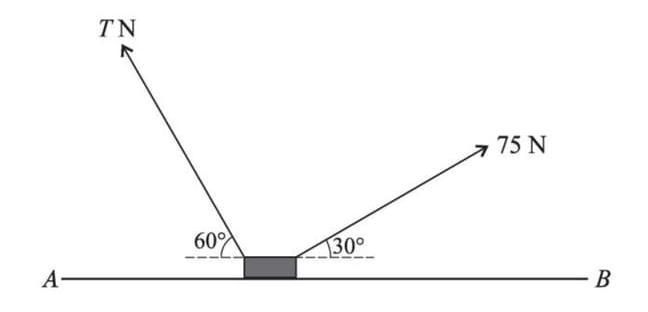
Two light strings are attached to a block of mass 20 kg. The block is in equilibrium on a horizontal surface AB with the strings taut. The strings make angles of 60° and 30° with the horizontal, on either side of the block, and the tensions in the strings are T N and 75 N respectively (see diagram).
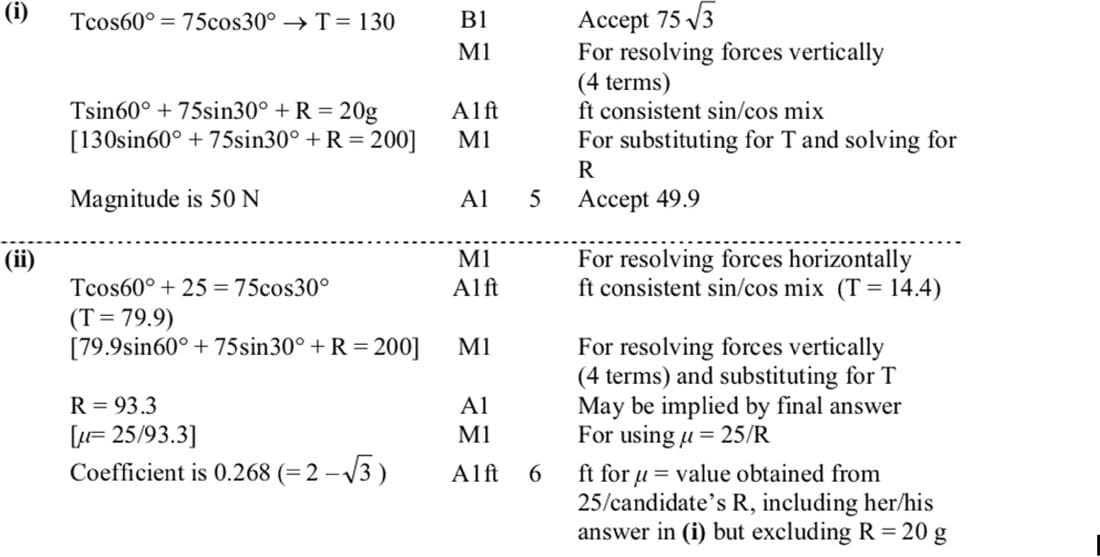
(i) Given that the surface is smooth, find the value of T and the magnitude of the contact force acting on the block.
(ii) It is given instead that the surface is rough and that the block is on the point of slipping. The frictional force on the block has magnitude 25 N and acts towards A. Find the coefficient of friction between the block and the surface.
Nov 2023 p42 q4
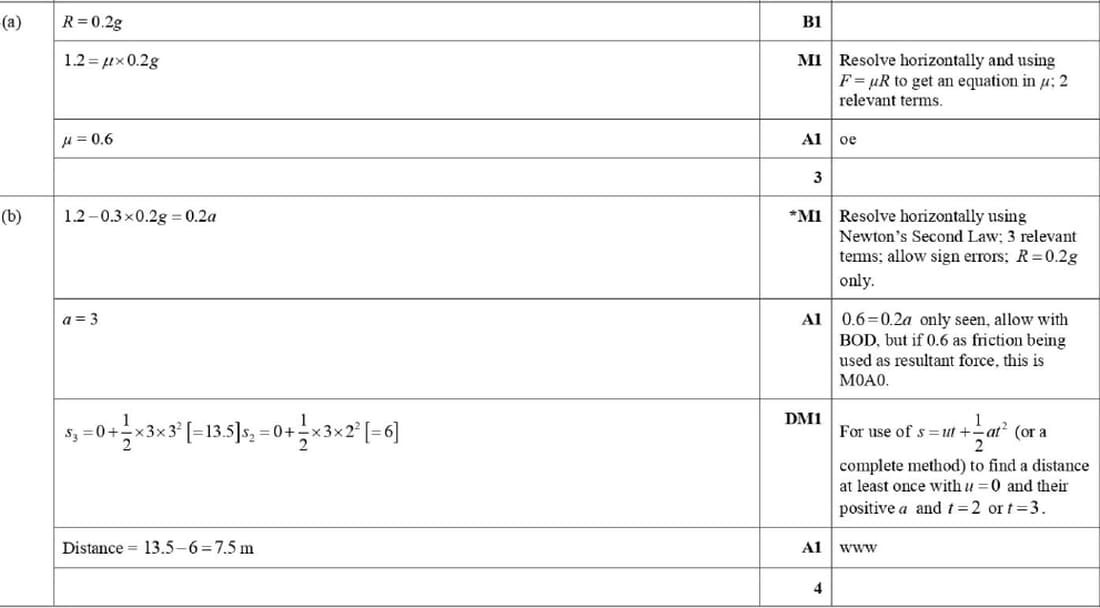
A particle P of mass 0.2 kg lies at rest on a rough horizontal plane. A horizontal force of 1.2 N is applied to P.
(a) Given that P is in limiting equilibrium, find the coefficient of friction between P and the plane.
(b) Given instead that the coefficient of friction between P and the plane is 0.3, find the distance travelled by P in the third second of its motion.
Nov 2016 p42 q1
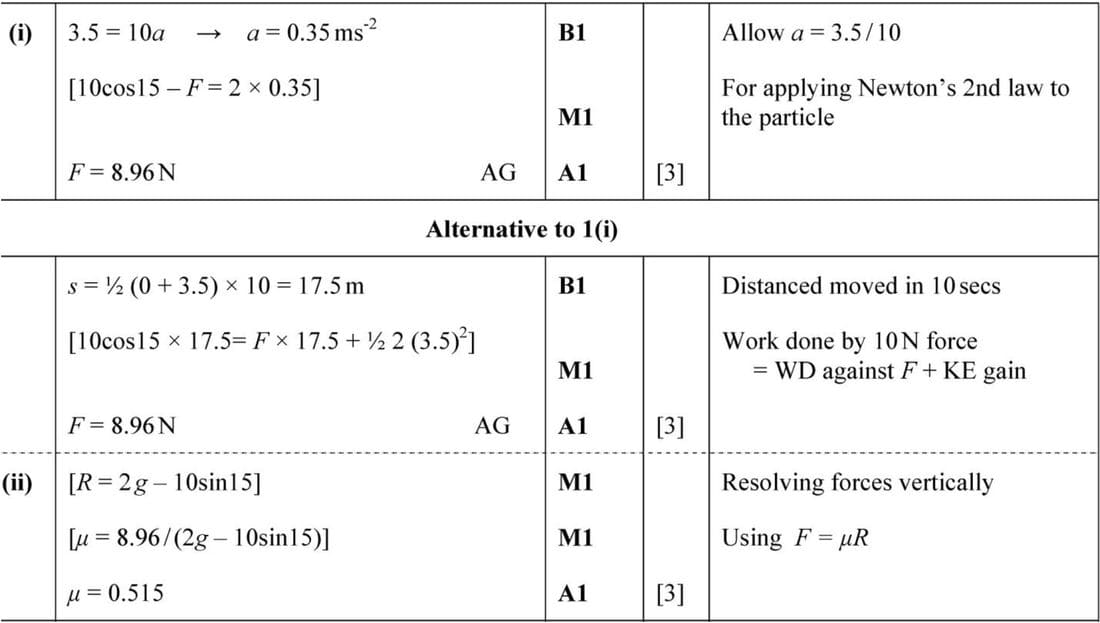
A particle of mass 2 kg is initially at rest on a rough horizontal plane. A force of magnitude 10 N is applied to the particle at 15° above the horizontal. It is given that 10 s after the force is applied, the particle has a speed of 3.5 m s-1.
(i) Show that the magnitude of the frictional force is 8.96 N, correct to 3 significant figures.
(ii) Find the coefficient of friction between the particle and the plane.
Feb/Mar 2016 p42 q4
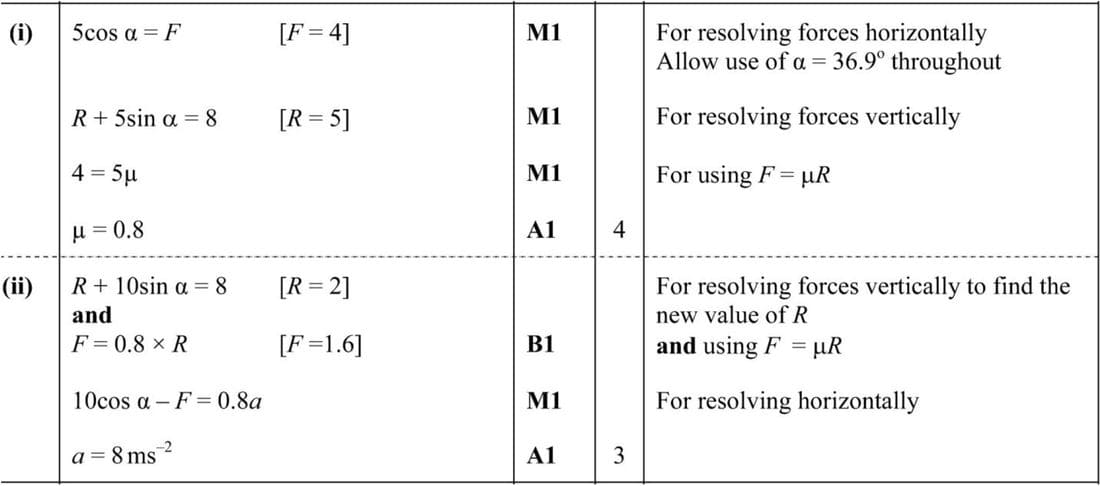
A particle P of mass 0.8 kg is placed on a rough horizontal table. The coefficient of friction between P and the table is \(\mu\). A force of magnitude 5 N, acting upwards at an angle \(\alpha\) above the horizontal, where \(\tan \alpha = \frac{3}{4}\), is applied to P. The particle is on the point of sliding on the table.
(i) Find the value of \(\mu\).
(ii) The magnitude of the force acting on P is increased to 10 N, with the direction of the force remaining the same. Find the acceleration of P.