Exam-Style Problems
⬅ Back to SubchapterNov 2014 p43 q3
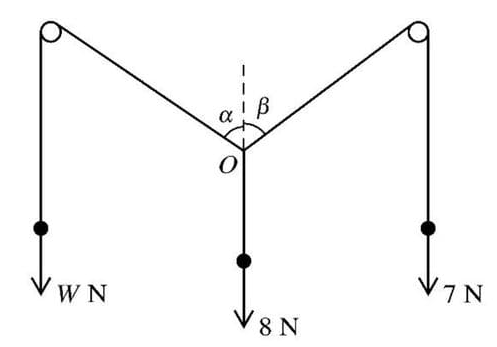
Each of three light inextensible strings has a particle attached to one of its ends. The other ends of the strings are tied together at a point O. Two of the strings pass over fixed smooth pegs and the particles hang freely in equilibrium. The weights of the particles and the angles between the sloping parts of the strings and the vertical are as shown in the diagram. It is given that \(\sin \beta = 0.8\) and \(\cos \beta = 0.6\).
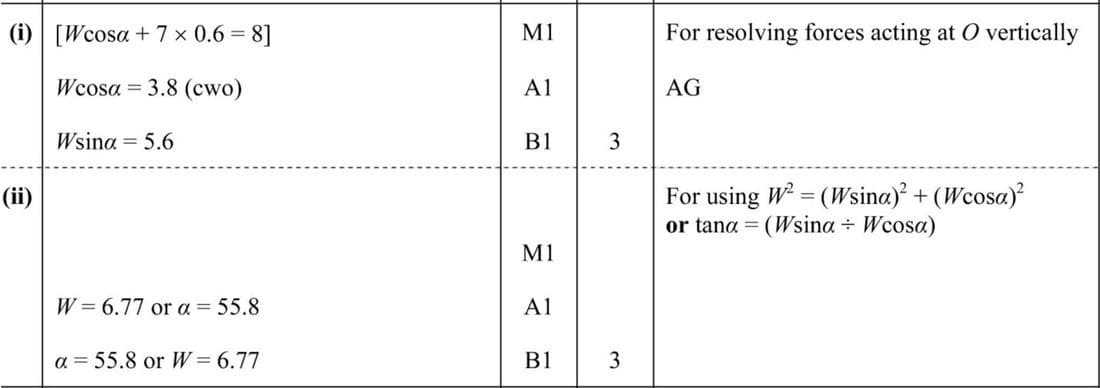
(i) Show that \(W \cos \alpha = 3.8\) and find the value of \(W \sin \alpha\).
(ii) Hence find the values of \(W\) and \(\alpha\).
June 2014 p43 q3
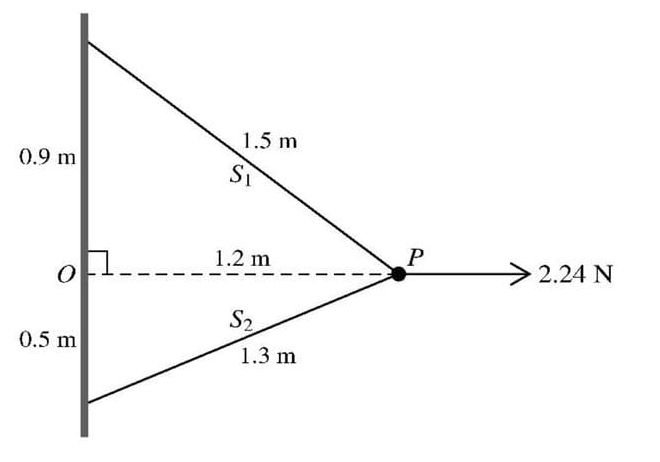
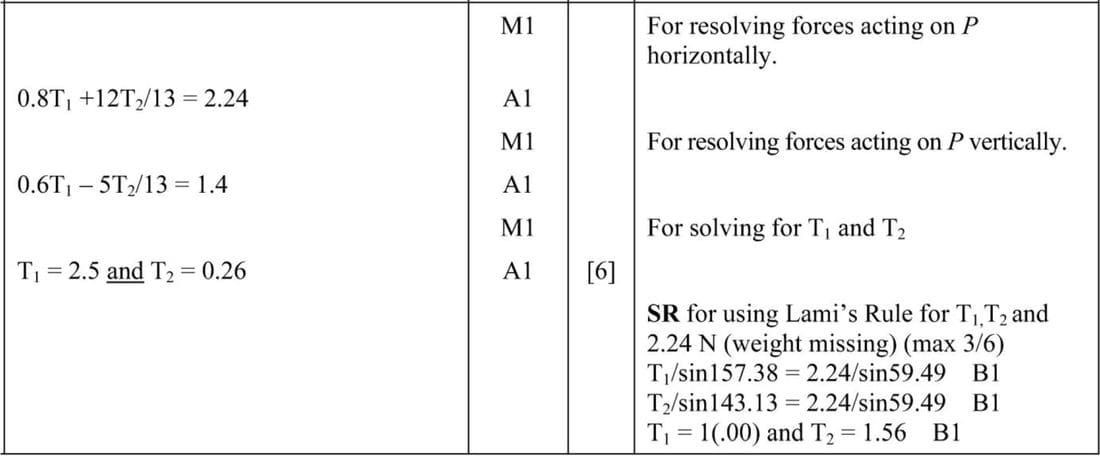
A particle P of weight 1.4 N is attached to one end of a light inextensible string S1 of length 1.5 m, and to one end of another light inextensible string S2 of length 1.3 m. The other end of S1 is attached to a wall at the point 0.9 m vertically above a point O of the wall. The other end of S2 is attached to the wall at the point 0.5 m vertically below O. The particle is held in equilibrium, at the same horizontal level as O, by a horizontal force of magnitude 2.24 N acting away from the wall and perpendicular to it (see diagram). Find the tensions in the strings.
June 2014 p42 q3
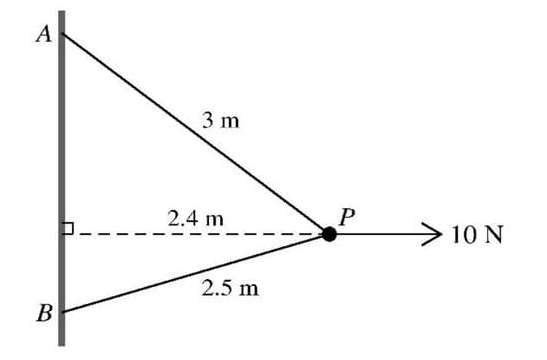
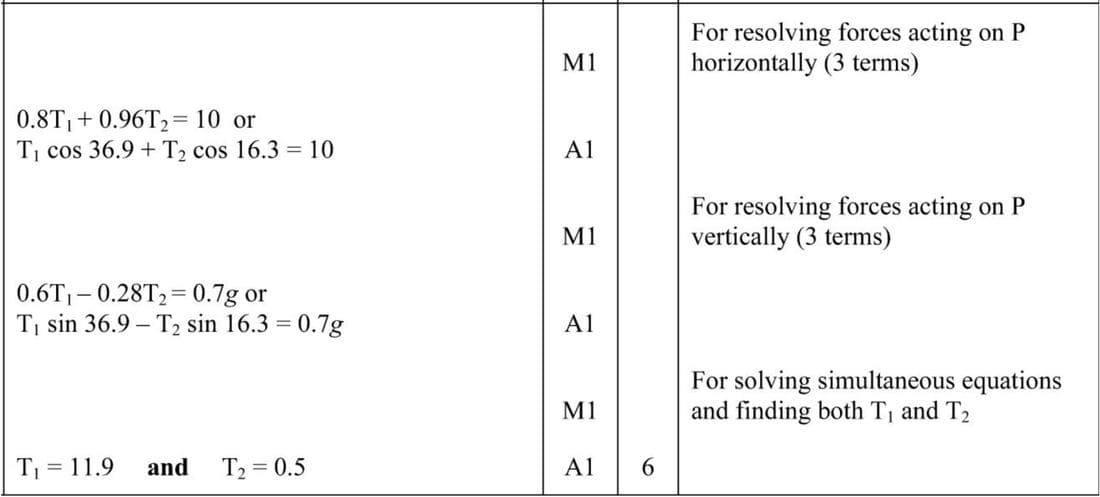
A and B are fixed points of a vertical wall with A vertically above B. A particle P of mass 0.7 kg is attached to A by a light inextensible string of length 3 m. P is also attached to B by a light inextensible string of length 2.5 m. P is maintained in equilibrium at a distance of 2.4 m from the wall by a horizontal force of magnitude 10 N acting on P (see diagram). Both strings are taut, and the 10 N force acts in the plane APB which is perpendicular to the wall. Find the tensions in the strings.
Nov 2013 p43 q3
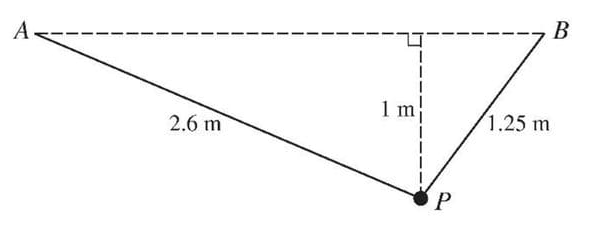
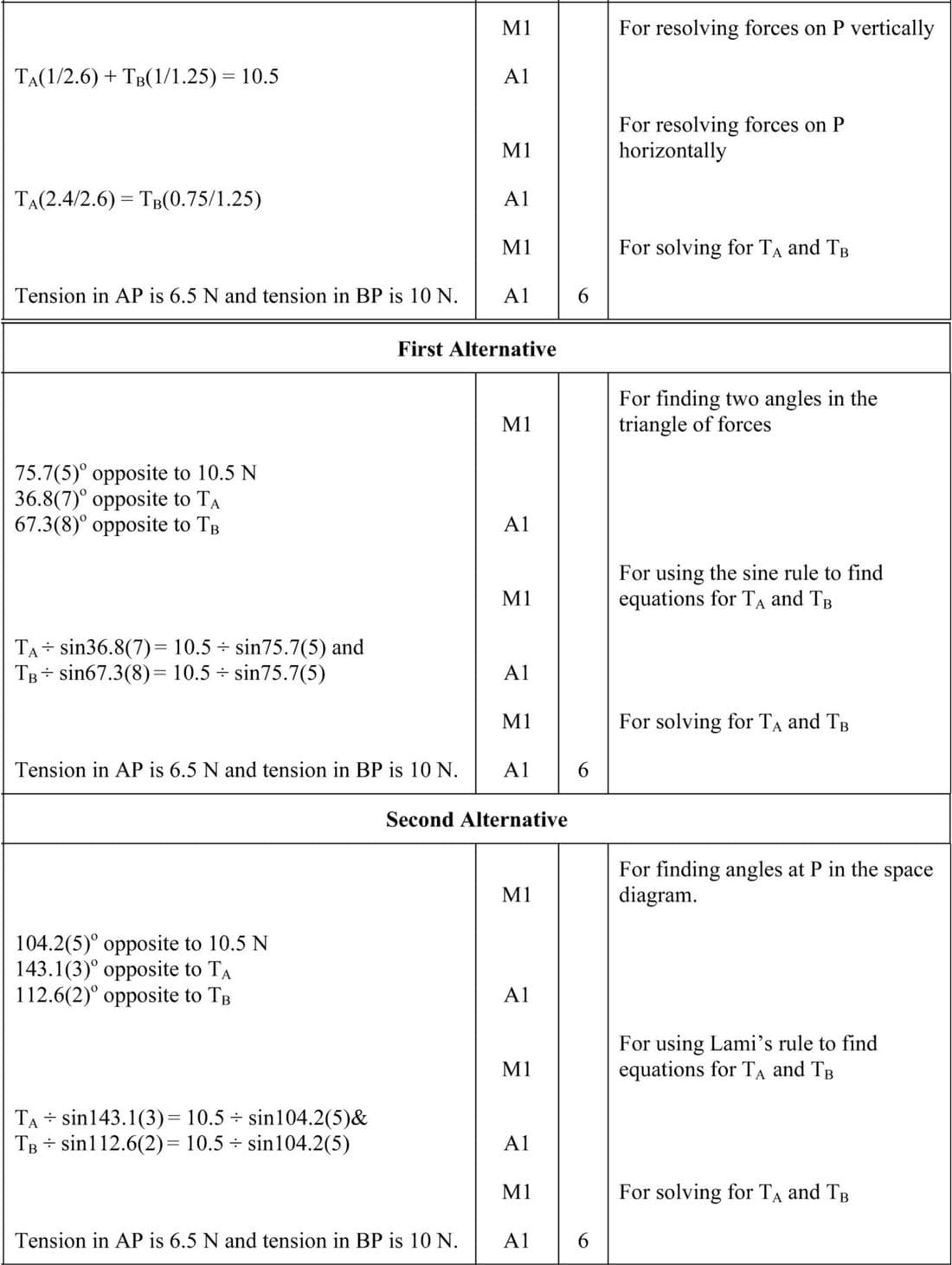
A particle P of mass 1.05 kg is attached to one end of each of two light inextensible strings, of lengths 2.6 m and 1.25 m. The other ends of the strings are attached to fixed points A and B, which are at the same horizontal level. P hangs in equilibrium at a point 1 m below the level of A and B (see diagram). Find the tensions in the strings.
Nov 2013 p41 q1
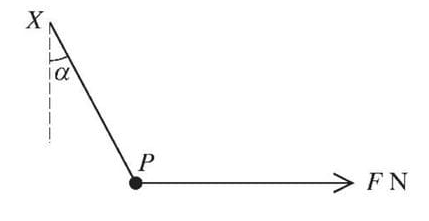
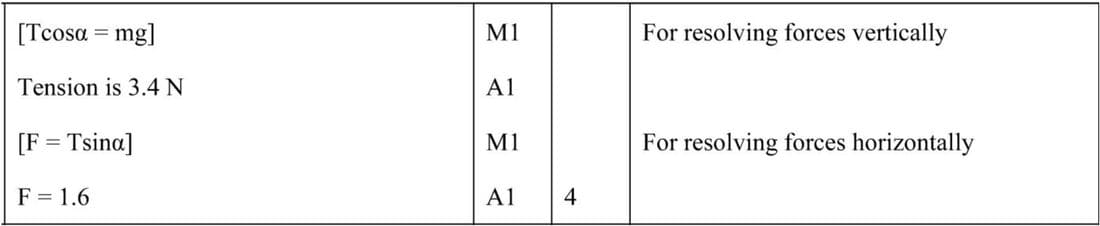
A particle P of mass 0.3 kg is attached to one end of a light inextensible string. The other end of the string is attached to a fixed point X. A horizontal force of magnitude F N is applied to the particle, which is in equilibrium when the string is at an angle α to the vertical, where \(\tan \alpha = \frac{8}{15}\) (see diagram). Find the tension in the string and the value of F.