Exam-Style Problems
⬅ Back to SubchapterNov 2020 p53 q6
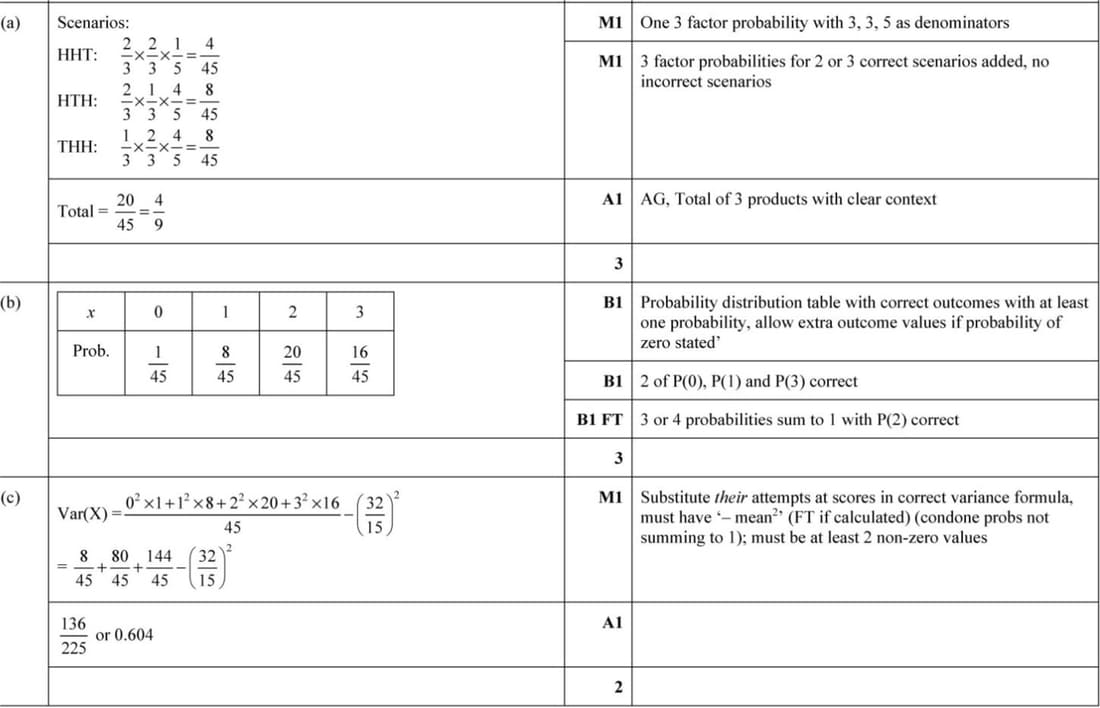
Three coins A, B and C are each thrown once.
- Coins A and B are each biased so that the probability of obtaining a head is \(\frac{2}{3}\).
- Coin C is biased so that the probability of obtaining a head is \(\frac{4}{5}\).
(a) Show that the probability of obtaining exactly 2 heads and 1 tail is \(\frac{4}{9}\).
The random variable \(X\) is the number of heads obtained when the three coins are thrown.
(b) Draw up the probability distribution table for \(X\).
(c) Given that \(\text{E}(X) = \frac{32}{15}\), find \(\text{Var}(X)\).
Nov 2020 p52 q2
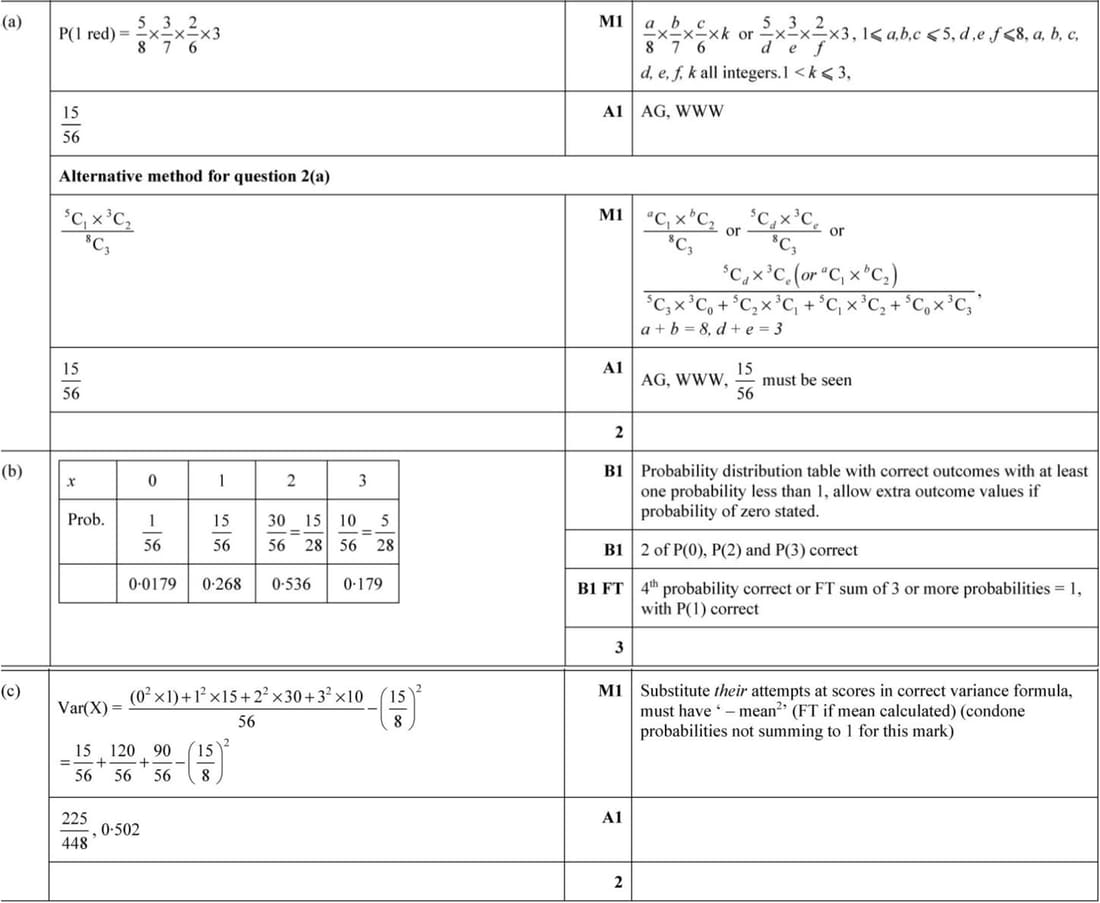
A bag contains 5 red balls and 3 blue balls. Sadie takes 3 balls at random from the bag, without replacement. The random variable X represents the number of red balls that she takes.
(a) Show that the probability that Sadie takes exactly 1 red ball is \(\frac{15}{56}\).
(b) Draw up the probability distribution table for X.
(c) Given that \(E(X) = \frac{15}{8}\), find \(\text{Var}(X)\).
Nov 2020 p51 q4
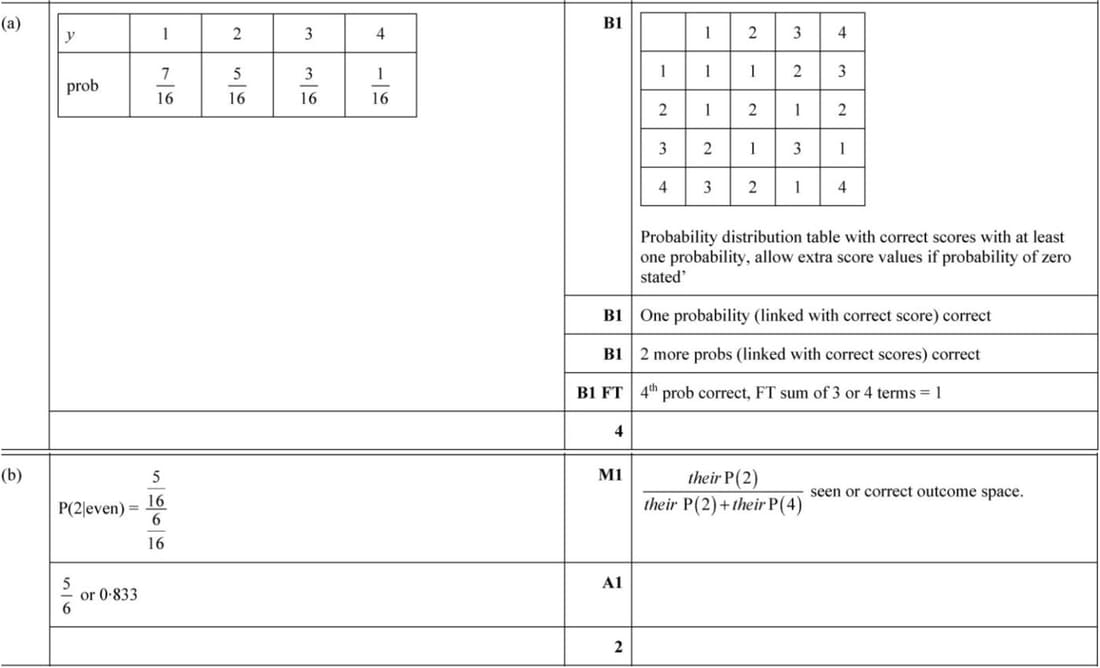
The random variable X takes each of the values 1, 2, 3, 4 with probability \(\frac{1}{4}\). Two independent values of X are chosen at random. If the two values of X are the same, the random variable Y takes that value. Otherwise, the value of Y is the larger value of X minus the smaller value of X.
(a) Draw up the probability distribution table for Y.
\((b) Find the probability that Y = 2 given that Y is even.\)
June 2020 p53 q4
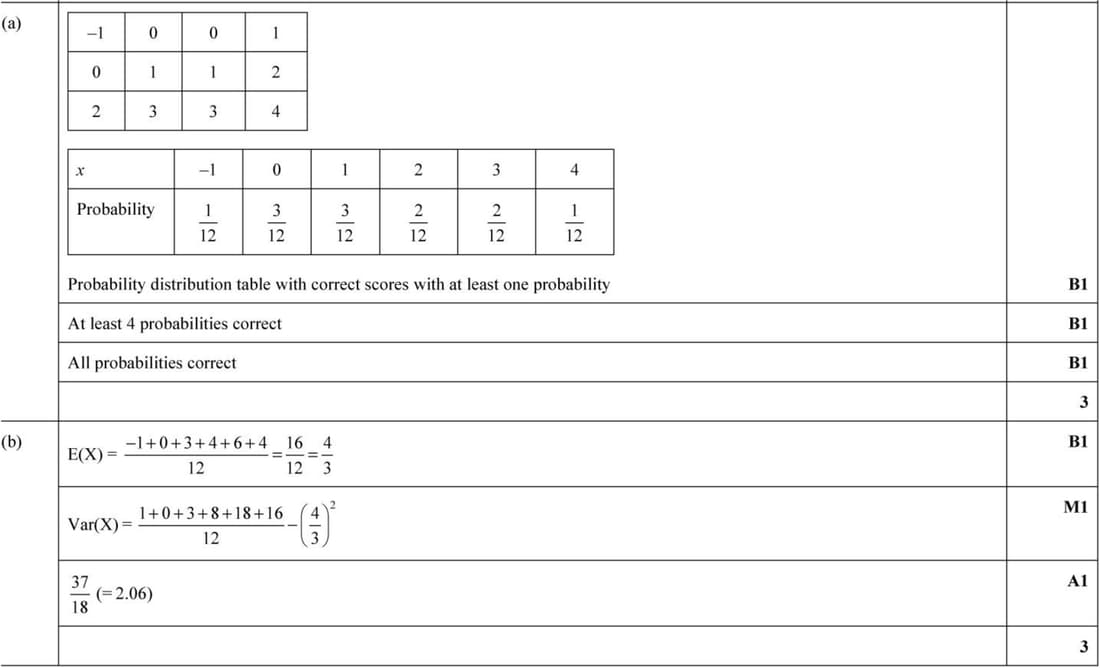
A fair four-sided spinner has edges numbered 1, 2, 2, 3. A fair three-sided spinner has edges numbered -2, -1, 1. Each spinner is spun and the number on the edge on which it comes to rest is noted. The random variable X is the sum of the two numbers that have been noted.
(a) Draw up the probability distribution table for X.
(b) Find Var(X).
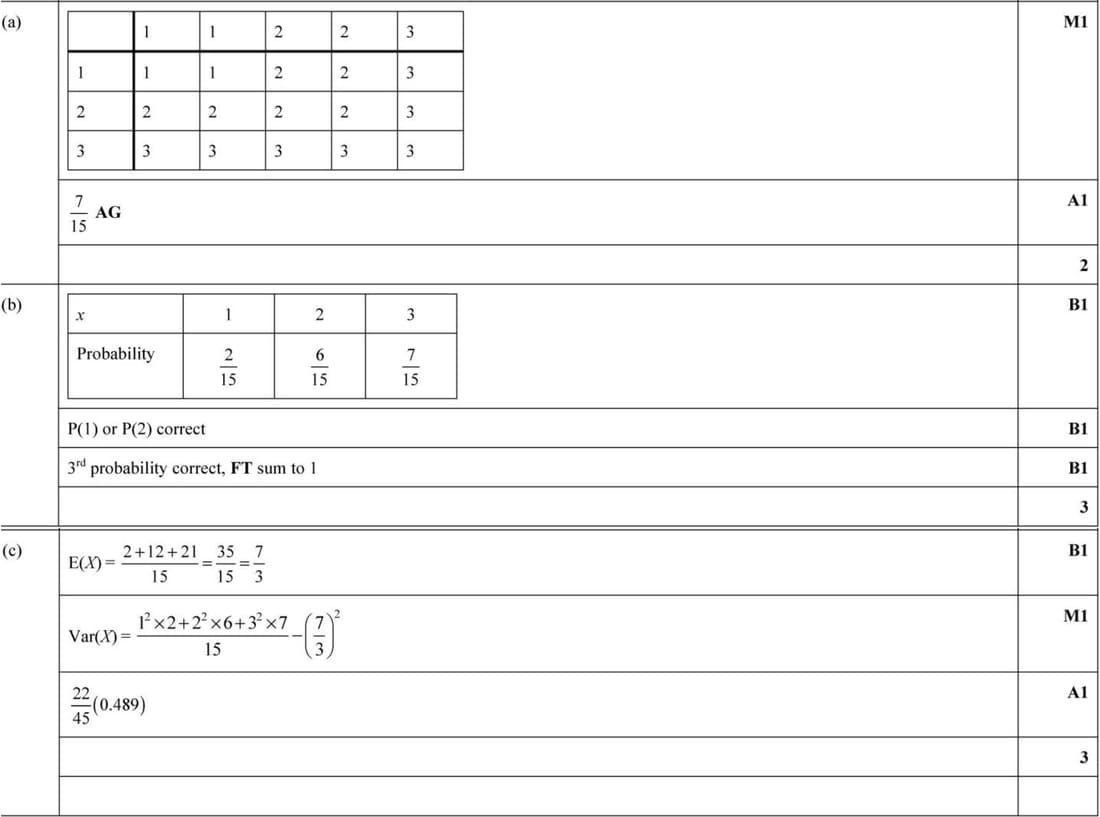
June 2020 p52 q5
A fair three-sided spinner has sides numbered 1, 2, 3. A fair five-sided spinner has sides numbered 1, 1, 2, 2, 3. Both spinners are spun once. For each spinner, the number on the side on which it lands is noted. The random variable X is the larger of the two numbers if they are different, and their common value if they are the same.
(a) Show that P(X = 3) = \(\frac{7}{15}\).
(b) Draw up the probability distribution table for X.
(c) Find E(X) and Var(X).