Exam-Style Problems
⬅ Back to SubchapterJune 2017 p61 q2
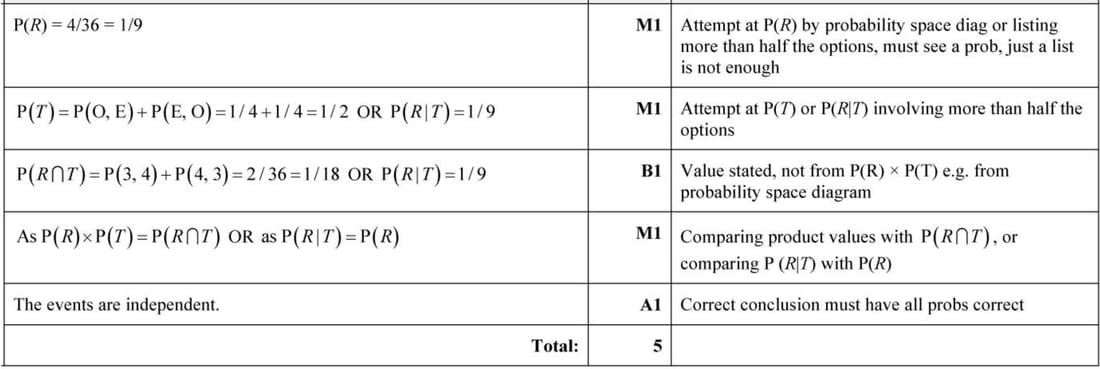
Ashfaq throws two fair dice and notes the numbers obtained. R is the event 'The product of the two numbers is 12'. T is the event 'One of the numbers is odd and one of the numbers is even'. By finding appropriate probabilities, determine whether events R and T are independent.
Nov 2016 p63 q4
For a group of 250 cars the numbers, classified by colour and country of manufacture, are shown in the table.
| Germany | Japan | Korea | |
|---|---|---|---|
| Silver | 40 | 26 | 34 |
| White | 32 | 22 | 26 |
| Red | 28 | 12 | 30 |
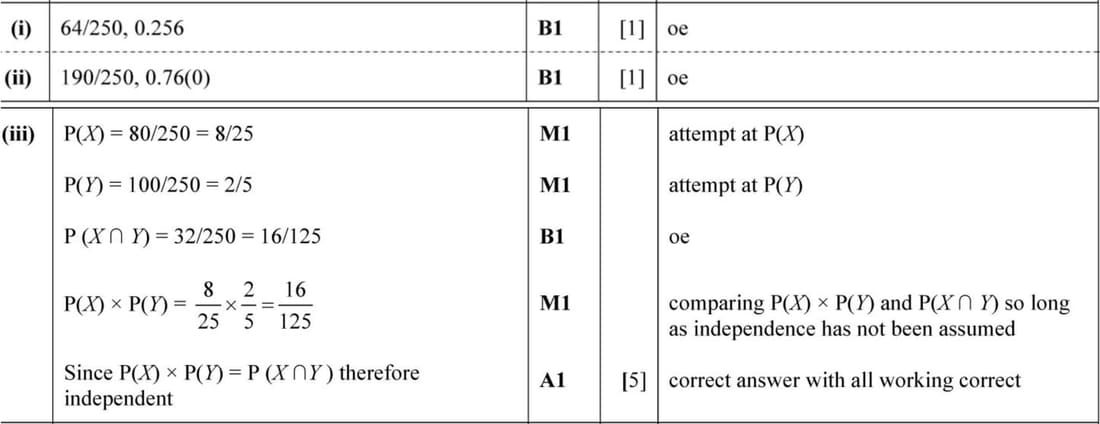
One car is selected at random from this group. Find the probability that the selected car is
- a red or silver car manufactured in Korea,
- not manufactured in Japan.
X is the event that the selected car is white. Y is the event that the selected car is manufactured in Germany.
(iii) By using appropriate probabilities, determine whether events X and Y are independent.
June 2016 p63 q1
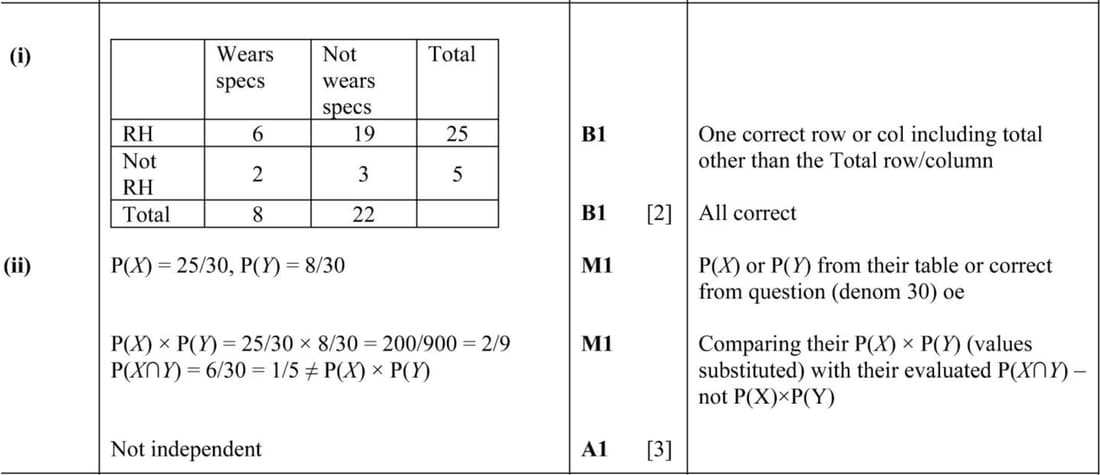
In a group of 30 adults, 25 are right-handed and 8 wear spectacles. The number who are right-handed and do not wear spectacles is 19.
(i) Copy and complete the following table to show the number of adults in each category.
| Wears spectacles | Does not wear spectacles | Total | |
|---|---|---|---|
| Right-handed | |||
| Not right-handed | |||
| Total | 30 |
An adult is chosen at random from the group. Event X is ‘the adult chosen is right-handed’; event Y is ‘the adult chosen wears spectacles’.
(ii) Determine whether X and Y are independent events, justifying your answer.
Feb/Mar 2016 p62 q3
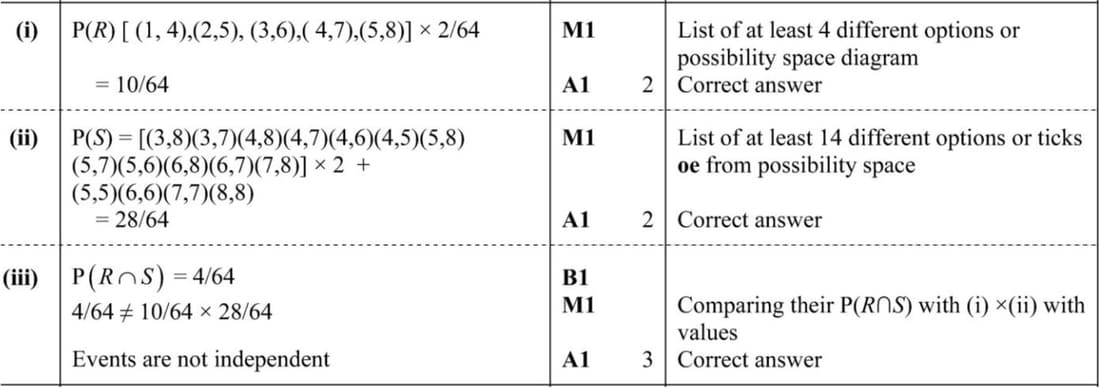
A fair eight-sided die has faces marked 1, 2, 3, 4, 5, 6, 7, 8. The score when the die is thrown is the number on the face the die lands on. The die is thrown twice.
- Event R is ‘one of the scores is exactly 3 greater than the other score’.
- Event S is ‘the product of the scores is more than 19’.
- Find the probability of R. [2]
- Find the probability of S. [2]
- Determine whether events R and S are independent. Justify your answer. [3]
Nov 2015 p63 q3
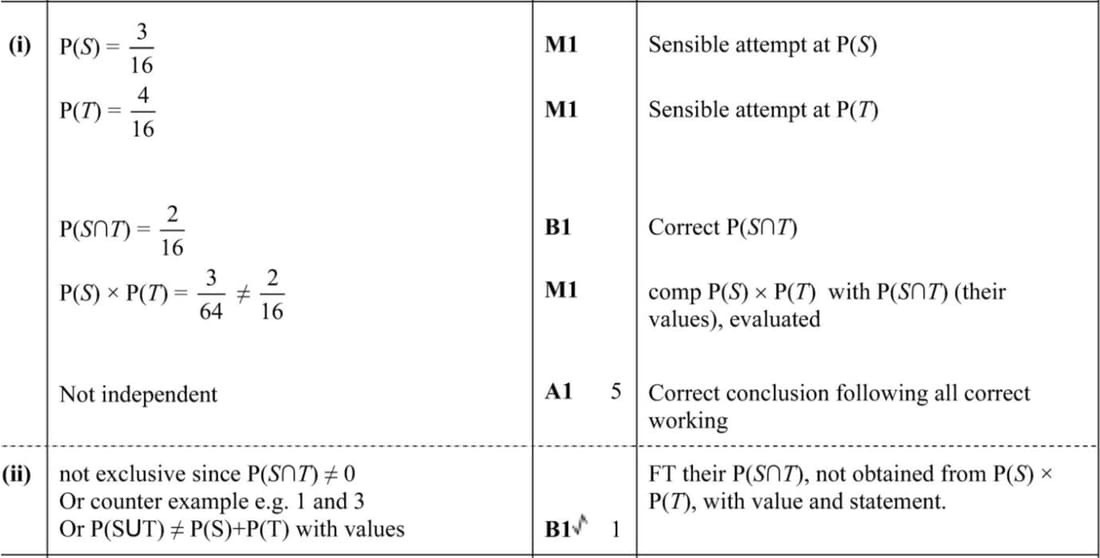
Ellie throws two fair tetrahedral dice, each with faces numbered 1, 2, 3, and 4. She notes the numbers on the faces that the dice land on. Event S is 'the sum of the two numbers is 4'. Event T is 'the product of the two numbers is an odd number'.
- Determine whether events S and T are independent, showing your working.
- Are events S and T exclusive? Justify your answer.