Exam-Style Problems
⬅ Back to SubchapterJune 2020 p32 q7
2329
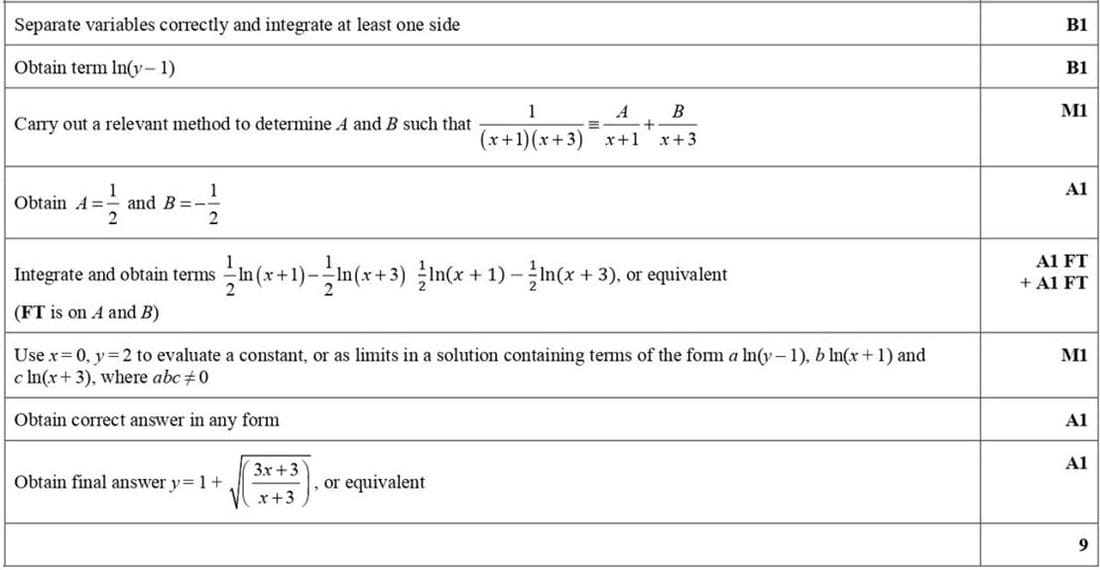
The variables x and y satisfy the differential equation
\(\frac{dy}{dx} = \frac{y-1}{(x+1)(x+3)}\).
It is given that \(y = 2\) when \(x = 0\).
Solve the differential equation, obtaining an expression for \(y\) in terms of \(x\).
June 2018 p33 q6
2330
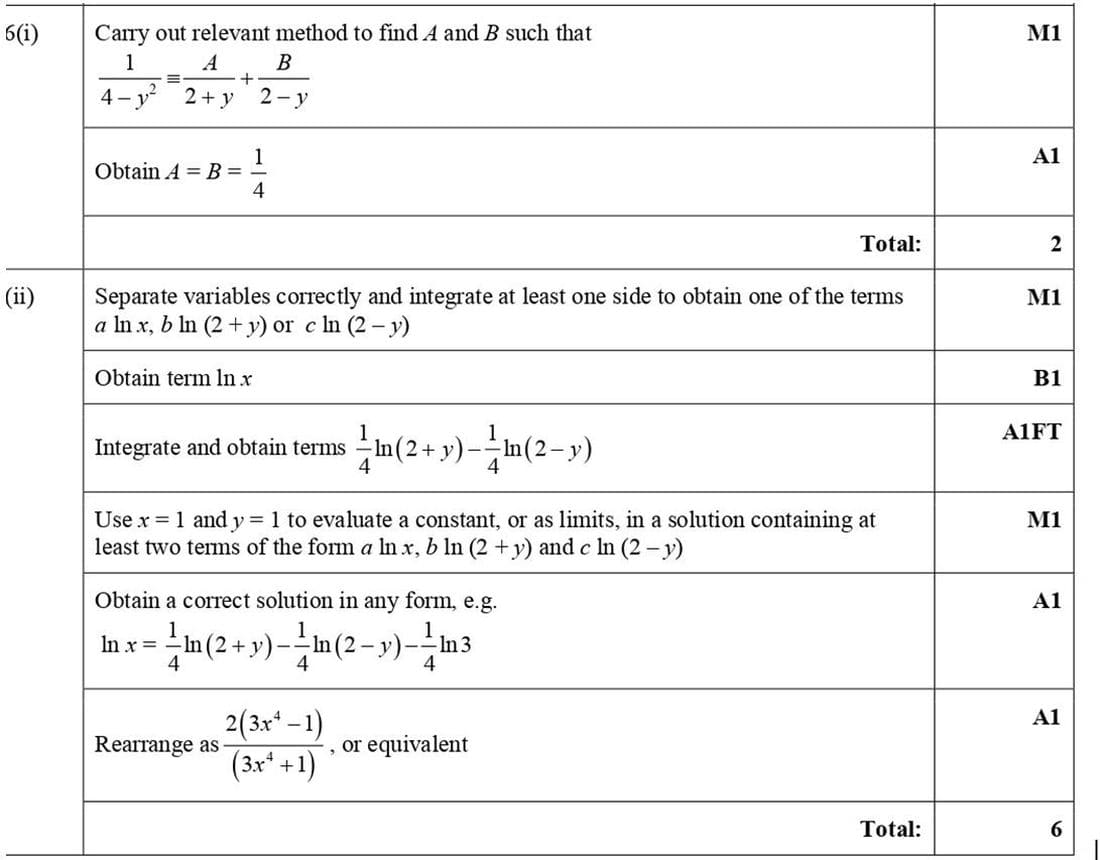
(i) Express \(\frac{1}{4-y^2}\) in partial fractions.
(ii) The variables \(x\) and \(y\) satisfy the differential equation \(\frac{dy}{dx} = \frac{x}{4-y^2}\), and \(y = 1\) when \(x = 1\). Solve the differential equation, obtaining an expression for \(y\) in terms of \(x\).
June 2017 p31 q9
2331
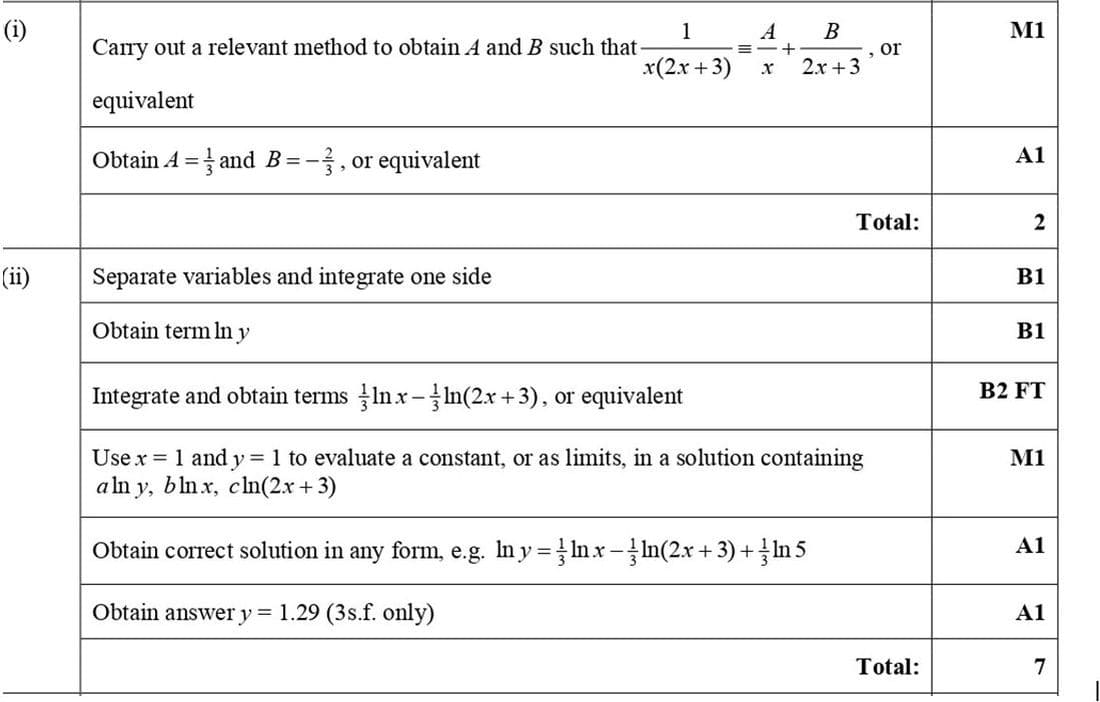
(i) Express \(\frac{1}{x(2x+3)}\) in partial fractions.
(ii) The variables \(x\) and \(y\) satisfy the differential equation \(x(2x+3) \frac{dy}{dx} = y\), and it is given that \(y = 1\) when \(x = 1\). Solve the differential equation and calculate the value of \(y\) when \(x = 9\), giving your answer correct to 3 significant figures.
June 2015 p31 q7
2332
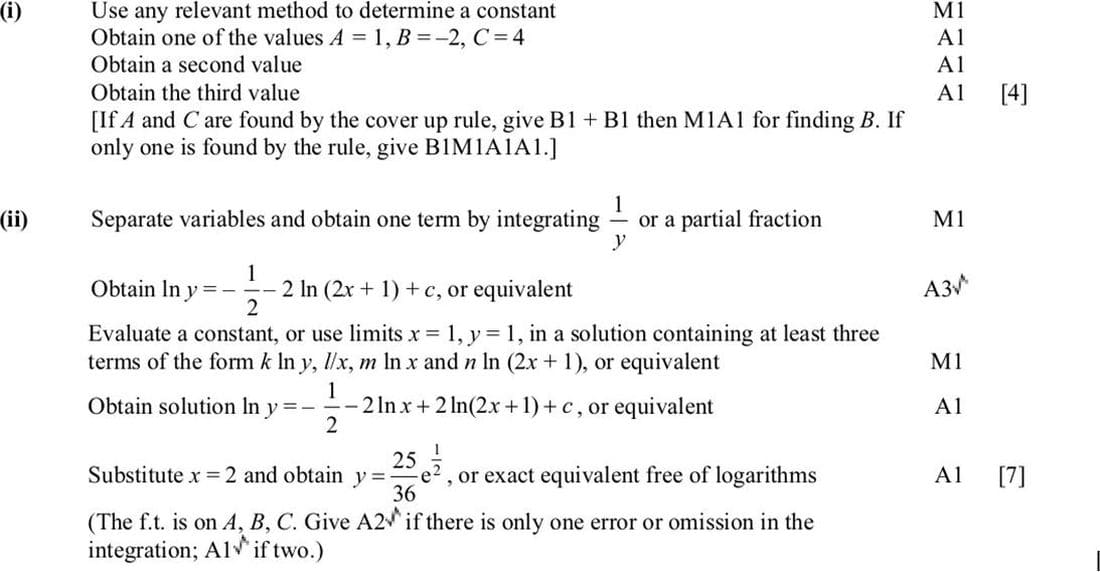
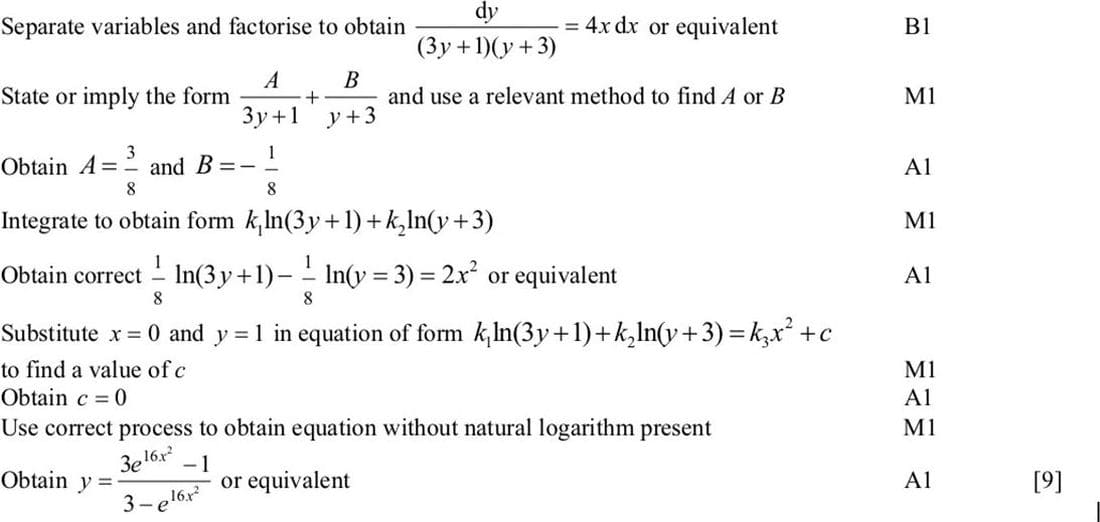
Given that \(y = 1\) when \(x = 0\), solve the differential equation \(\frac{dy}{dx} = 4x(3y^2 + 10y + 3)\), obtaining an expression for \(y\) in terms of \(x\).
June 2013 p32 q8
2333
(i) Express \(\frac{1}{x^2(2x+1)}\) in the form \(\frac{A}{x^2} + \frac{B}{x} + \frac{C}{2x+1}\).
(ii) The variables \(x\) and \(y\) satisfy the differential equation \(y = x^2(2x+1) \frac{dy}{dx}\), and \(y = 1\) when \(x = 1\). Solve the differential equation and find the exact value of \(y\) when \(x = 2\). Give your value of \(y\) in a form not involving logarithms.