Exam-Style Problems
⬅ Back to SubchapterNov 2005 p3 q8
2284
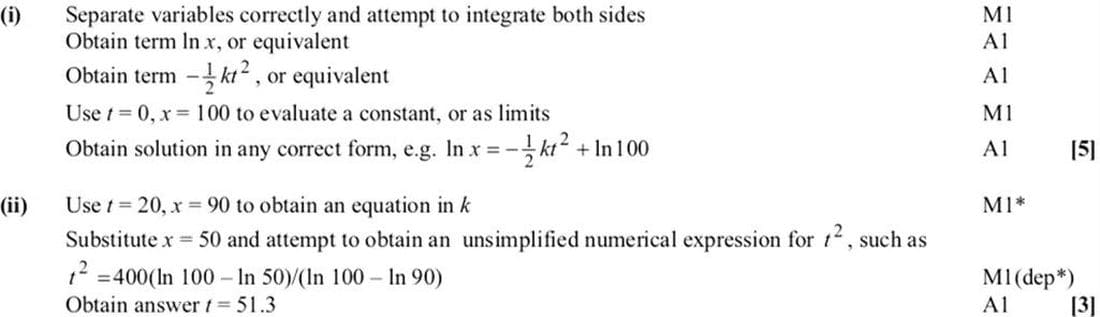
In a certain chemical reaction the amount, x grams, of a substance present is decreasing. The rate of decrease of x is proportional to the product of x and the time, t seconds, since the start of the reaction. Thus x and t satisfy the differential equation
\(\frac{dx}{dt} = -kxt\),
\(where k is a positive constant. At the start of the reaction, when t = 0, x = 100.\)
(i) Solve this differential equation, obtaining a relation between x, k and t.
(ii) 20 seconds after the start of the reaction the amount of substance present is 90 grams. Find the time after the start of the reaction at which the amount of substance present is 50 grams.
Nov 2003 p3 q9
2285
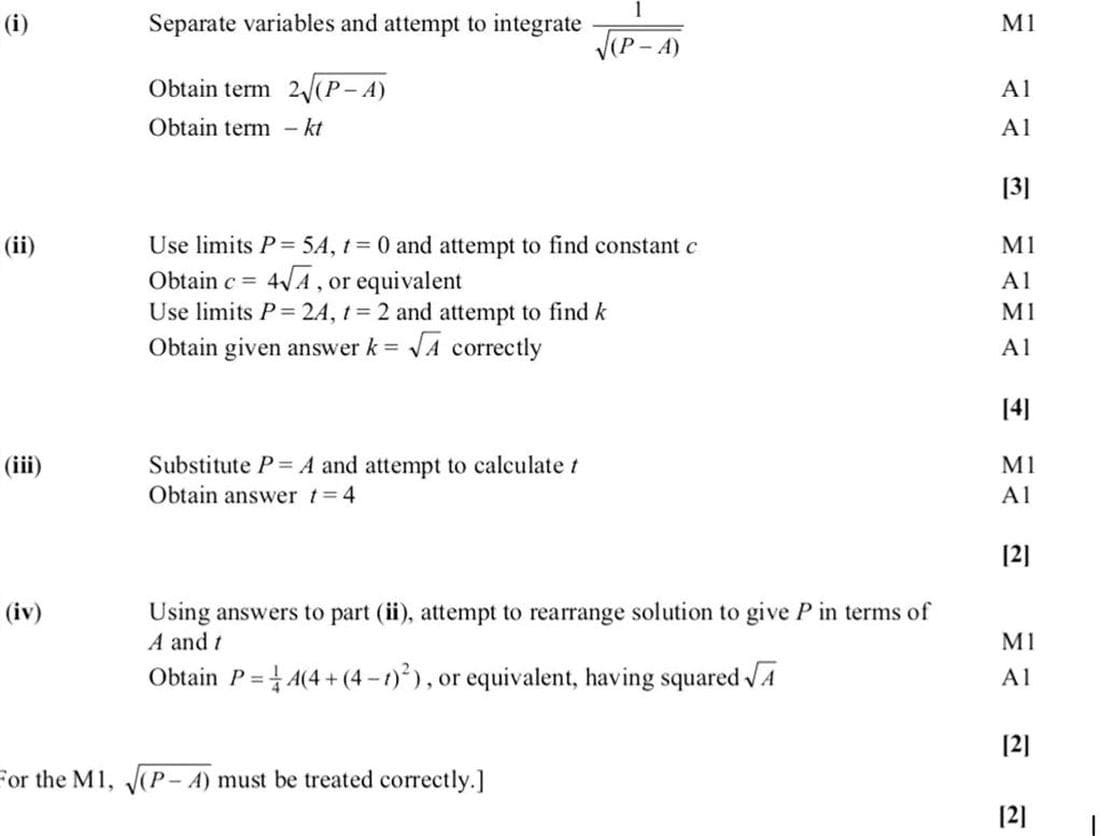
Compressed air is escaping from a container. The pressure of the air in the container at time t is P, and the constant atmospheric pressure of the air outside the container is A. The rate of decrease of P is proportional to the square root of the pressure difference \\(P - A\\). Thus the differential equation connecting P and t is
\\(\frac{dP}{dt} = -k \sqrt{P - A} \\),
where k is a positive constant.
- Find, in any form, the general solution of this differential equation. [3]
- Given that P = 5A when t = 0, and that P = 2A when t = 2, show that k = \\(\sqrt{A} \\). [4]
- Find the value of t when P = A. [2]
- Obtain an expression for P in terms of A and t. [2]
Nov 2022 p31 q8
2286
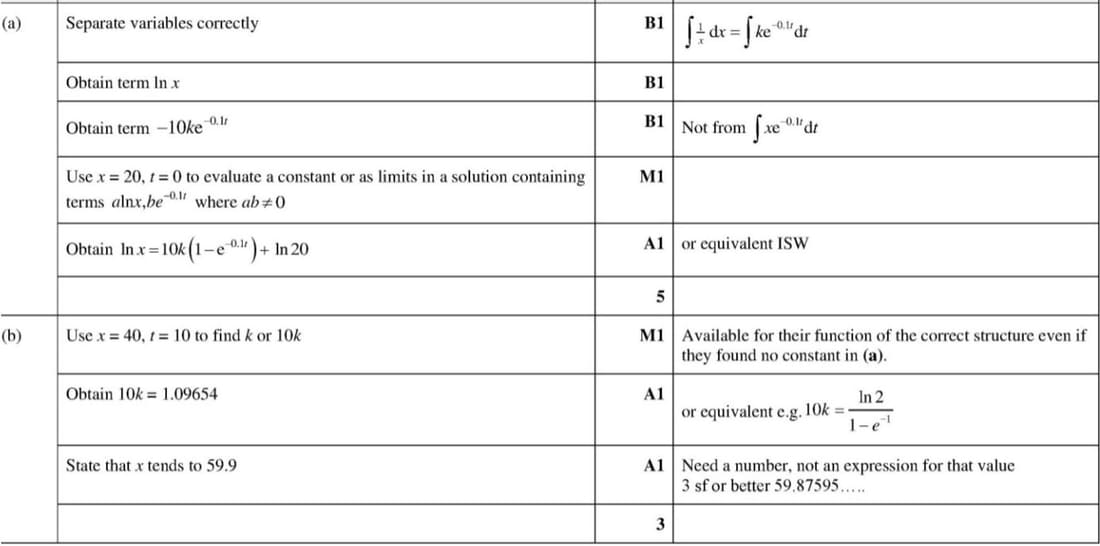
In a certain chemical reaction the amount, x grams, of a substance is increasing. The differential equation satisfied by x and t, the time in seconds since the reaction began, is
\(\frac{dx}{dt} = kxe^{-0.1t}\),
\(where k is a positive constant. It is given that x = 20 at the start of the reaction.\)
(a) Solve the differential equation, obtaining a relation between x, t and k.
(b) Given that x = 40 when t = 10, find the value of k and find the value approached by x as t becomes large.
June 2022 p33 q8
2287
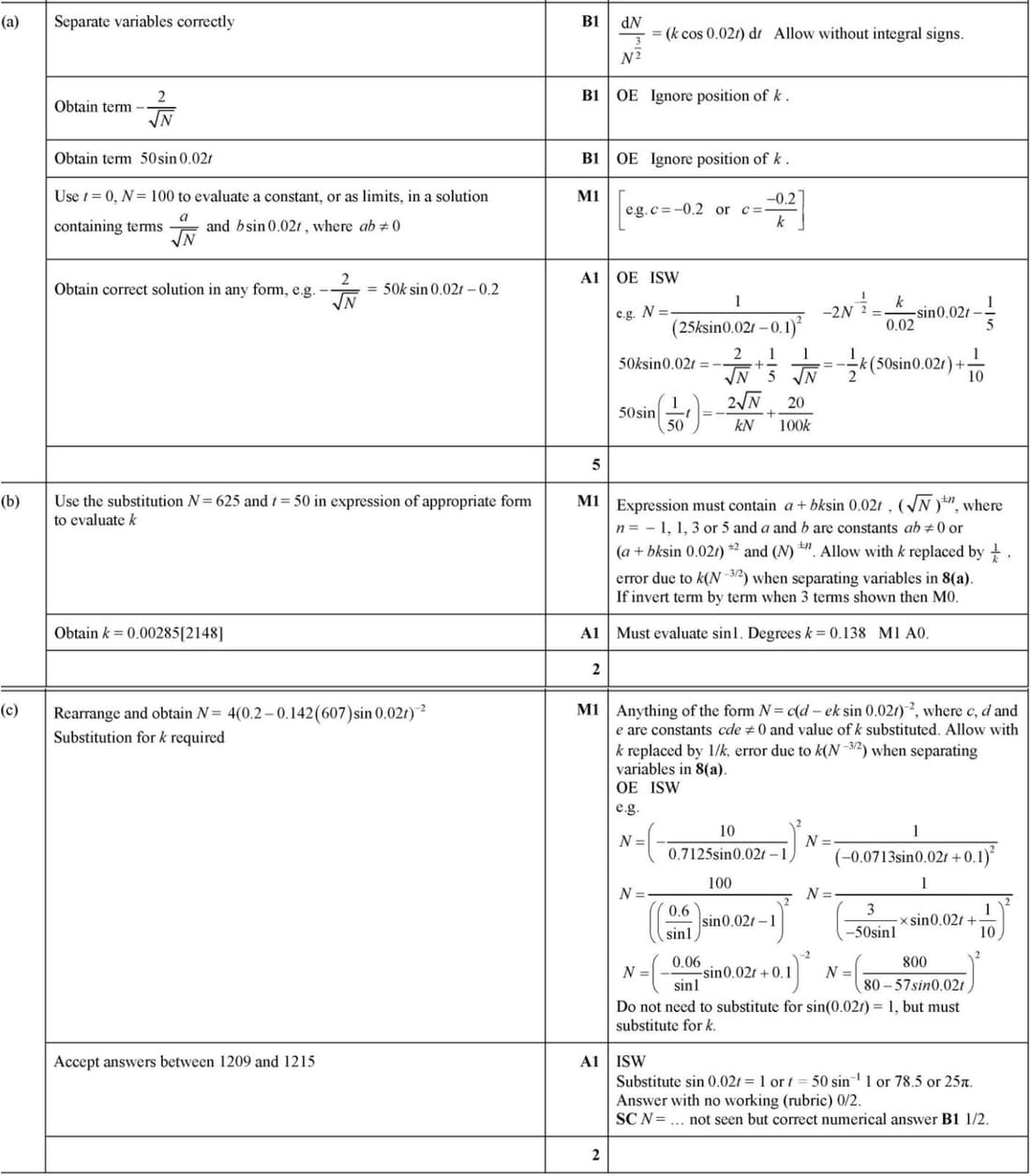
At time t days after the start of observations, the number of insects in a population is N. The variation in the number of insects is modelled by a differential equation of the form \(\frac{dN}{dt} = kN^{\frac{3}{2}} \cos 0.02t\), where k is a constant and N is a continuous variable. It is given that when t = 0, N = 100.
(a) Solve the differential equation, obtaining a relation between N, k and t.
\((b) Given also that N = 625 when t = 50, find the value of k.\)
(c) Obtain an expression for N in terms of t, and find the greatest value of N predicted by this model.
Nov 2019 p33 q9
2288
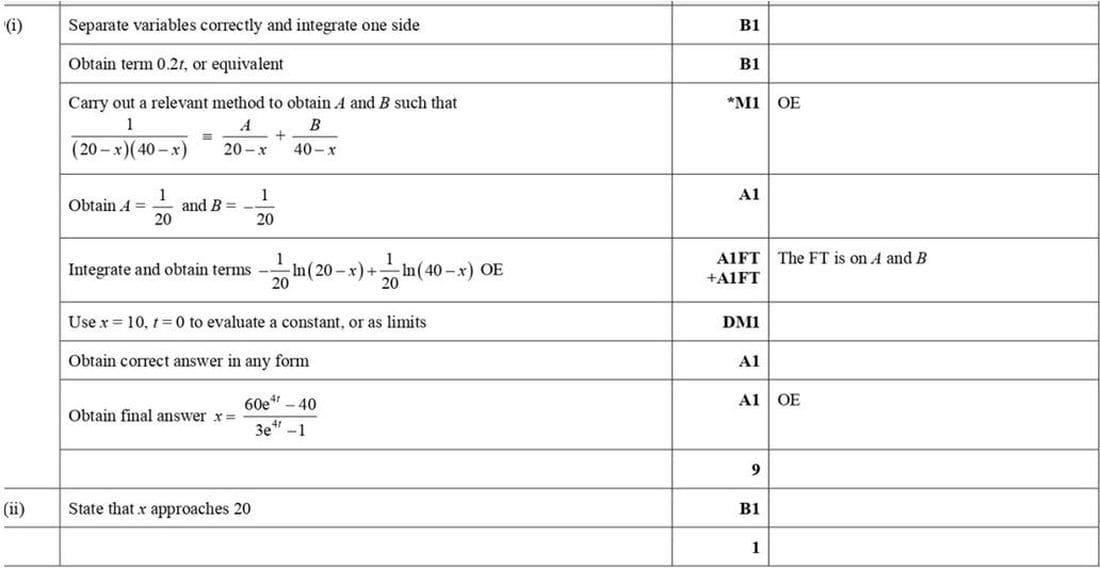
The variables x and t satisfy the differential equation \(5 \frac{dx}{dt} = (20-x)(40-x)\). It is given that \(x = 10\) when \(t = 0\).
(i) Using partial fractions, solve the differential equation, obtaining an expression for x in terms of t.
(ii) State what happens to the value of x when t becomes large.