Exam-Style Problems
⬅ Back to SubchapterJune 2004 p3 q6
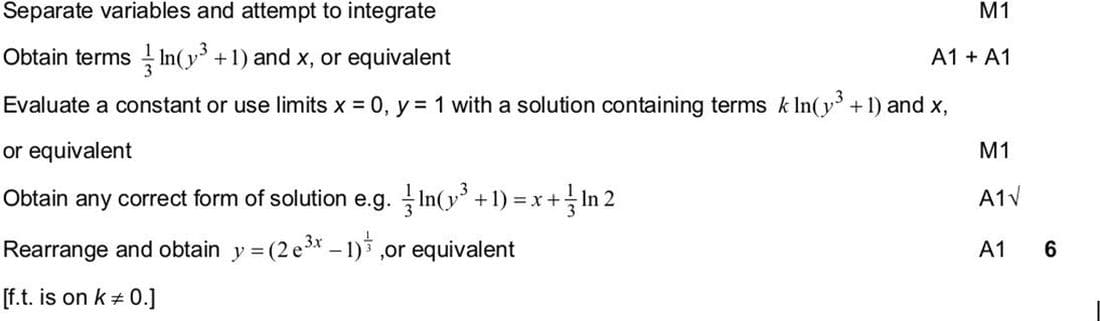
Given that \(y = 1\) when \(x = 0\), solve the differential equation \(\frac{dy}{dx} = \frac{y^3 + 1}{y^2}\), obtaining an expression for \(y\) in terms of \(x\).
June 2022 p31 q4
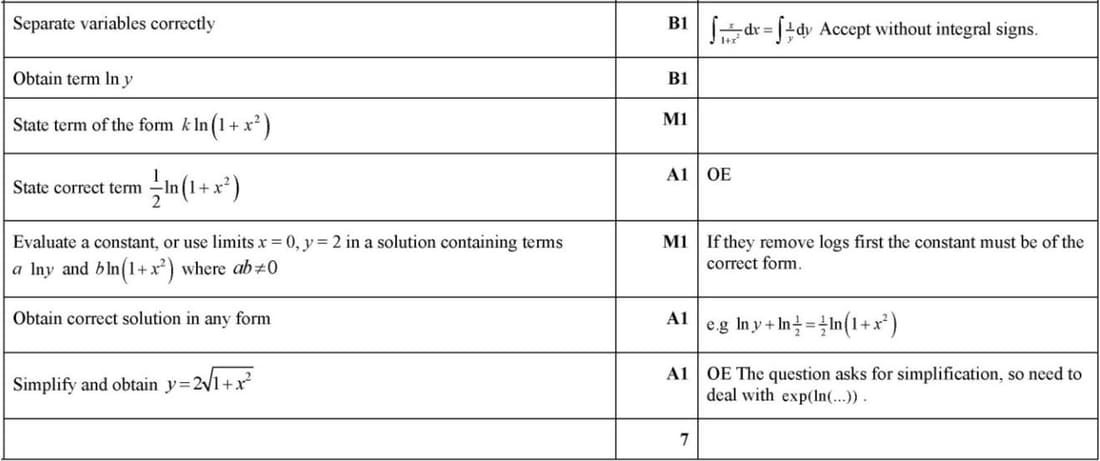
The variables x and y satisfy the differential equation \(\frac{dy}{dx} = \frac{xy}{1+x^2}\), and \(y = 2\) when \(x = 0\). Solve the differential equation, obtaining a simplified expression for y in terms of x.
June 2021 p32 q7
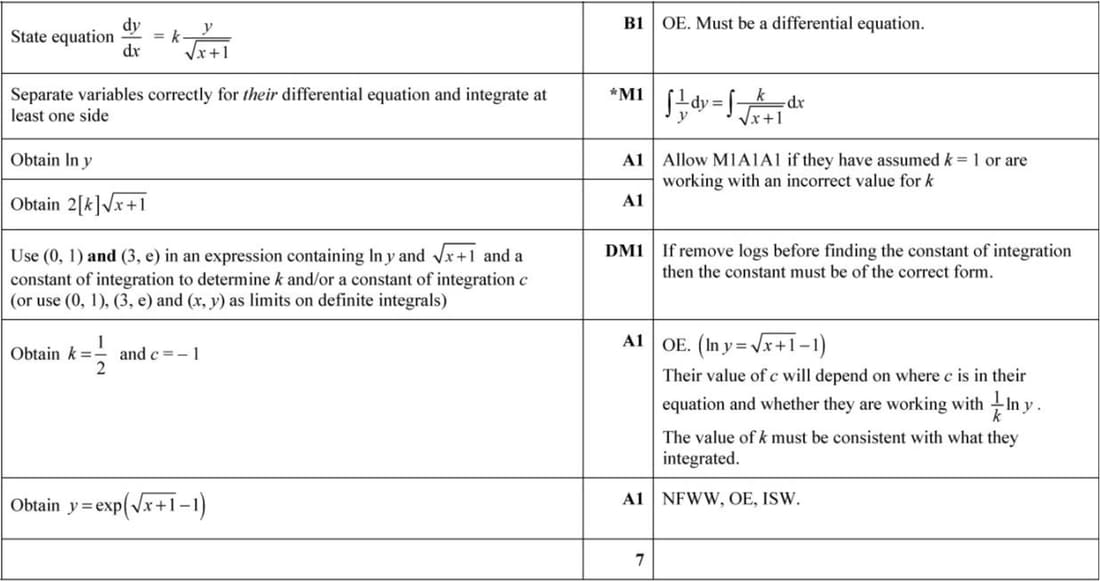
A curve is such that the gradient at a general point with coordinates \((x, y)\) is proportional to \(\frac{y}{\sqrt{x+1}}\).
The curve passes through the points with coordinates \((0, 1)\) and \((3, e)\).
By setting up and solving a differential equation, find the equation of the curve, expressing \(y\) in terms of \(x\).
Nov 2020 p31 q8
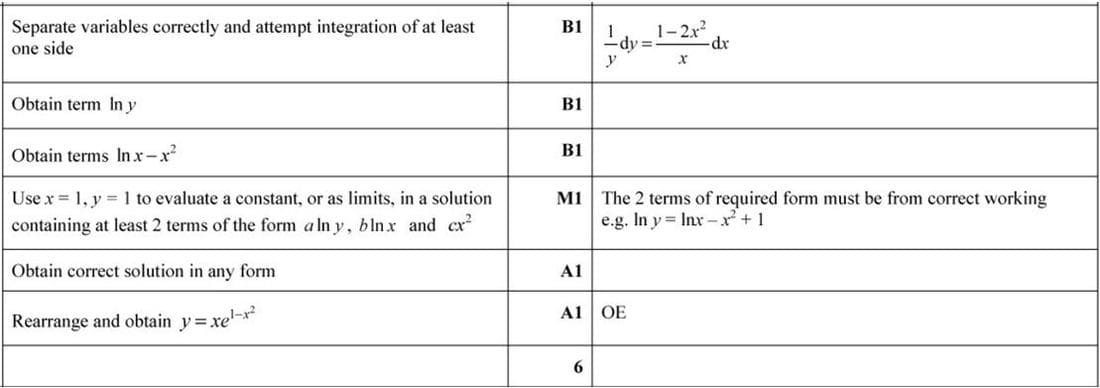
The coordinates (x, y) of a general point of a curve satisfy the differential equation \(x \frac{dy}{dx} = (1 - 2x^2)y\), for \(x > 0\). It is given that \(y = 1\) when \(x = 1\).
Solve the differential equation, obtaining an expression for \(y\) in terms of \(x\).
June 2019 p33 q5
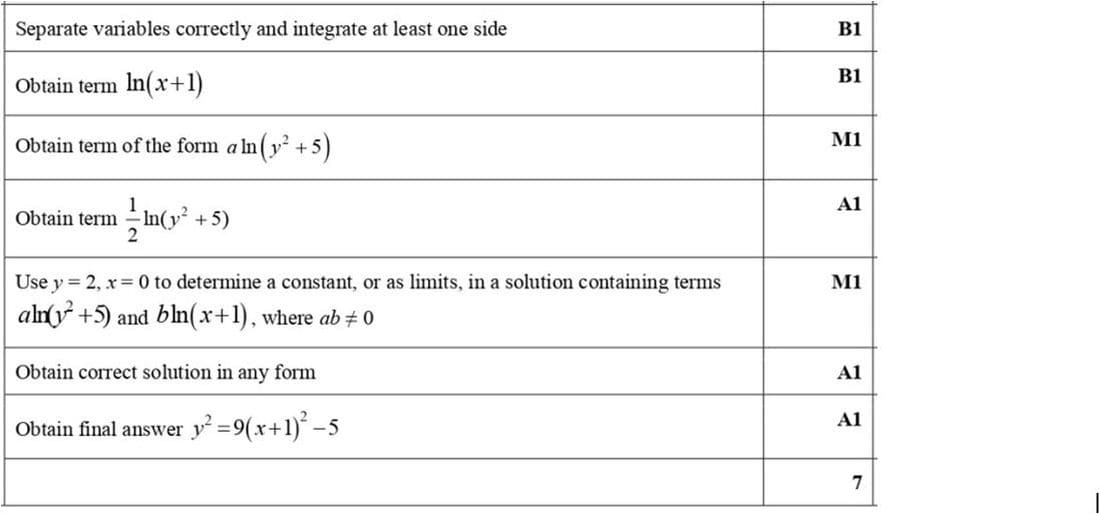
The variables x and y satisfy the differential equation \((x + 1) y \frac{dy}{dx} = y^2 + 5\).
It is given that \(y = 2\) when \(x = 0\). Solve the differential equation obtaining an expression for \(y^2\) in terms of \(x\).