Exam-Style Problems
⬅ Back to SubchapterNov 2016 p13 q7
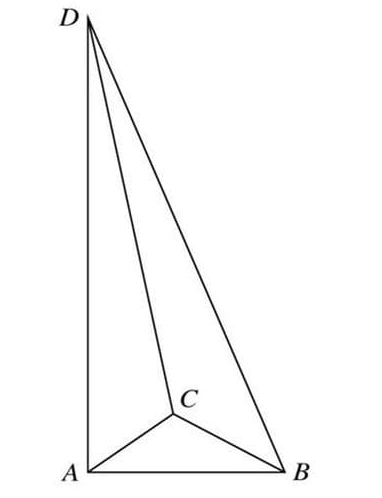
The diagram shows a triangular pyramid ABCD. It is given that \(\overrightarrow{AB} = 3\mathbf{i} + \mathbf{j} + \mathbf{k}\), \(\overrightarrow{AC} = \mathbf{i} - 2\mathbf{j} - \mathbf{k}\), and \(\overrightarrow{AD} = \mathbf{i} + 4\mathbf{j} - 7\mathbf{k}\).
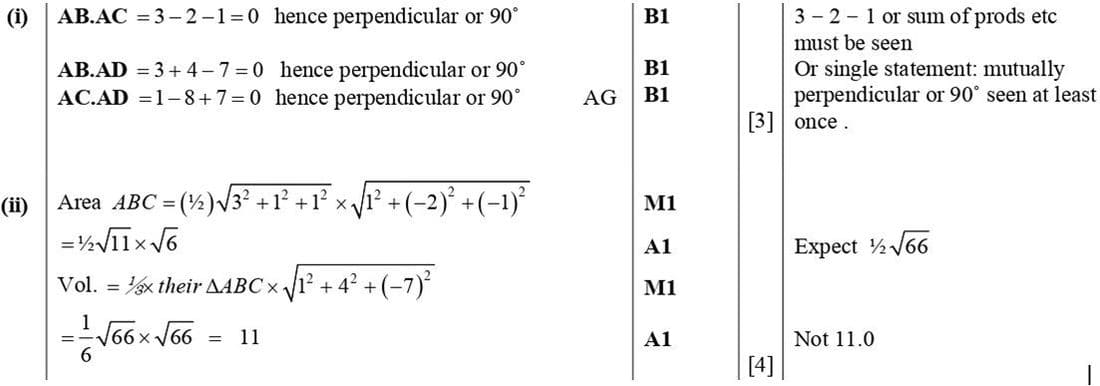
(i) Verify, showing all necessary working, that each of the angles \(DAB\), \(DAC\), and \(CAB\) is \(90^\circ\).
(ii) Find the exact value of the area of the triangle \(ABC\), and hence find the exact value of the volume of the pyramid.
[The volume \(V\) of a pyramid of base area \(A\) and vertical height \(h\) is given by \(V = \frac{1}{3}Ah\).]
Nov 2016 p11 q9
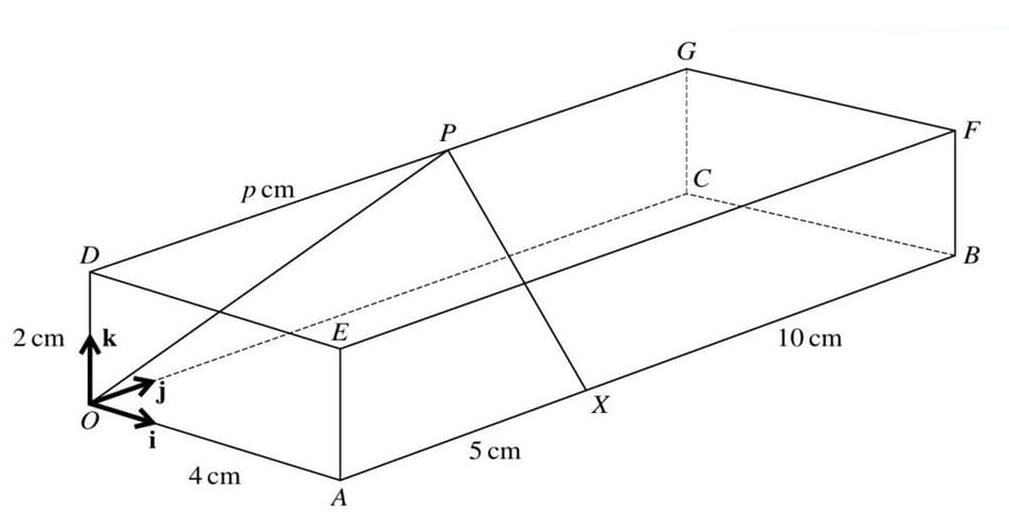
The diagram shows a cuboid OABCDEFG with a horizontal base OABC in which OA = 4 ext{ cm} and AB = 15 ext{ cm}. The height OD of the cuboid is 2 ext{ cm}. The point X on AB is such that AX = 5 ext{ cm} and the point P on DG is such that DP = p ext{ cm}, where p is a constant. Unit vectors i, j and k are parallel to OA, OC and OD respectively.
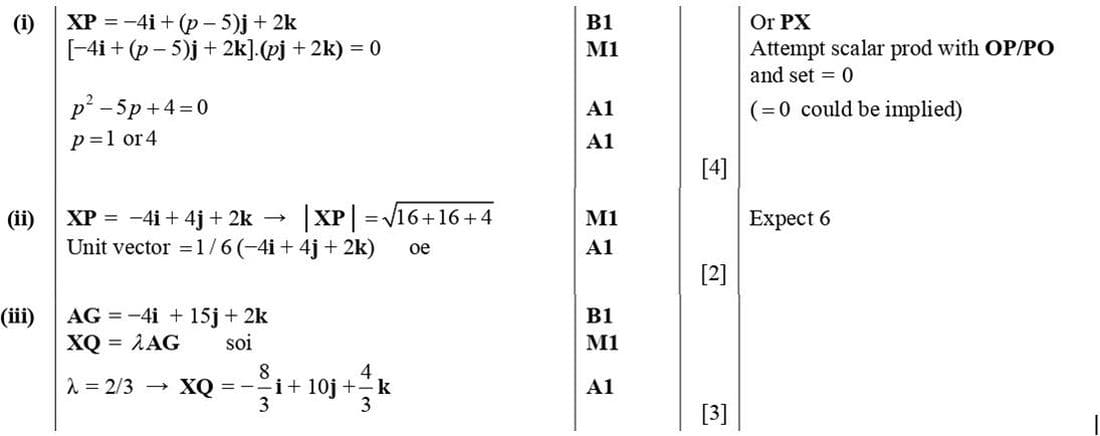
- Find the possible values of p such that angle OPX = 90^ 0.
- For the case where p = 9, find the unit vector in the direction of \(\overrightarrow{XP}\).
- A point Q lies on the face CBFG and is such that \(XQ\) is parallel to AG. Find \(\overrightarrow{XQ}\).
Feb/Mar 2016 p12 q7
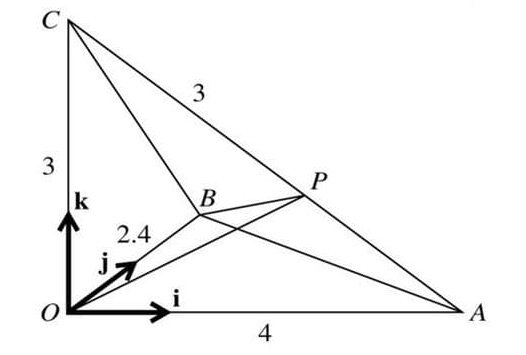
The diagram shows a pyramid OABC with a horizontal triangular base OAB and vertical height OC. Angles AOB, BOC and AOC are each right angles. Unit vectors i, j and k are parallel to OA, OB and OC respectively, with OA = 4 units, OB = 2.4 units and OC = 3 units. The point P on CA is such that CP = 3 units.
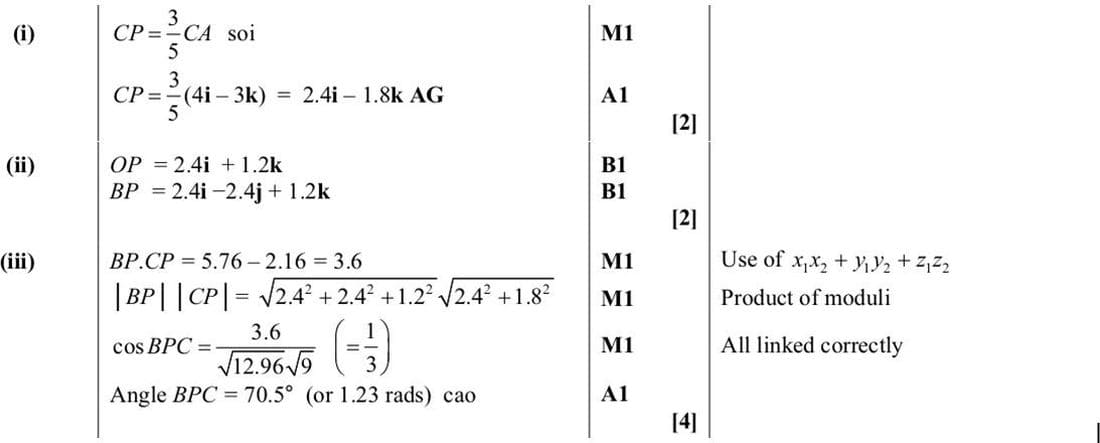
- Show that \(\overrightarrow{CP} = 2.4\mathbf{i} - 1.8\mathbf{k}\).
- Express \(\overrightarrow{OP}\) and \(\overrightarrow{BP}\) in terms of \(\mathbf{i}, \mathbf{j}\) and \(\mathbf{k}\).
- Use a scalar product to find angle BPC.
Nov 2015 p11 q10
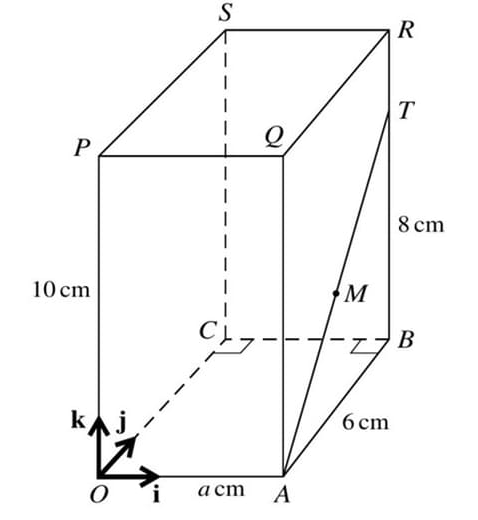
The diagram shows a cuboid OABCPQRS with a horizontal base OABC in which AB = 6 cm and OA = a cm, where a is a constant. The height OP of the cuboid is 10 cm. The point T on BR is such that BT = 8 cm, and M is the mid-point of AT. Unit vectors i, j and k are parallel to OA, OC and OP respectively.
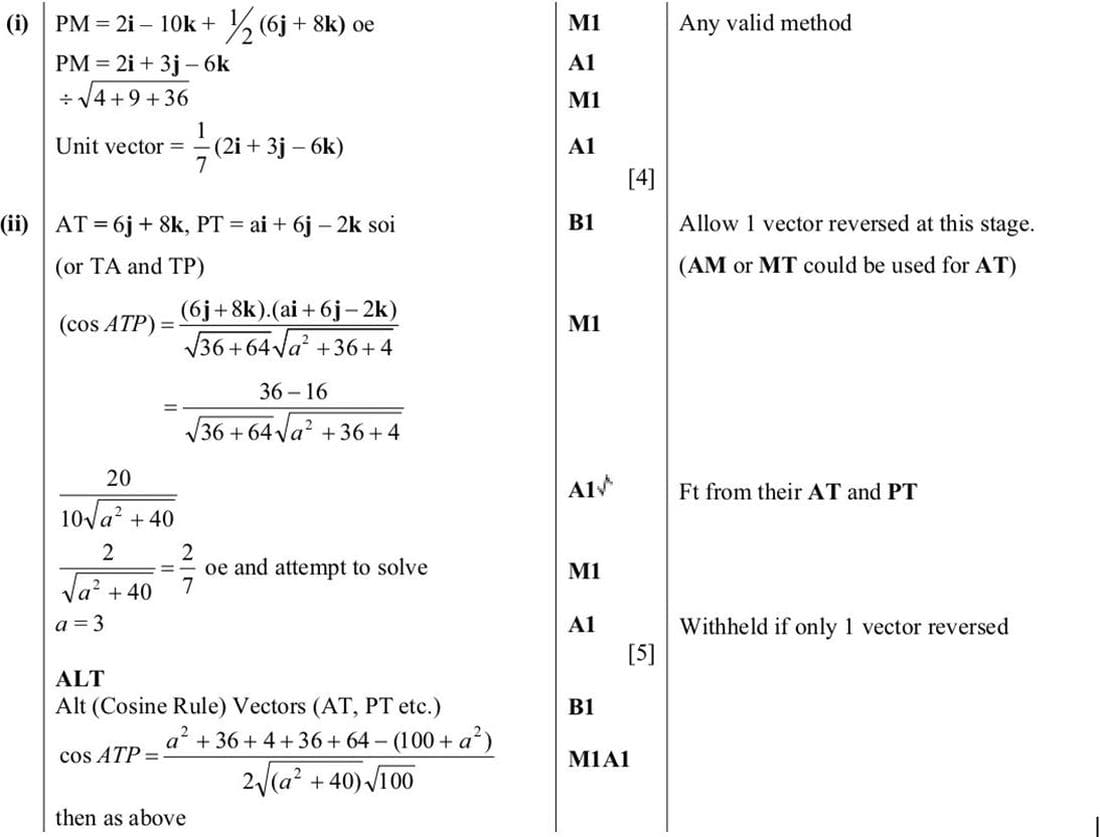
(i) For the case where a = 2, find the unit vector in the direction of \(\overrightarrow{PM}\).
(ii) For the case where angle \(ATP = \cos^{-1}\left(\frac{2}{7}\right)\), find the value of a.
Nov 2014 p12 q7
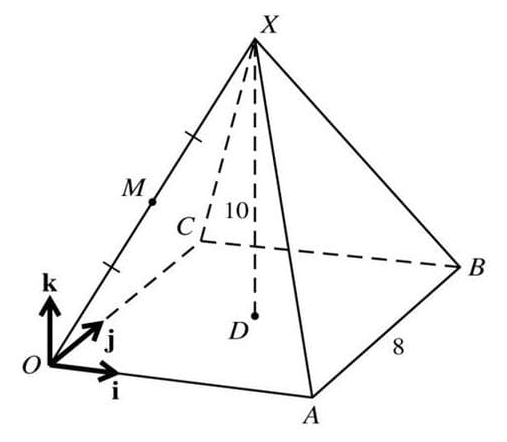
The diagram shows a pyramid \(OABCX\). The horizontal square base \(OABC\) has side 8 units and the centre of the base is \(D\). The top of the pyramid, \(X\), is vertically above \(D\) and \(XD = 10\) units. The mid-point of \(OX\) is \(M\). The unit vectors \(\mathbf{i}\) and \(\mathbf{j}\) are parallel to \(\overrightarrow{OA}\) and \(\overrightarrow{OC}\) respectively and the unit vector \(\mathbf{k}\) is vertically upwards.
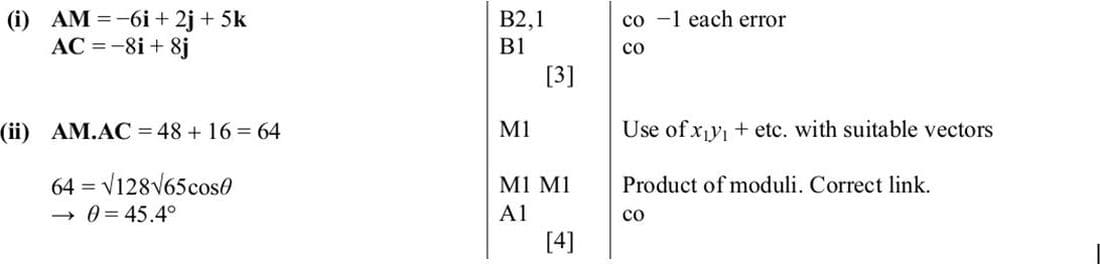
(i) Express the vectors \(\overrightarrow{AM}\) and \(\overrightarrow{AC}\) in terms of \(\mathbf{i}\), \(\mathbf{j}\) and \(\mathbf{k}\).
(ii) Use a scalar product to find angle \(MAC\).