Exam-Style Problems
⬅ Back to SubchapterJune 2021 p31 q8
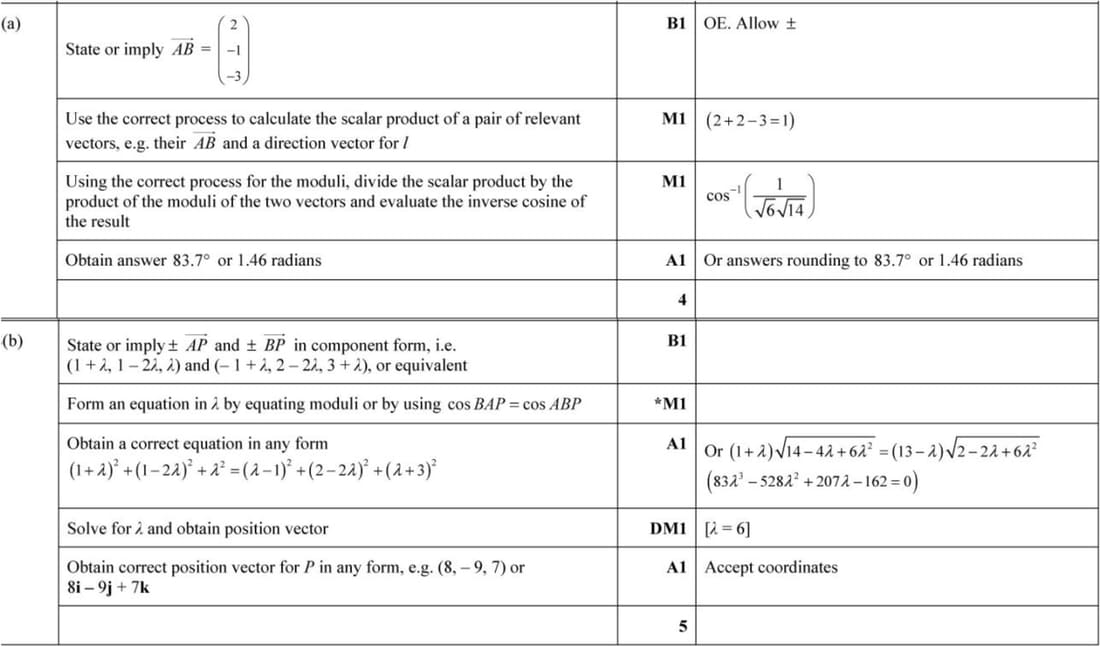
With respect to the origin \(O\), the points \(A\) and \(B\) have position vectors given by \(\overrightarrow{OA} = \begin{pmatrix} 1 \\ 2 \\ 1 \end{pmatrix}\) and \(\overrightarrow{OB} = \begin{pmatrix} 3 \\ 1 \\ -2 \end{pmatrix}\). The line \(l\) has equation \(\mathbf{r} = \begin{pmatrix} 2 \\ 3 \\ 1 \end{pmatrix} + \lambda \begin{pmatrix} 1 \\ -2 \\ 1 \end{pmatrix}\).
(a) Find the acute angle between the directions of \(AB\) and \(l\).
(b) Find the position vector of the point \(P\) on \(l\) such that \(AP = BP\).
Feb/Mar 2021 p32 q7
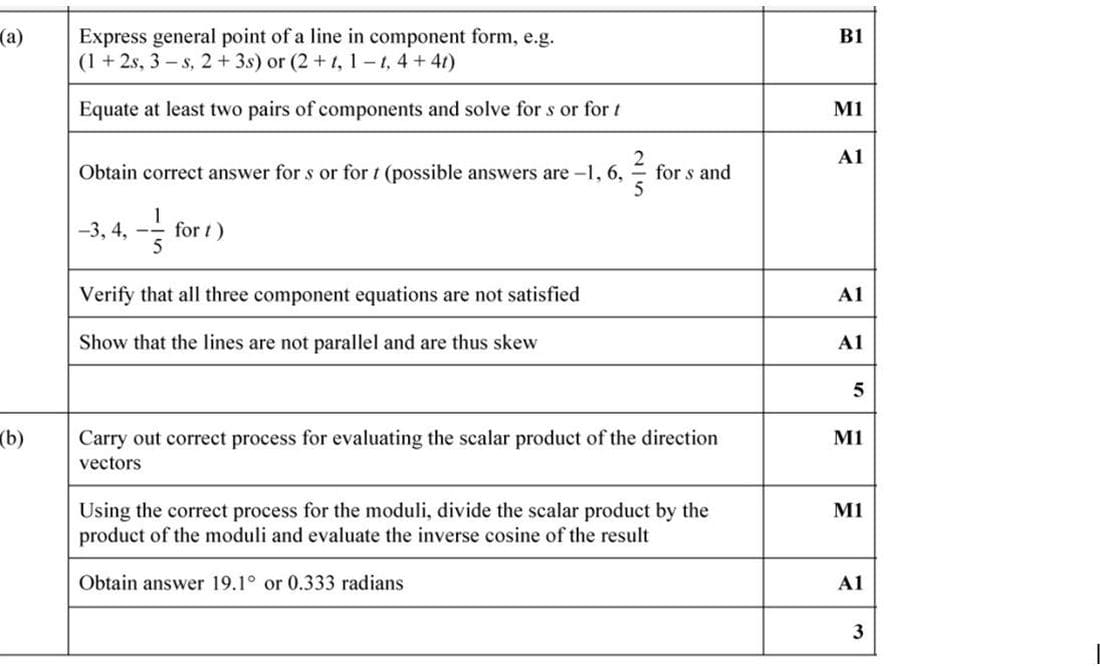
Two lines have equations \(\mathbf{r} = \begin{pmatrix} 1 \\ 3 \\ 2 \end{pmatrix} + s \begin{pmatrix} 2 \\ -1 \\ 3 \end{pmatrix}\) and \(\mathbf{r} = \begin{pmatrix} 2 \\ 1 \\ 4 \end{pmatrix} + t \begin{pmatrix} 1 \\ -1 \\ 4 \end{pmatrix}\).
(a) Show that the lines are skew.
(b) Find the acute angle between the directions of the two lines.
Nov 2021 p33 q8
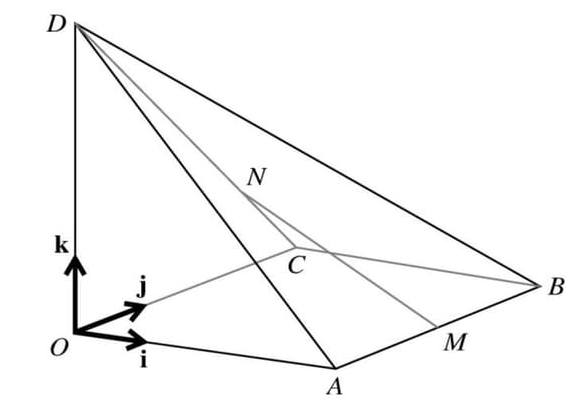
In the diagram, \(OABCD\) is a pyramid with vertex \(D\). The horizontal base \(OABC\) is a square of side 4 units. The edge \(OD\) is vertical and \(OD = 4\) units. The unit vectors \(\mathbf{i}, \mathbf{j}\) and \(\mathbf{k}\) are parallel to \(OA, OC\) and \(OD\) respectively.
The midpoint of \(AB\) is \(M\) and the point \(N\) on \(CD\) is such that \(DN = 3NC\).
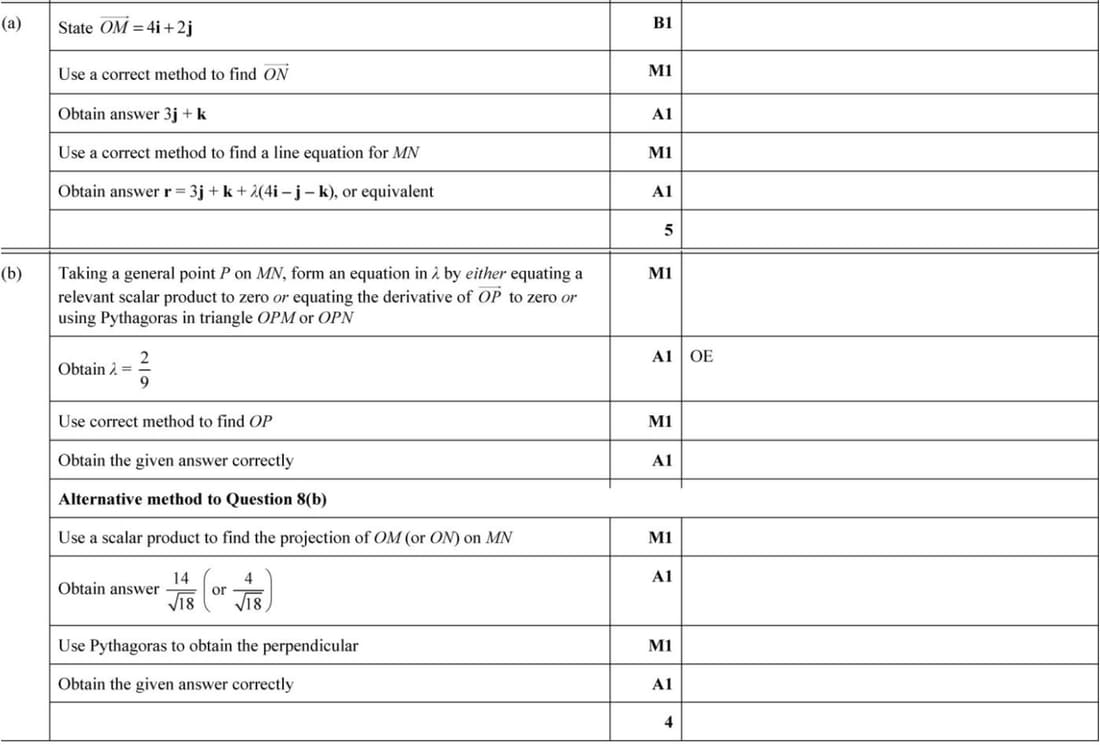
(a) Find a vector equation for the line through \(M\) and \(N\).
(b) Show that the length of the perpendicular from \(O\) to \(MN\) is \(\frac{1}{3}\sqrt{82}\).
Nov 2020 p32 q8
With respect to the origin O, the position vectors of the points A, B, C and D are given by
\(\overrightarrow{OA} = \begin{pmatrix} 2 \\ 1 \\ 5 \end{pmatrix}, \quad \overrightarrow{OB} = \begin{pmatrix} 4 \\ -1 \\ 1 \end{pmatrix}, \quad \overrightarrow{OC} = \begin{pmatrix} 1 \\ 1 \\ 2 \end{pmatrix} \quad \text{and} \quad \overrightarrow{OD} = \begin{pmatrix} 3 \\ 2 \\ 3 \end{pmatrix}.\)
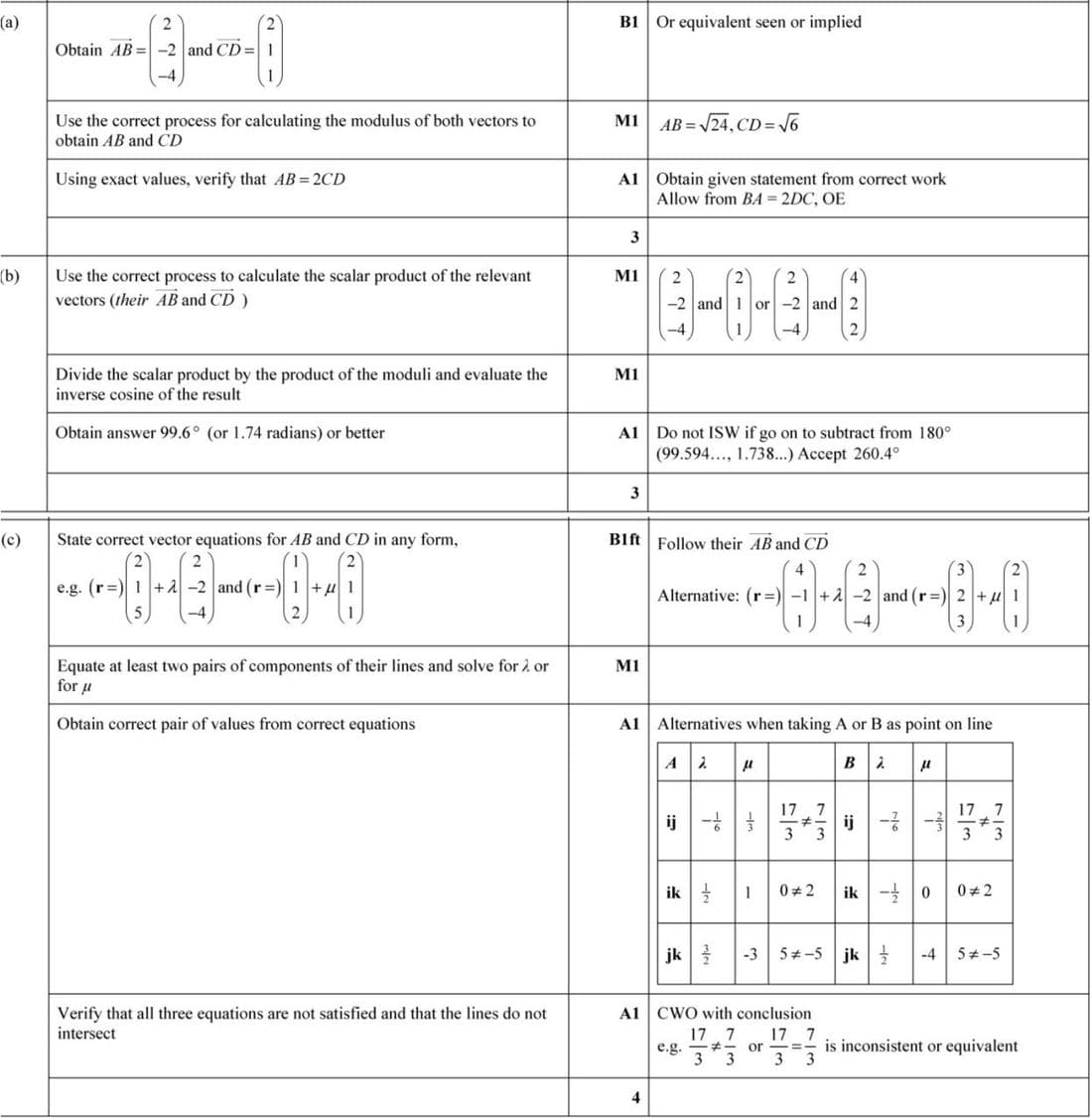
(a) Show that \(AB = 2CD.\)
(b) Find the angle between the directions of \(\overrightarrow{AB}\) and \(\overrightarrow{CD}.\)
(c) Show that the line through A and B does not intersect the line through C and D.
Nov 2020 p31 q11
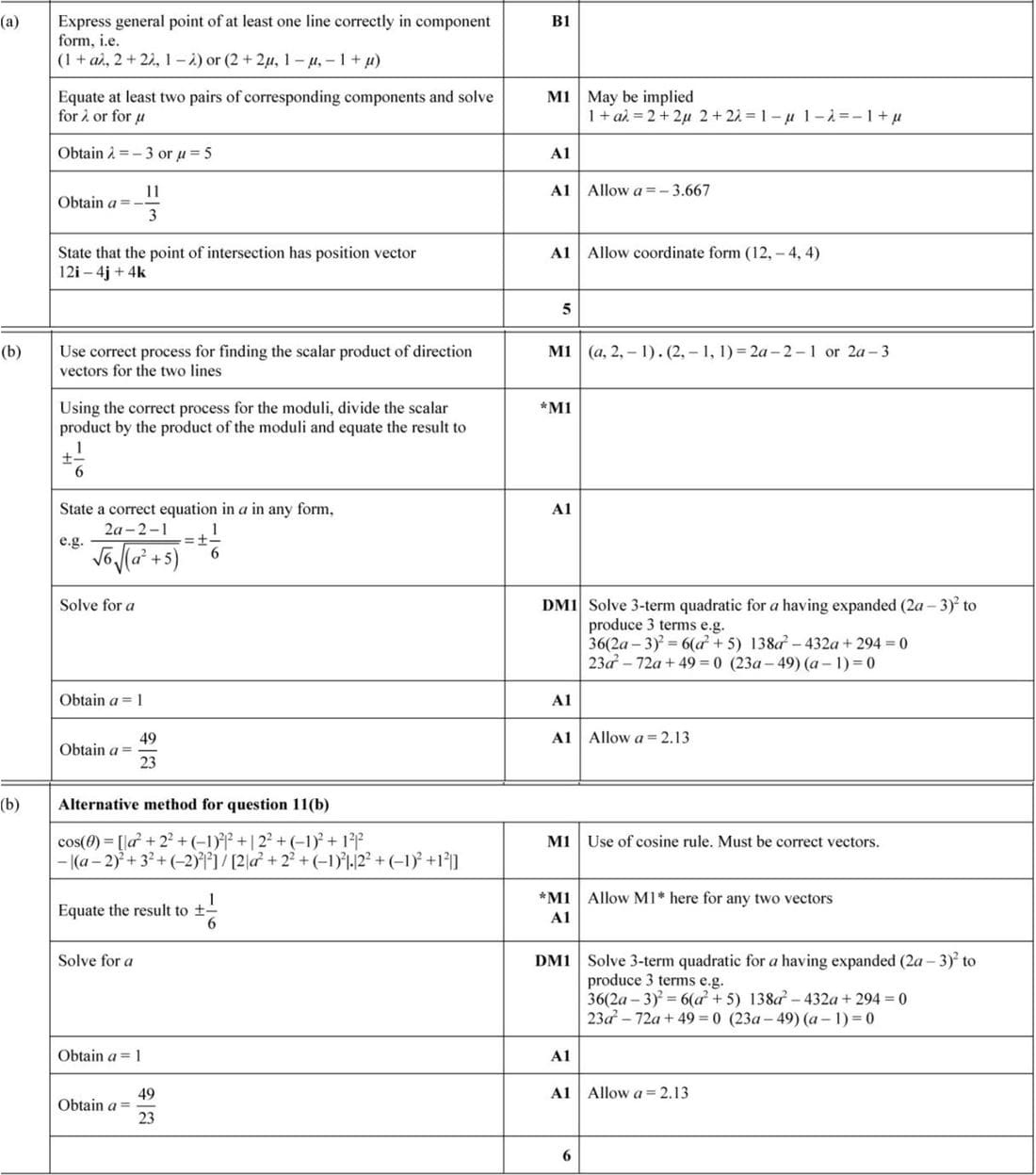
Two lines have equations \(\mathbf{r} = \mathbf{i} + 2\mathbf{j} + \mathbf{k} + \lambda(a\mathbf{i} + 2\mathbf{j} - \mathbf{k})\) and \(\mathbf{r} = 2\mathbf{i} + \mathbf{j} - \mathbf{k} + \mu(2\mathbf{i} - \mathbf{j} + \mathbf{k})\), where \(a\) is a constant.
(a) Given that the two lines intersect, find the value of \(a\) and the position vector of the point of intersection.
(b) Given instead that the acute angle between the directions of the two lines is \(\cos^{-1}\left(\frac{1}{6}\right)\), find the two possible values of \(a\).