Exam-Style Problems
⬅ Back to SubchapterJune 2006 p3 q7
1910
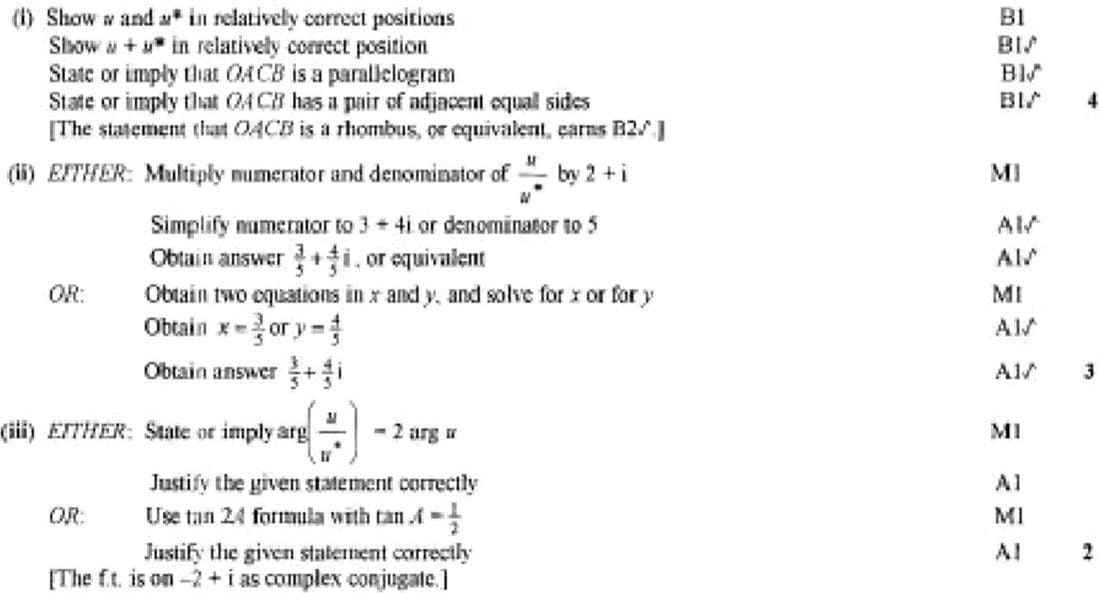
The complex number 2 + i is denoted by u. Its complex conjugate is denoted by u*.
(i) Show, on a sketch of an Argand diagram with origin O, the points A, B and C representing the complex numbers u, u* and u + u* respectively. Describe in geometrical terms the relationship between the four points O, A, B and C. [4]
(ii) Express \(\frac{u}{u^*}\) in the form \(x + iy\), where x and y are real. [3]
(iii) By considering the argument of \(\frac{u}{u^*}\), or otherwise, prove that \(\arctan\left(\frac{4}{3}\right) = 2 \arctan\left(\frac{1}{2}\right)\). [2]
Nov 2005 p3 q7
1911
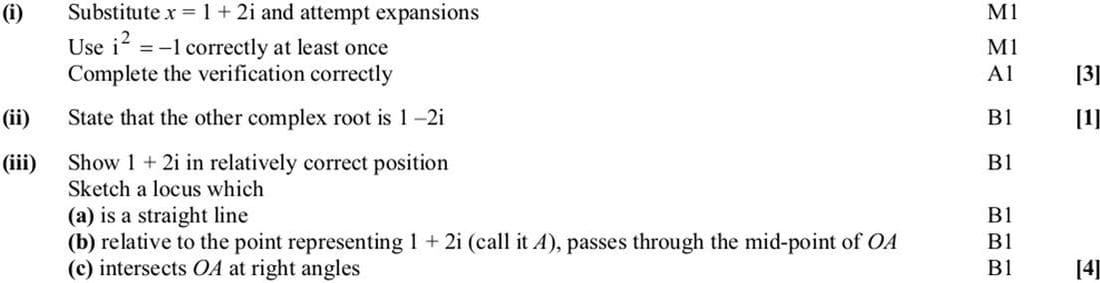
The equation \(2x^3 + x^2 + 25 = 0\) has one real root and two complex roots.
- Verify that \(1 + 2i\) is one of the complex roots.
- Write down the other complex root of the equation.
- Sketch an Argand diagram showing the point representing the complex number \(1 + 2i\). Show on the same diagram the set of points representing the complex numbers \(z\) which satisfy \(|z| = |z - 1 - 2i|\).
June 2005 p3 q3
1912
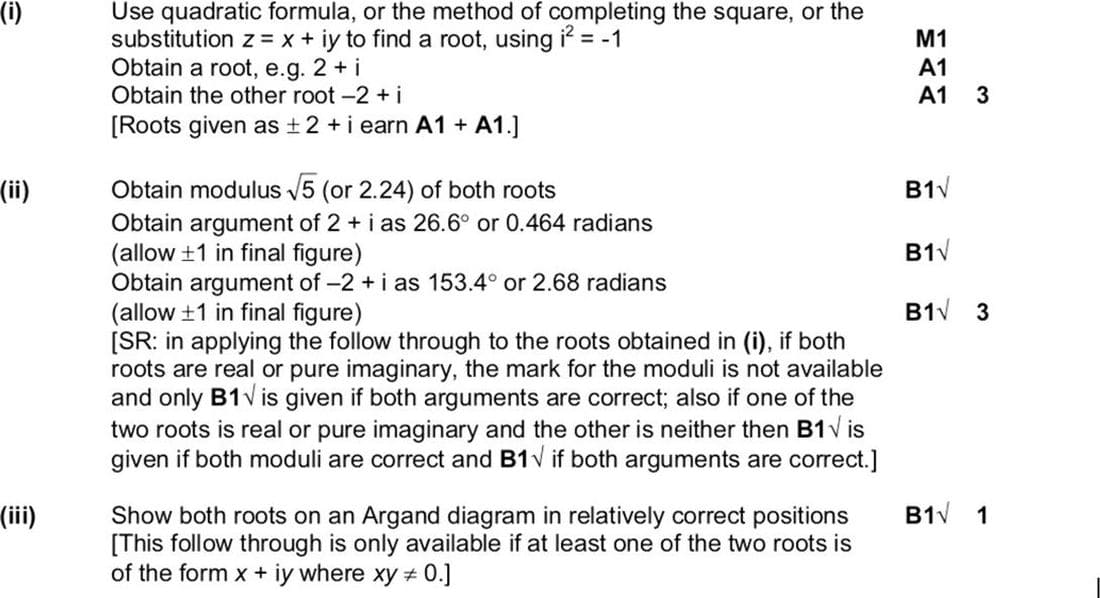
(i) Solve the equation \(z^2 - 2iz - 5 = 0\), giving your answers in the form \(x + iy\) where \(x\) and \(y\) are real.
(ii) Find the modulus and argument of each root.
(iii) Sketch an Argand diagram showing the points representing the roots.
Nov 2004 p3 q6
1913
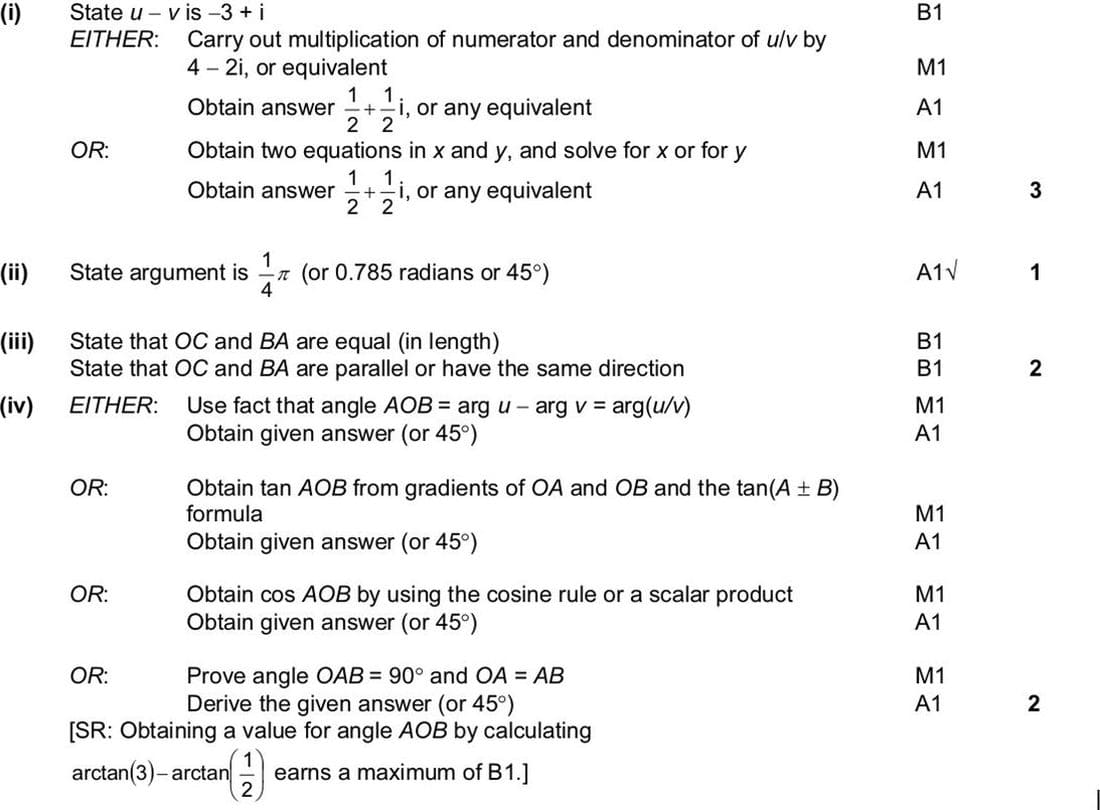
The complex numbers 1 + 3i and 4 + 2i are denoted by u and v respectively.
- Find, in the form x + iy, where x and y are real, the complex numbers u - v and \(\frac{u}{v}\).
- State the argument of \(\frac{u}{v}\).
In an Argand diagram, with origin O, the points A, B and C represent the numbers u, v and u - v respectively.
- State fully the geometrical relationship between OC and BA.
- Prove that angle AOB = \(\frac{1}{4} \pi\) radians.
June 2004 p3 q8
1914
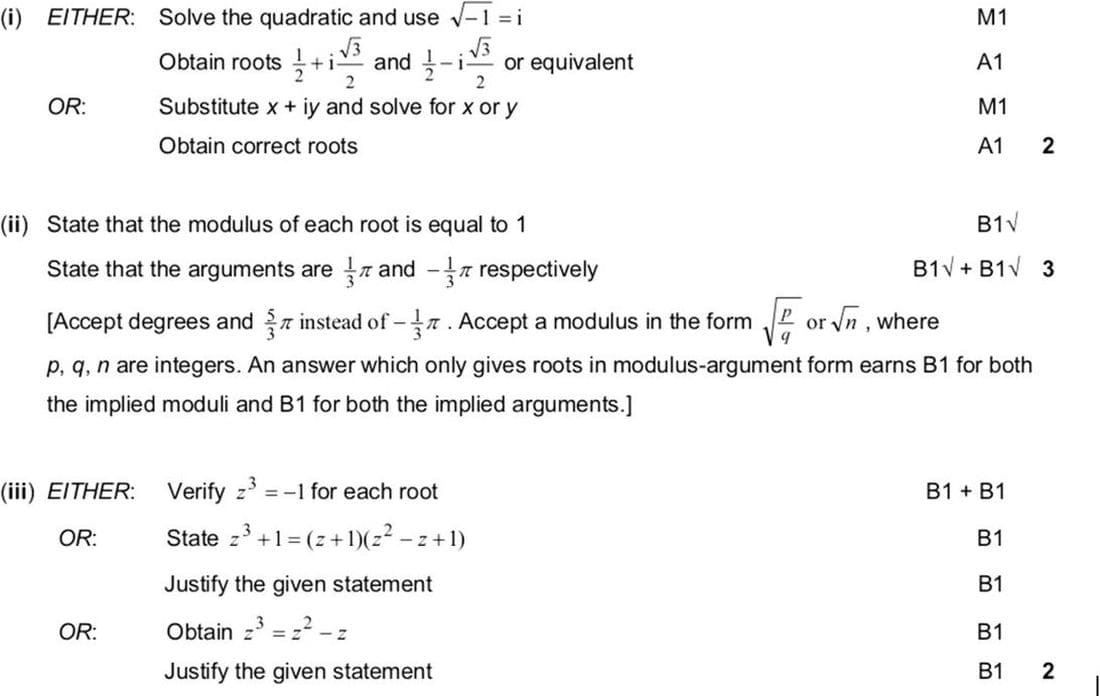
(i) Find the roots of the equation \(z^2 - z + 1 = 0\), giving your answers in the form \(x + iy\), where \(x\) and \(y\) are real.
(ii) Obtain the modulus and argument of each root.
(iii) Show that each root also satisfies the equation \(z^3 = -1\).