Exam-Style Problems
⬅ Back to SubchapterNov 2009 p32 q2
The equation \(x^3 - 8x - 13 = 0\) has one real root.
(i) Find the two consecutive integers between which this root lies.
(ii) Use the iterative formula \(x_{n+1} = (8x_n + 13)^{\frac{1}{3}}\) to determine this root correct to 2 decimal places. Give the result of each iteration to 4 decimal places.

Nov 2009 p31 q3
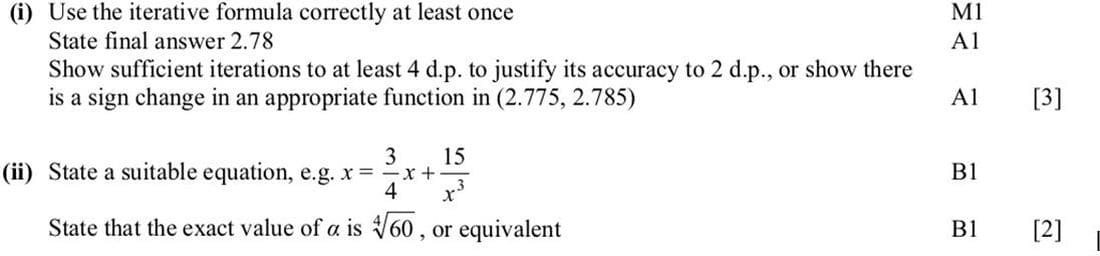
The sequence of values given by the iterative formula \(x_{n+1} = \frac{3x_n}{4} + \frac{15}{x_n^3}\), with initial value \(x_1 = 3\), converges to \(\alpha\).
(i) Use this iterative formula to find \(\alpha\) correct to 2 decimal places, giving the result of each iteration to 4 decimal places.
(ii) State an equation satisfied by \(\alpha\) and hence find the exact value of \(\alpha\).
June 2009 p3 q4
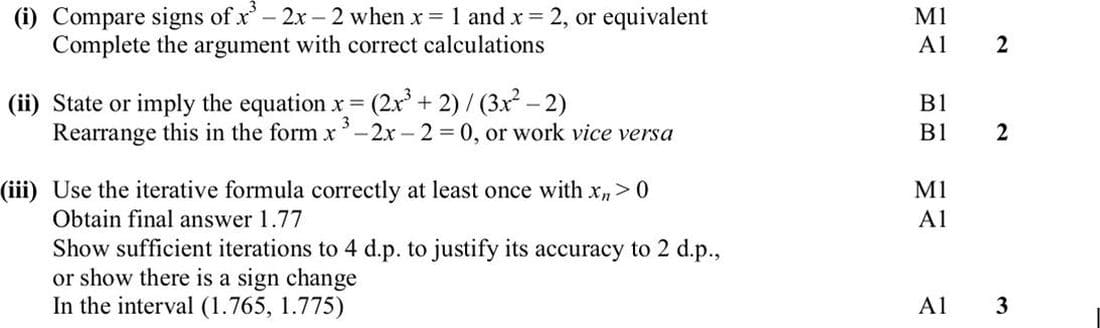
The equation \(x^3 - 2x - 2 = 0\) has one real root.
(i) Show by calculation that this root lies between \(x = 1\) and \(x = 2\).
(ii) Prove that, if a sequence of values given by the iterative formula \(x_{n+1} = \frac{2x_n^3 + 2}{3x_n^2 - 2}\) converges, then it converges to this root.
(iii) Use this iterative formula to calculate the root correct to 2 decimal places. Give the result of each iteration to 4 decimal places.
Nov 2005 p3 q4
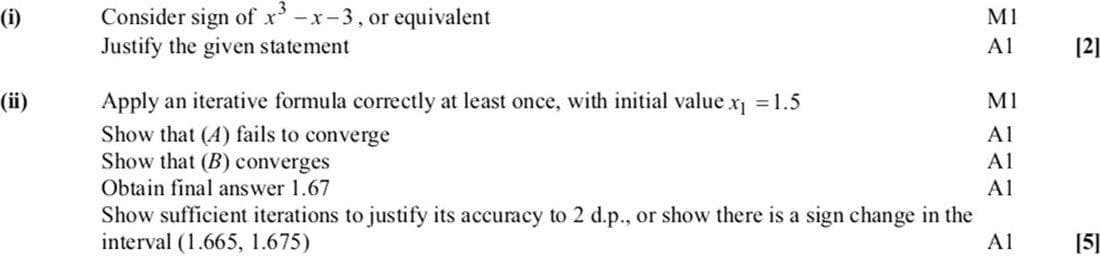
The equation \(x^3 - x - 3 = 0\) has one real root, \(\alpha\).
(i) Show that \(\alpha\) lies between 1 and 2.
Two iterative formulae derived from this equation are as follows:
\(x_{n+1} = x_n^3 - 3, \quad (A)\)
\(x_{n+1} = (x_n + 3)^{\frac{1}{3}}, \quad (B)\)
Each formula is used with initial value \(x_1 = 1.5\).
(ii) Show that one of these formulae produces a sequence which fails to converge, and use the other formula to calculate \(\alpha\) correct to 2 decimal places. Give the result of each iteration to 4 decimal places.
June 2004 p3 q7
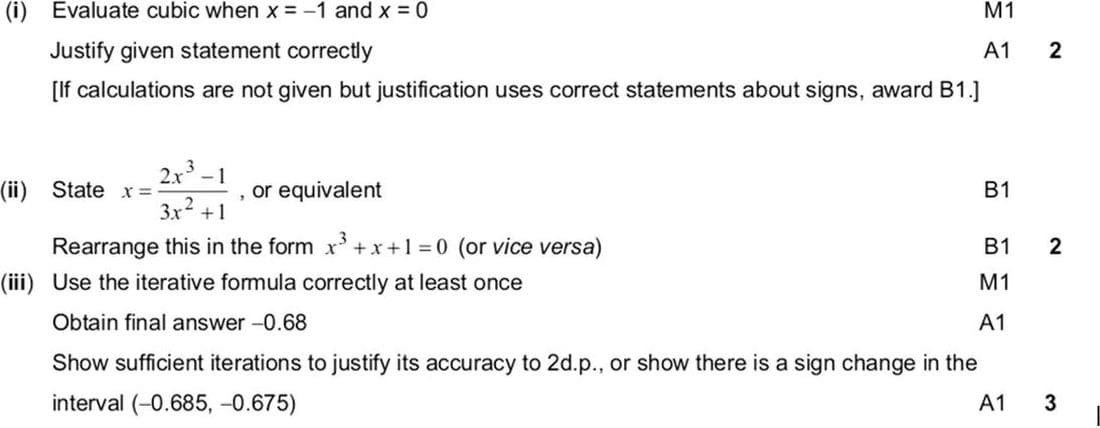
(i) The equation \(x^3 + x + 1 = 0\) has one real root. Show by calculation that this root lies between \(-1\) and \(0\).
(ii) Show that, if a sequence of values given by the iterative formula \(x_{n+1} = \frac{2x_n^3 - 1}{3x_n^2 + 1}\) converges, then it converges to the root of the equation given in part (i).
(iii) Use this iterative formula, with initial value \(x_1 = -0.5\), to determine the root correct to 2 decimal places, showing the result of each iteration.