Exam-Style Problems
⬅ Back to SubchapterNov 2023 p31 q9
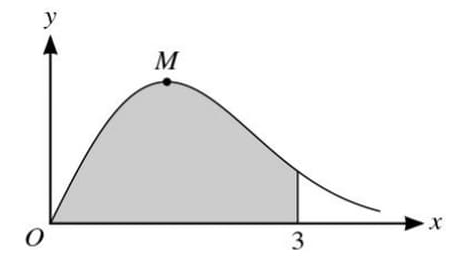
The diagram shows the curve \(y = xe^{-\frac{1}{4}x^2}\), for \(x \geq 0\), and its maximum point \(M\).
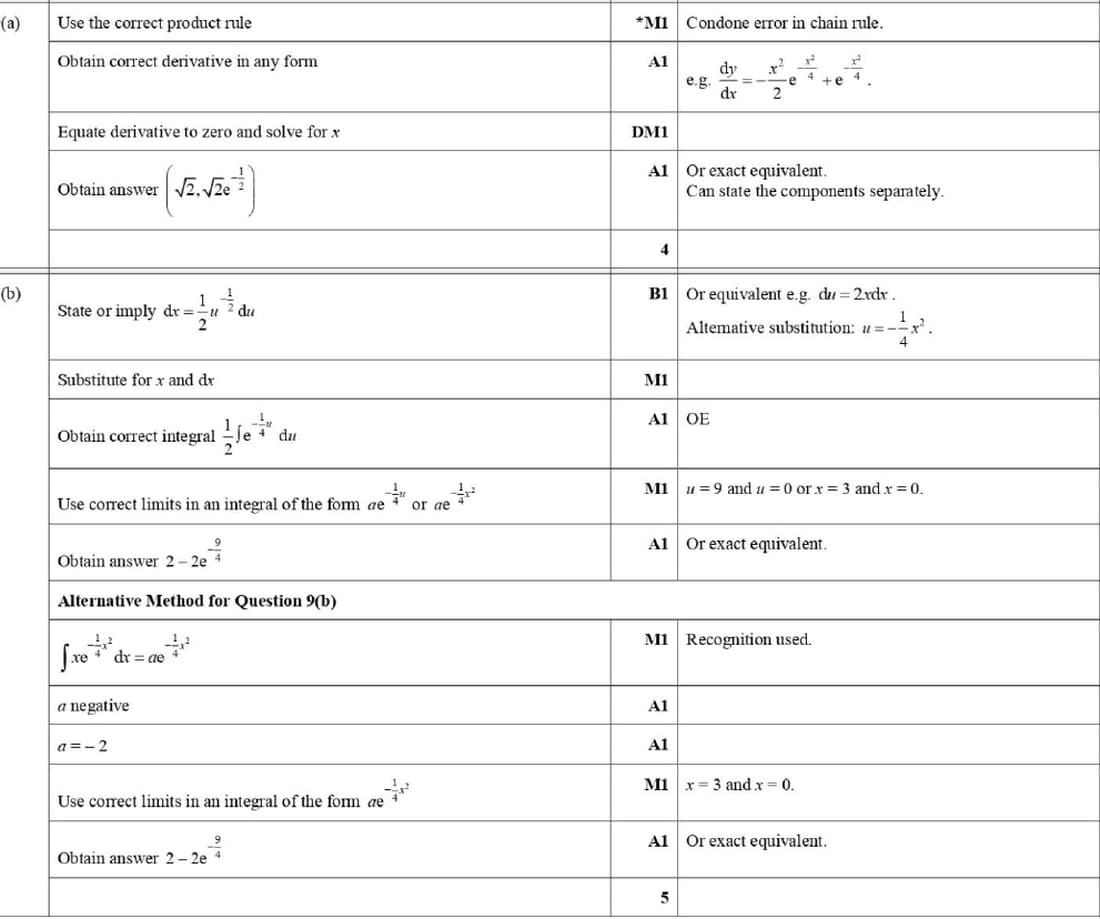
(a) Find the exact coordinates of \(M\).
(b) Using the substitution \(x = \sqrt{u}\), or otherwise, find by integration the exact area of the shaded region bounded by the curve, the \(x\)-axis and the line \(x = 3\).
June 2013 p33 q9
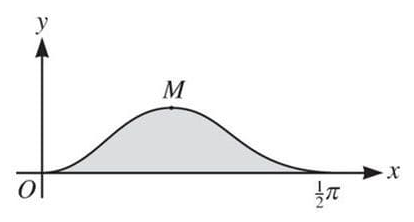
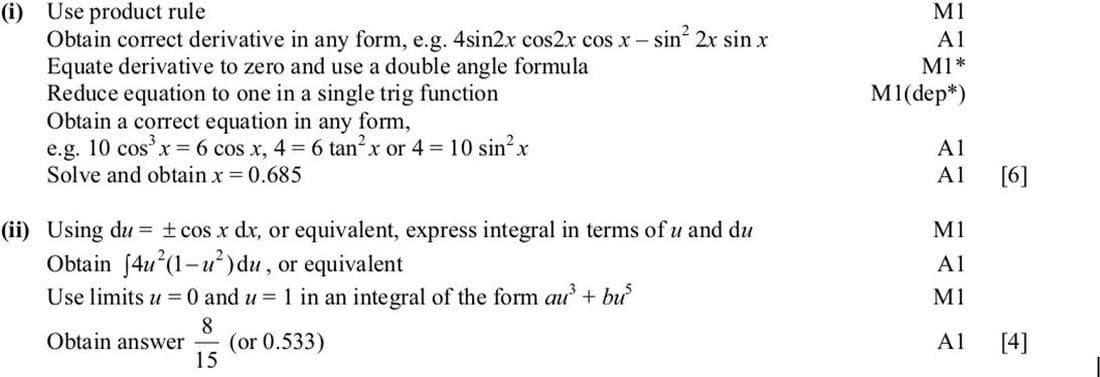
The diagram shows the curve \(y = \\sin^2 2x \\cos x\) for \(0 \leq x \leq \frac{1}{2} \pi\), and its maximum point \(M\).
(i) Find the \(x\)-coordinate of \(M\).
(ii) Using the substitution \(u = \\sin x\), find by integration the area of the shaded region bounded by the curve and the \(x\)-axis.
June 2011 p33 q8
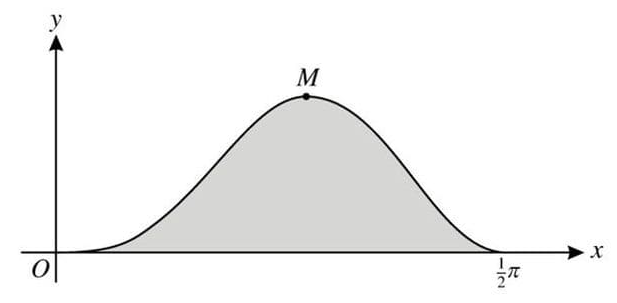
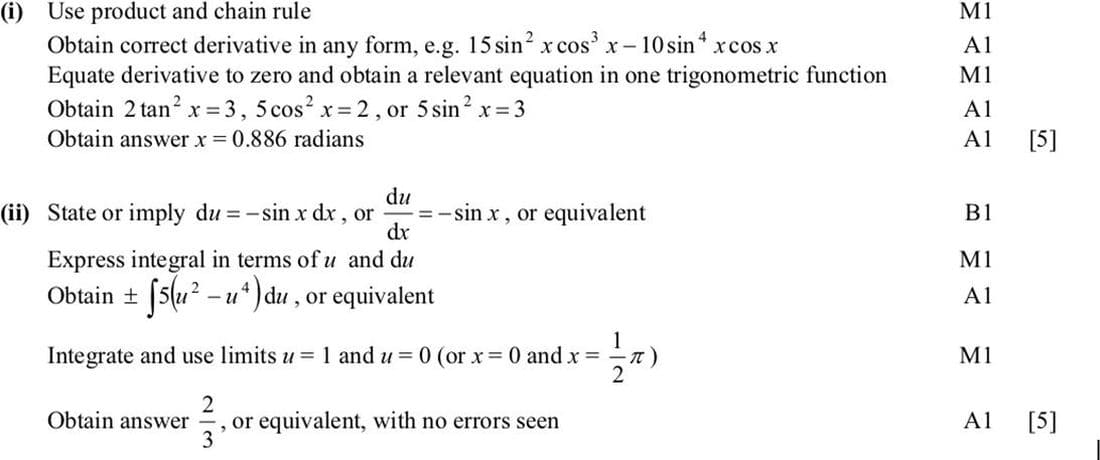
The diagram shows the curve \(y = 5 \sin^3 x \cos^2 x\) for \(0 \leq x \leq \frac{1}{2} \pi\), and its maximum point \(M\).
(i) Find the \(x\)-coordinate of \(M\).
(ii) Using the substitution \(u = \cos x\), find by integration the area of the shaded region bounded by the curve and the \(x\)-axis.
June 2009 p3 q10
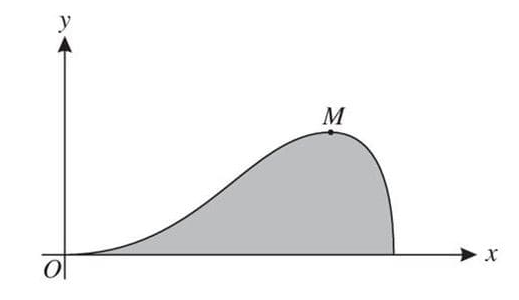
The diagram shows the curve \(y = x^2 \sqrt{1-x^2}\) for \(x \geq 0\) and its maximum point \(M\).
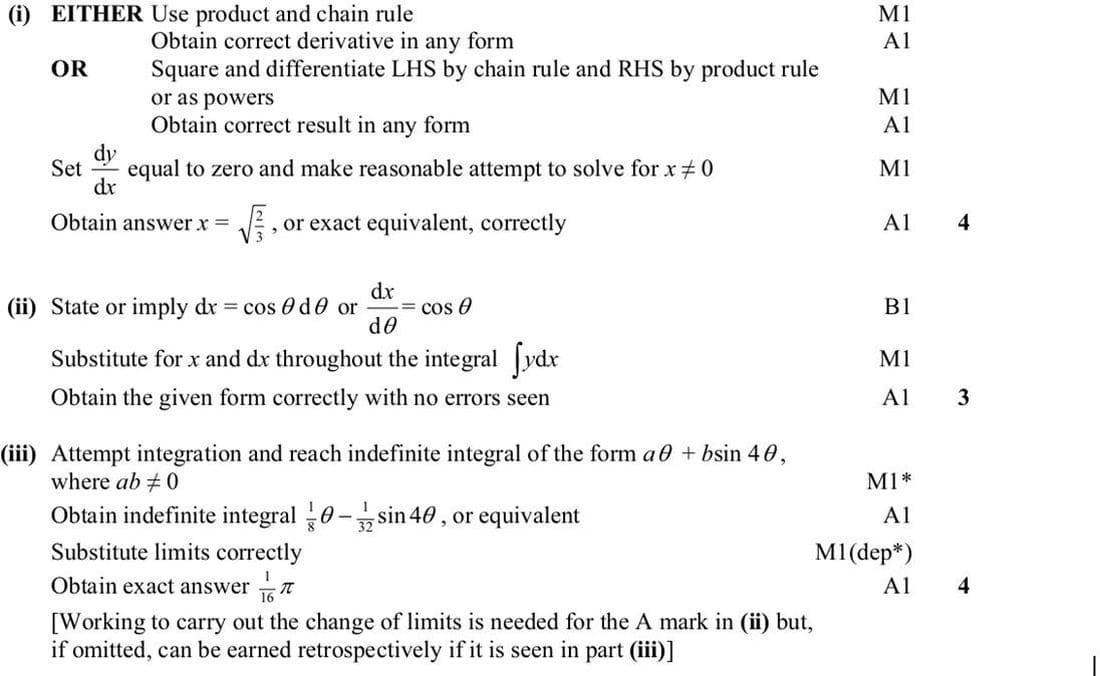
(i) Find the exact value of the \(x\)-coordinate of \(M\).
(ii) Show, by means of the substitution \(x = \sin \theta\), that the area \(A\) of the shaded region between the curve and the \(x\)-axis is given by
\(A = \frac{1}{4} \int_0^{\frac{\pi}{2}} \sin^2 2\theta \ d\theta.\)
(iii) Hence obtain the exact value of \(A\).
June 2023 p32 q10
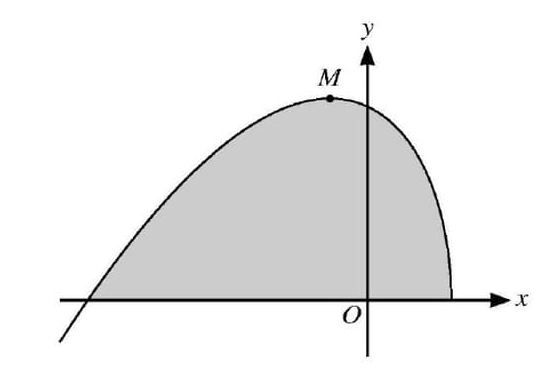
The diagram shows the curve \(y = (x + 5) \sqrt{3 - 2x}\) and its maximum point \(M\).
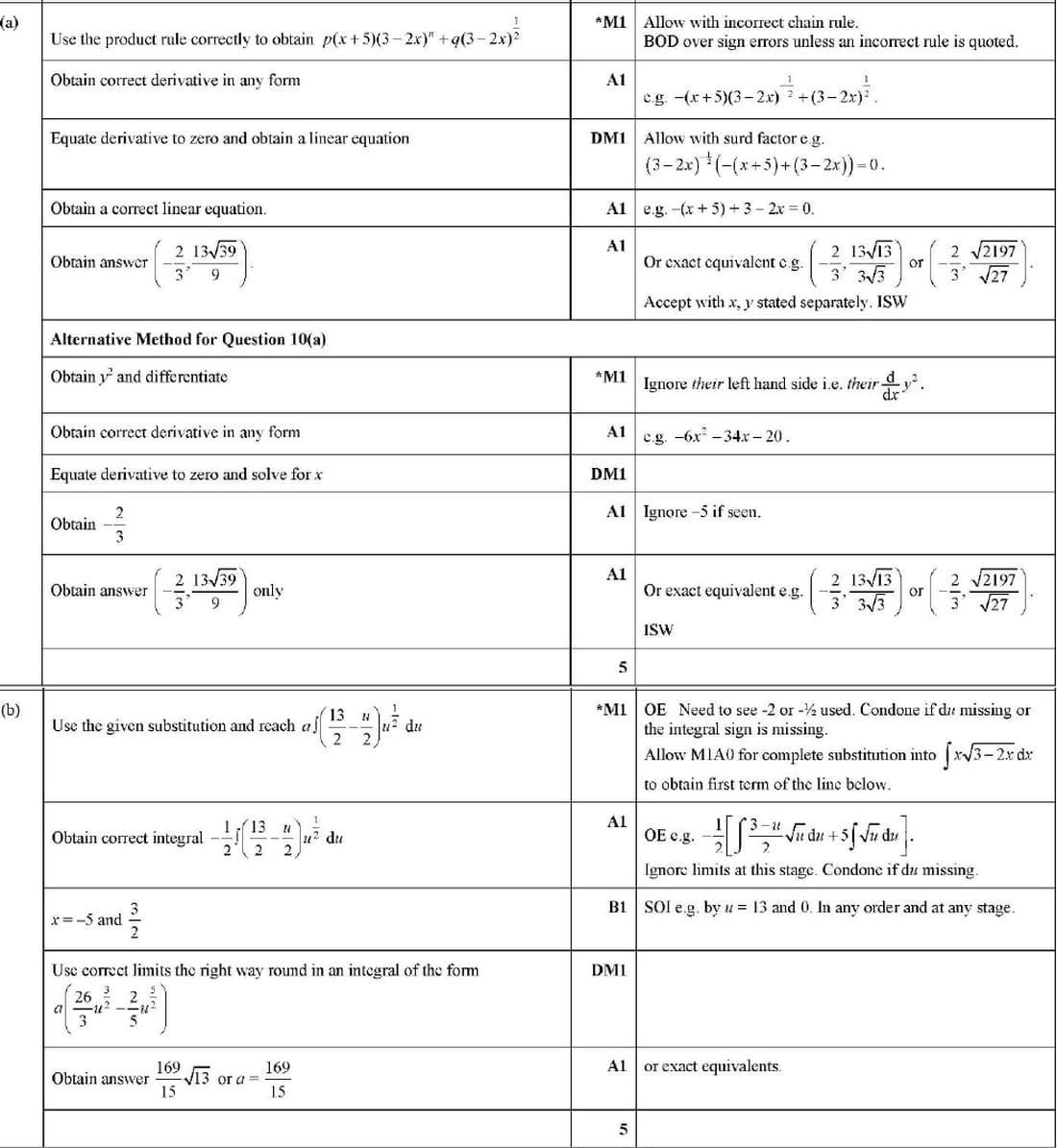
(a) Find the exact coordinates of \(M\).
(b) Using the substitution \(u = 3 - 2x\), find by integration the area of the shaded region bounded by the curve and the \(x\)-axis. Give your answer in the form \(a \sqrt{13}\), where \(a\) is a rational number.