Exam-Style Problems
⬅ Back to SubchapterNov 2013 p31 q5
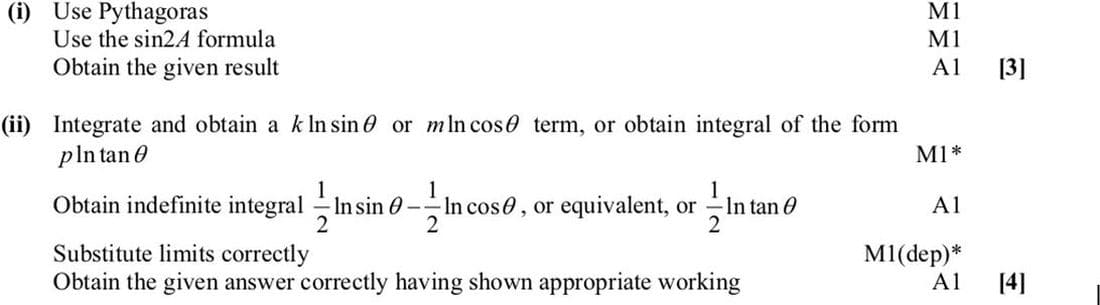
(i) Prove that \(\cot \theta + \tan \theta \equiv 2 \csc 2\theta\).
(ii) Hence show that \(\int_{\frac{1}{6}\pi}^{\frac{1}{3}\pi} \csc 2\theta \, d\theta = \frac{1}{2} \ln 3\).
June 2011 p31 q9
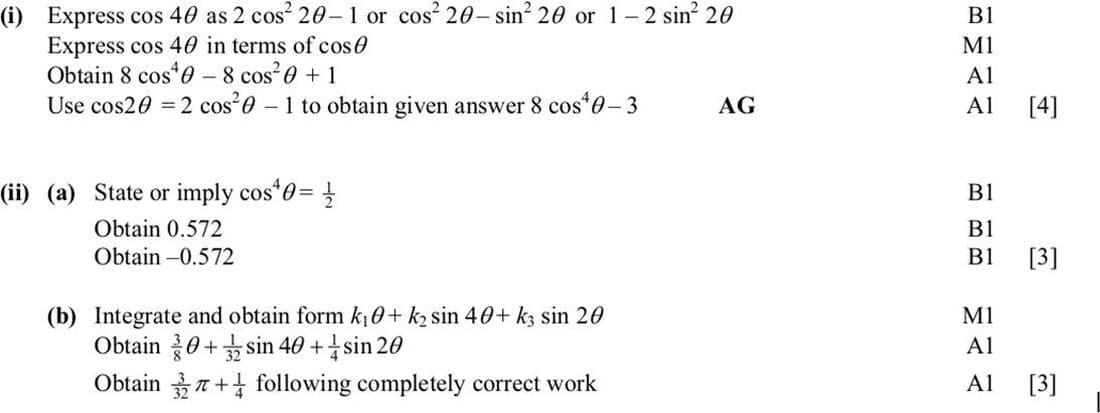
(i) Prove the identity \(\cos 4\theta + 4 \cos 2\theta \equiv 8 \cos^4 \theta - 3\).
(ii) Hence
(a) solve the equation \(\cos 4\theta + 4 \cos 2\theta = 1\) for \(-\frac{1}{2}\pi \leq \theta \leq \frac{1}{2}\pi\),
(b) find the exact value of \(\int_0^{\frac{1}{4}\pi} \cos^4 \theta \, d\theta\).
Nov 2010 p33 q4
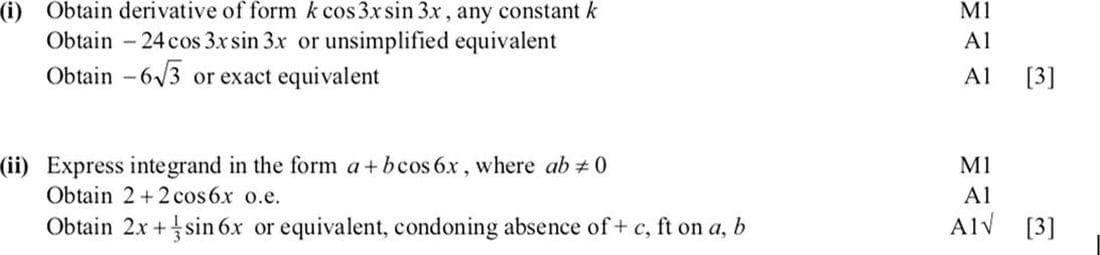
It is given that \(f(x) = 4 \cos^2 3x\).
(i) Find the exact value of \(f'(\frac{1}{9}\pi)\).
(ii) Find \(\int f(x) \, dx\).
June 2010 p33 q7
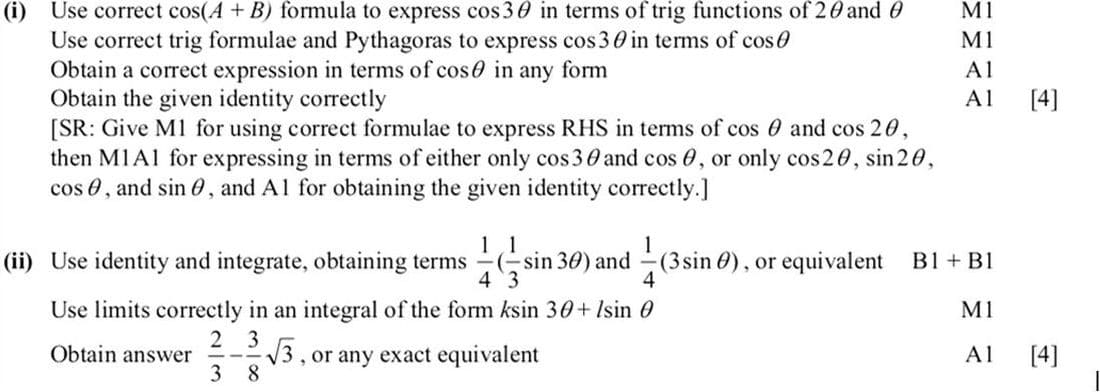
(i) Prove the identity \(\cos 3\theta \equiv 4 \cos^3 \theta - 3 \cos \theta\).
(ii) Using this result, find the exact value of \(\int_{\frac{1}{3}\pi}^{\frac{1}{2}\pi} \cos^3 \theta \, d\theta\).
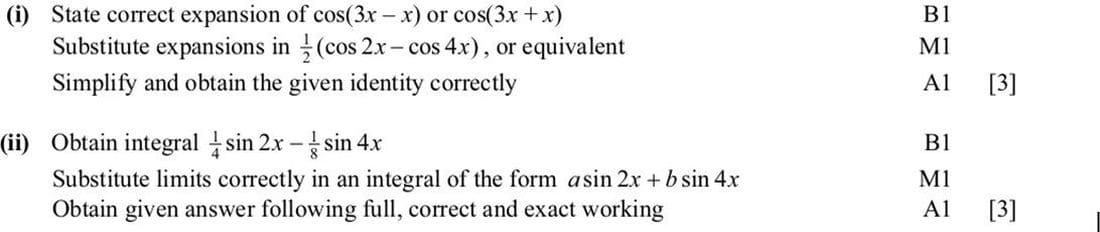
June 2010 p31 q4
(i) Using the expansions of \(\cos(3x-x)\) and \(\cos(3x+x)\), prove that \(\frac{1}{2}(\cos 2x - \cos 4x) \equiv \sin 3x \sin x\).
(ii) Hence show that \(\int_{\frac{1}{6}\pi}^{\frac{1}{3}\pi} \sin 3x \sin x \, dx = \frac{1}{8}\sqrt{3}\).