Exam-Style Problems
⬅ Back to SubchapterNov 2009 p11 q4
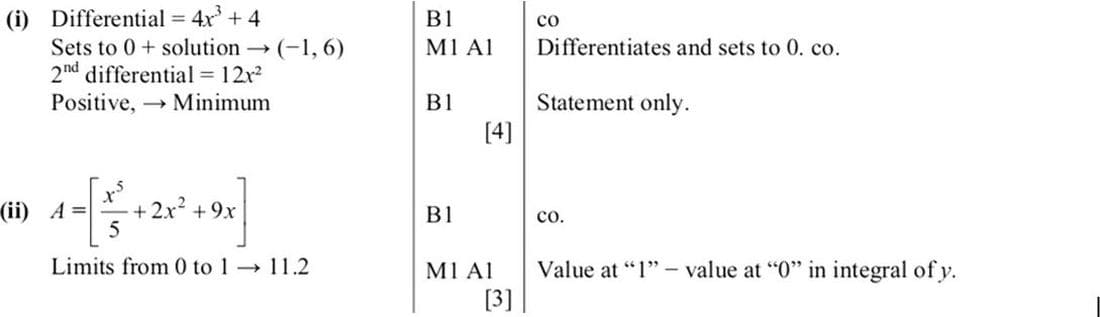
The equation of a curve is \(y = x^4 + 4x + 9\).
(i) Find the coordinates of the stationary point on the curve and determine its nature.
(ii) Find the area of the region enclosed by the curve, the x-axis and the lines \(x = 0\) and \(x = 1\).
June 2009 p1 q11
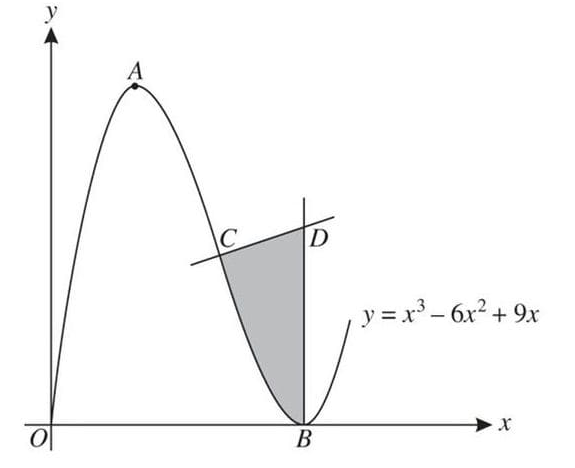
The diagram shows the curve \(y = x^3 - 6x^2 + 9x\) for \(x \geq 0\). The curve has a maximum point at \(A\) and a minimum point on the \(x\)-axis at \(B\). The normal to the curve at \(C (2, 2)\) meets the normal to the curve at \(B\) at the point \(D\).
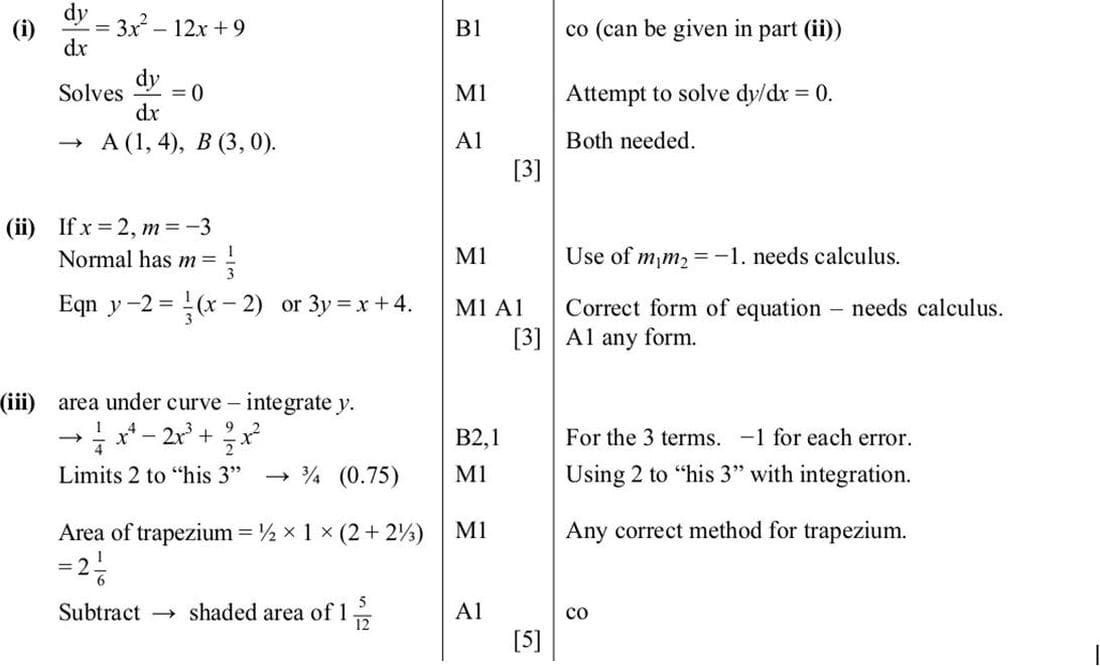
(i) Find the coordinates of \(A\) and \(B\).
(ii) Find the equation of the normal to the curve at \(C\).
(iii) Find the area of the shaded region.
June 2008 p1 q9
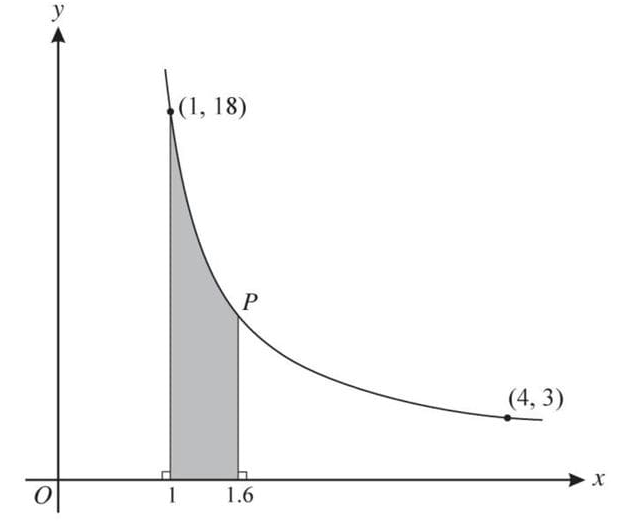
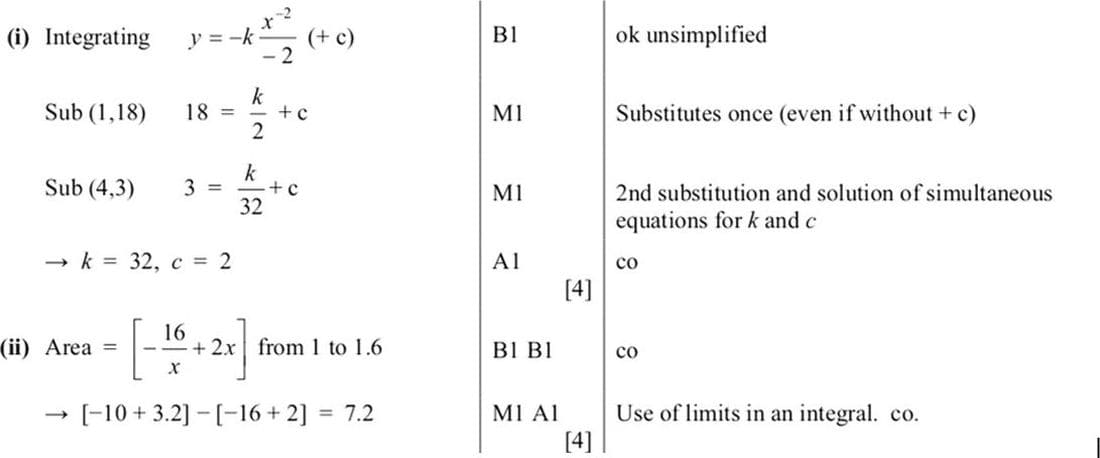
The diagram shows a curve for which \(\frac{dy}{dx} = -\frac{k}{x^3}\), where \(k\) is a constant. The curve passes through the points \((1, 18)\) and \((4, 3)\).
(i) Show, by integration, that the equation of the curve is \(y = \frac{16}{x^2} + 2\).
The point \(P\) lies on the curve and has \(x\)-coordinate 1.6.
(ii) Find the area of the shaded region.
Nov 2007 p1 q2
Find the area of the region enclosed by the curve \(y = 2\sqrt{x}\), the x-axis and the lines \(x = 1\) and \(x = 4\).

June 2007 p1 q10
The equation of a curve is \(y = 2x + \frac{8}{x^2}\).
Find the area of the region enclosed by the curve, the x-axis and the lines \(x = 1\) and \(x = 2\).
