Exam-Style Problems
⬅ Back to SubchapterJune 2015 p42 q2
The total mass of a cyclist and his cycle is 80 kg. The resistance to motion is zero.
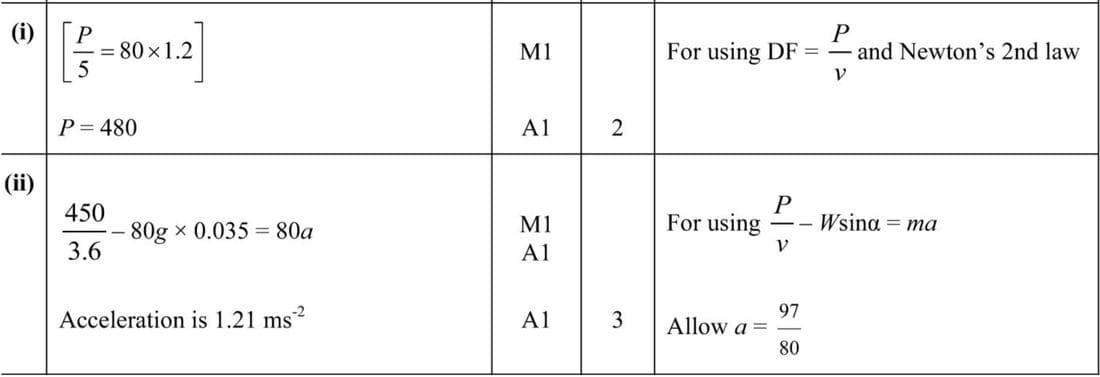
- The cyclist moves along a horizontal straight road working at a constant rate of \(P\) W. Find the value of \(P\) given that the cyclist’s speed is 5 m s\(^{-1}\) when his acceleration is 1.2 m s\(^{-2}\).
- The cyclist moves up a straight hill inclined at an angle \(\alpha\), where \(\sin \alpha = 0.035\). Find the acceleration of the cyclist at an instant when he is working at a rate of 450 W and has speed 3.6 m s\(^{-1}\).
June 2015 p41 q5
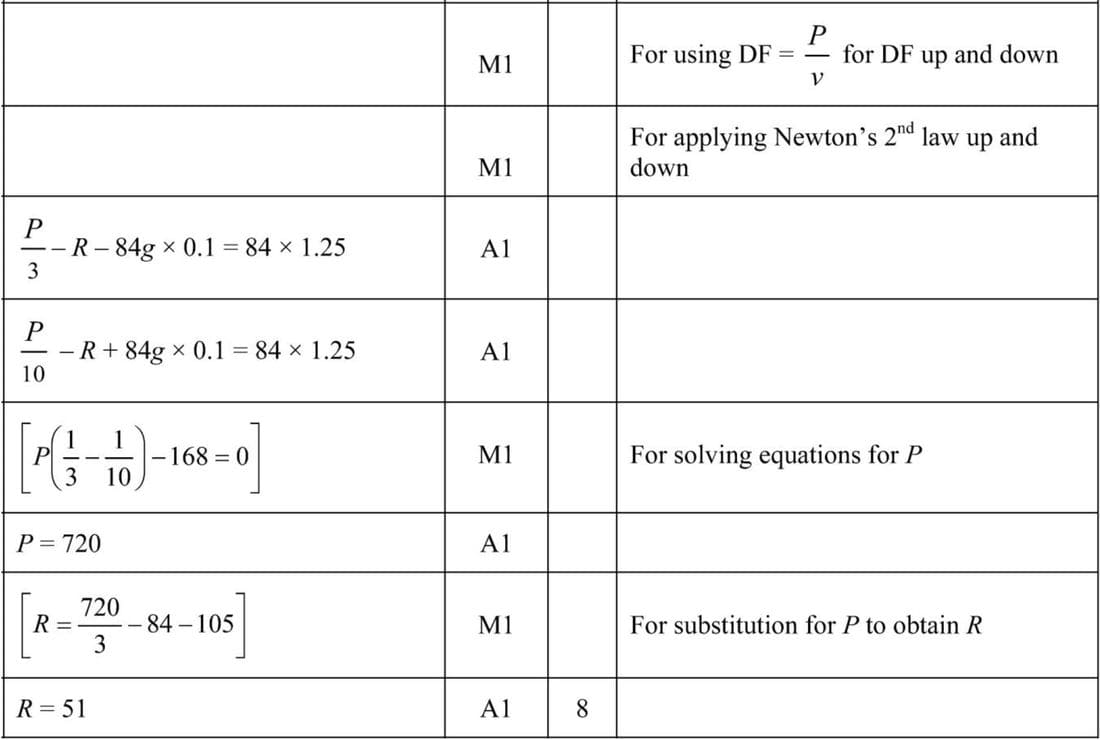
A cyclist and her bicycle have a total mass of 84 kg. She works at a constant rate of \(P \, W\) while moving on a straight road which is inclined to the horizontal at an angle \(\theta\), where \(\sin \theta = 0.1\). When moving uphill, the cyclist’s acceleration is \(1.25 \, \text{m/s}^2\) at an instant when her speed is \(3 \, \text{m/s}\). When moving downhill, the cyclist’s acceleration is \(1.25 \, \text{m/s}^2\) at an instant when her speed is \(10 \, \text{m/s}\). The resistance to the cyclist’s motion, whether the cyclist is moving uphill or downhill, is \(R \, N\). Find the values of \(P\) and \(R\).
Nov 2014 p43 q1
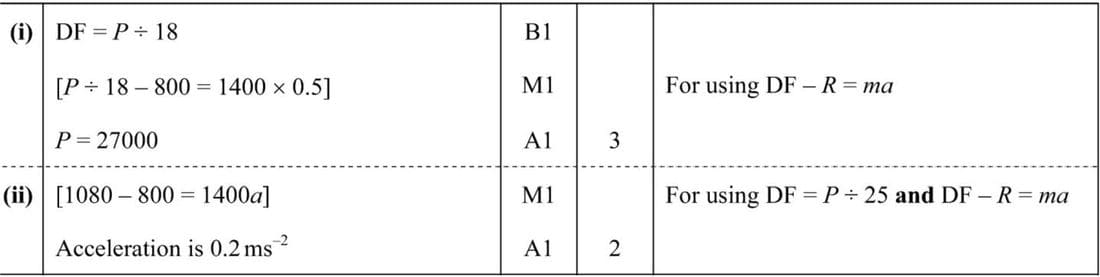
A car of mass 1400 kg moves on a horizontal straight road. The resistance to the car’s motion is constant and equal to 800 N and the power of the car’s engine is constant and equal to \(P\) W. At an instant when the car’s speed is 18 m s-1 its acceleration is 0.5 m s-2.
(i) Find the value of \(P\).
The car continues and passes through another point with speed 25 m s-1.
(ii) Find the car’s acceleration at this point.
Nov 2014 p42 q3
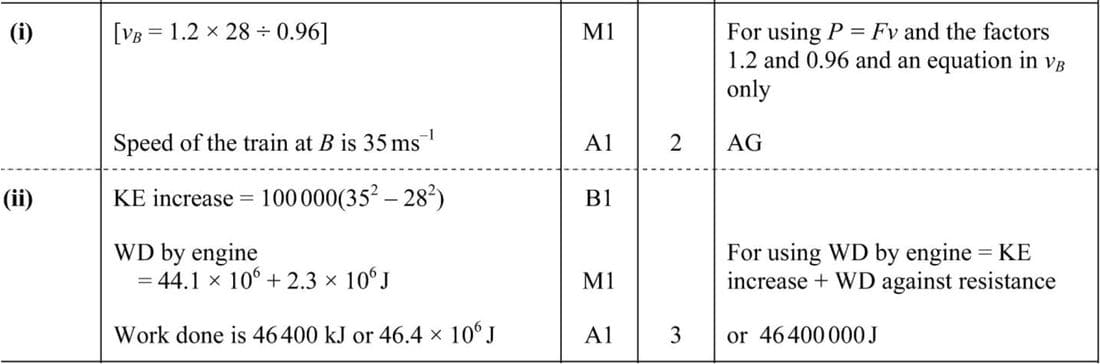
A train of mass 200,000 kg moves on a horizontal straight track. It passes through a point A with speed 28 m/s and later it passes through a point B. The power of the train’s engine at B is 1.2 times the power of the train’s engine at A. The driving force of the train’s engine at B is 0.96 times the driving force of the train’s engine at A.
(i) Show that the speed of the train at B is 35 m/s.
(ii) For the motion from A to B, find the work done by the train’s engine given that the work done against the resistance to the train’s motion is 2.3 × 10⁶ J.
Nov 2014 p41 q1
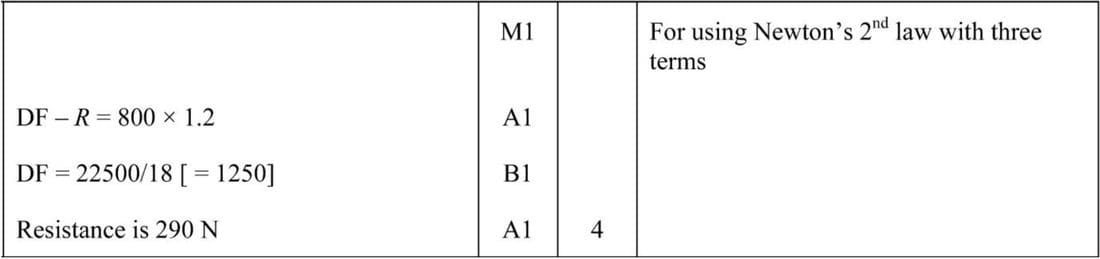
A car of mass 800 kg is moving on a straight horizontal road with its engine working at a rate of 22.5 kW. Find the resistance to the car’s motion at an instant when the car’s speed is 18 m/s and its acceleration is 1.2 m/s2.