Exam-Style Problems
⬅ Back to SubchapterJune 2016 p41 q2
3538
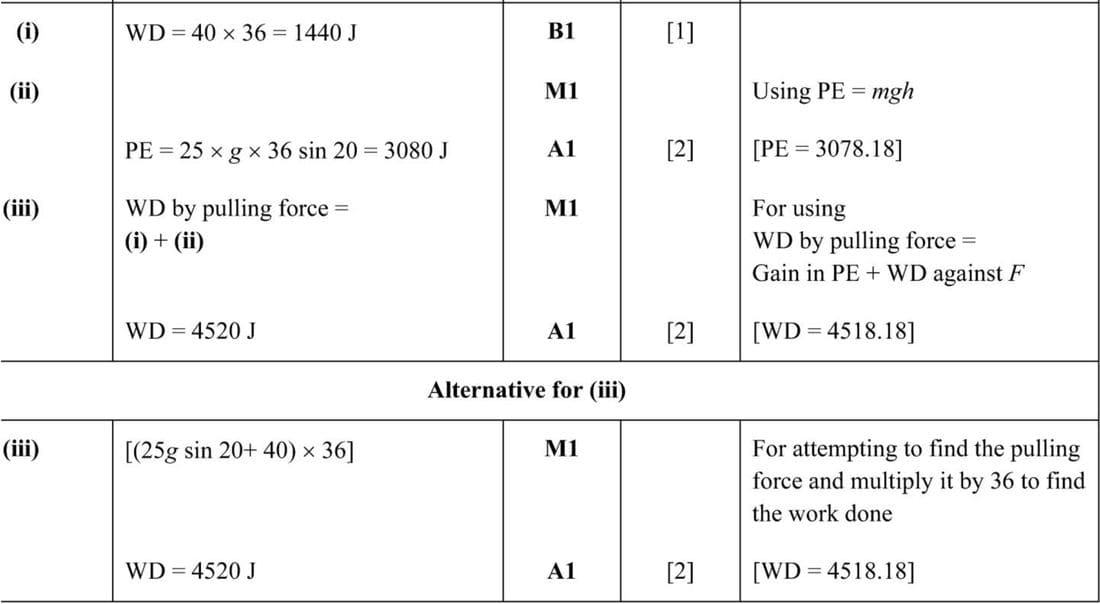
A box of mass 25 kg is pulled, at a constant speed, a distance of 36 m up a rough plane inclined at an angle of 20° to the horizontal. The box moves up a line of greatest slope against a constant frictional force of 40 N. The force pulling the box is parallel to the line of greatest slope. Find
- the work done against friction,
- the change in gravitational potential energy of the box,
- the work done by the pulling force.
Nov 2015 p43 q7
3539
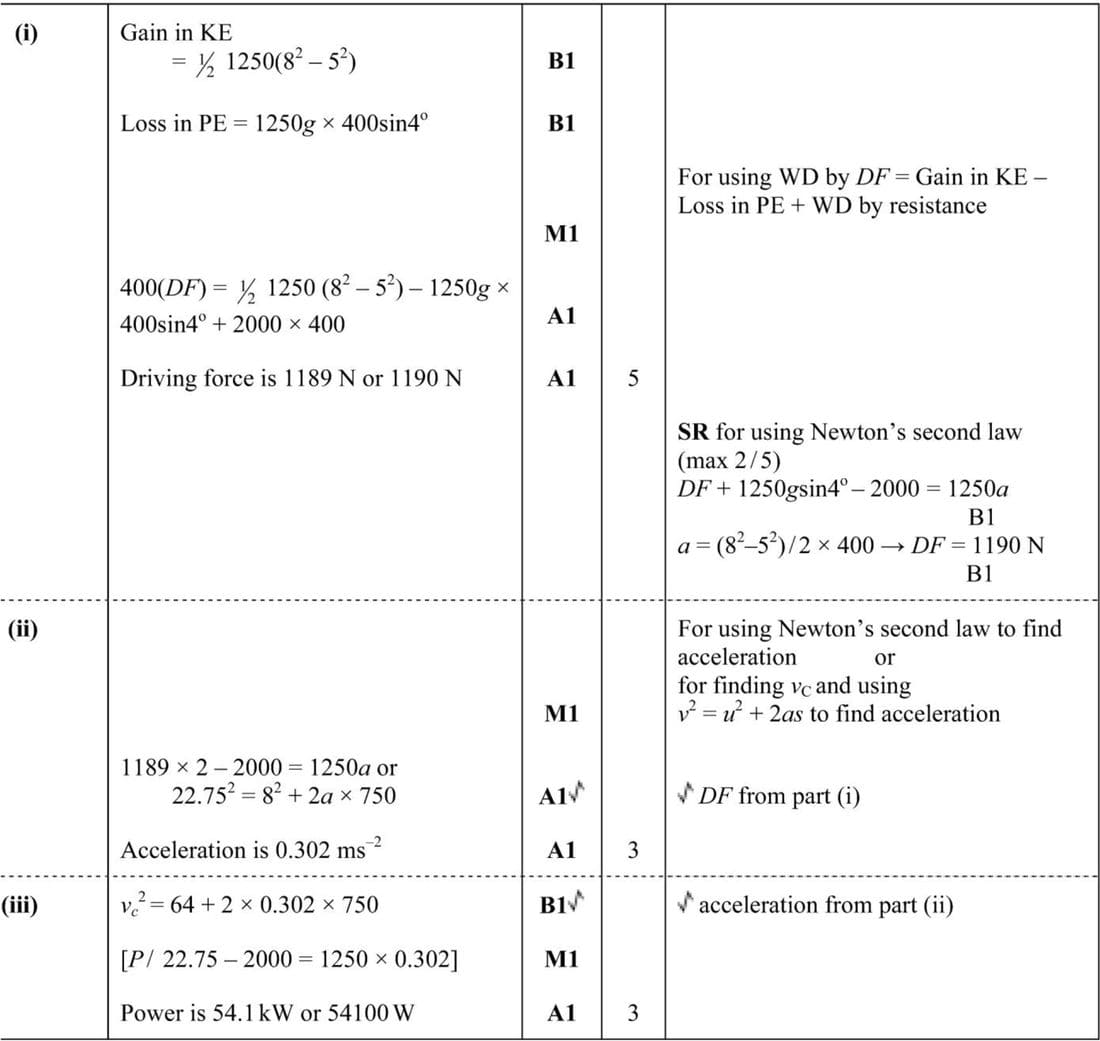
A straight hill AB has length 400 m with A at the top and B at the bottom and is inclined at an angle of 4° to the horizontal. A straight horizontal road BC has length 750 m. A car of mass 1250 kg has a speed of 5 m s-1 at A when starting to move down the hill. While moving down the hill the resistance to the motion of the car is 2000 N and the driving force is constant. The speed of the car on reaching B is 8 m s-1.
- By using work and energy, find the driving force of the car.
- On reaching B the car moves along the road BC. The driving force is constant and twice that when the car was on the hill. The resistance to the motion of the car continues to be 2000 N. Find
- the acceleration of the car while moving from B to C,
- the power of the car’s engine as the car reaches C.
Nov 2015 p42 q7
3540
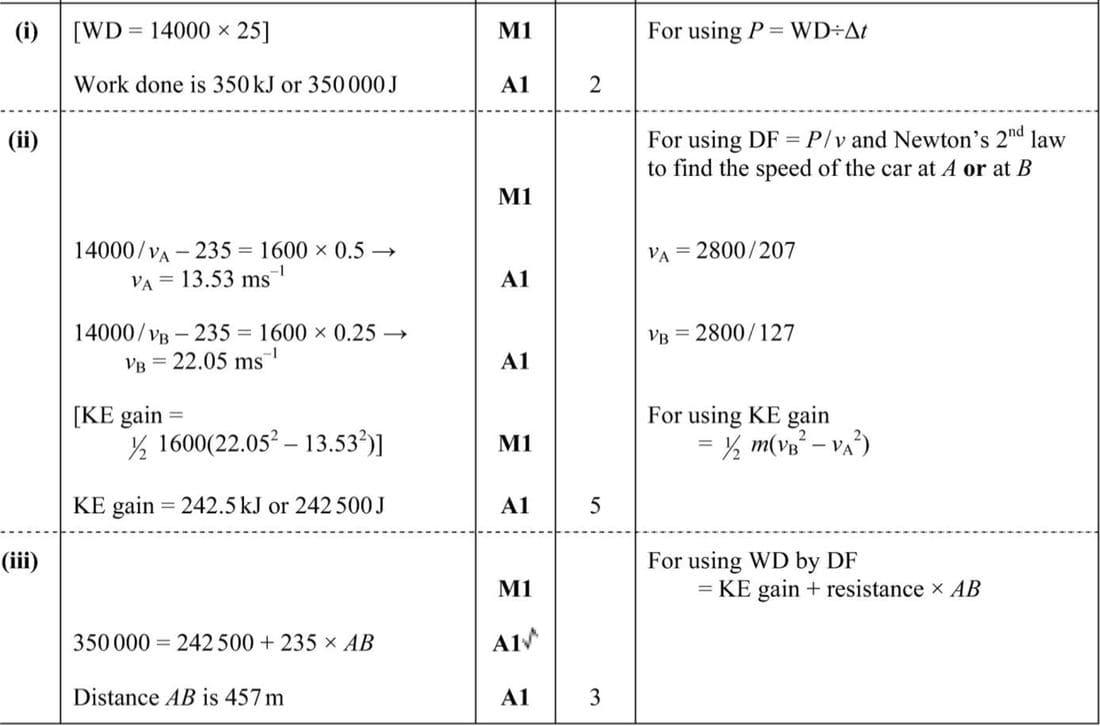
A car of mass 1600 kg moves with constant power 14 kW as it travels along a straight horizontal road. The car takes 25 s to travel between two points A and B on the road.
(i) Find the work done by the car’s engine while the car travels from A to B.
The resistance to the car’s motion is constant and equal to 235 N. The car has accelerations at A and B of 0.5 m/s2 and 0.25 m/s2 respectively. Find
(ii) the gain in kinetic energy by the car in moving from A to B,
(iii) the distance AB.
Nov 2015 p42 q4
3541
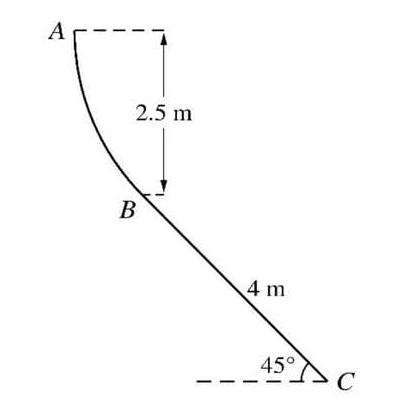
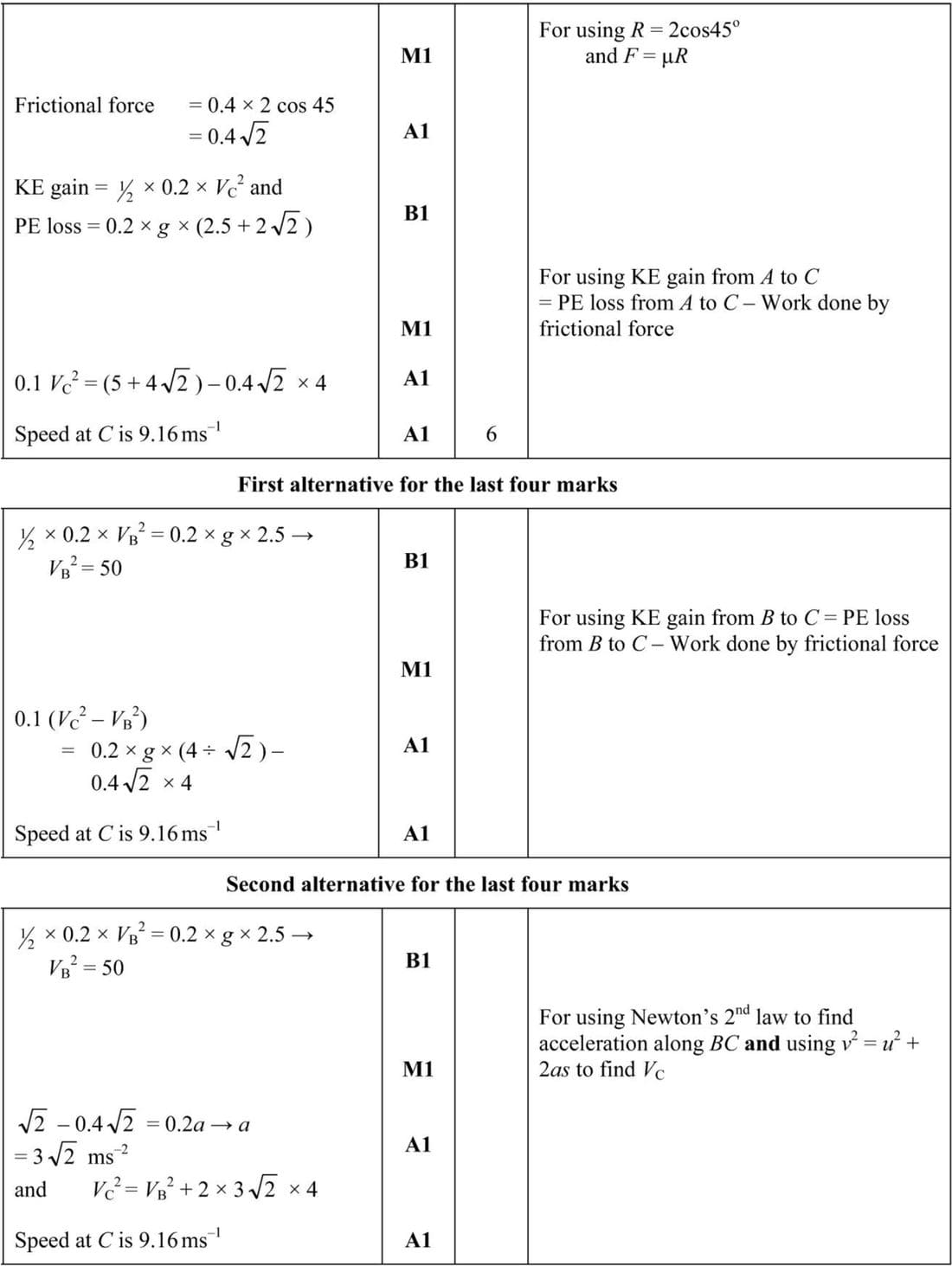
The diagram shows a vertical cross-section ABC of a surface. The part of the surface containing AB is smooth and A is 2.5 m above the level of B. The part of the surface containing BC is rough and is at 45° to the horizontal. The distance BC is 4 m (see diagram). A particle P of mass 0.2 kg is released from rest at A and moves in contact with the curve AB and then with the straight line BC. The coefficient of friction between P and the part of the surface containing BC is 0.4. Find the speed with which P reaches C.
June 2015 p42 q3
3542
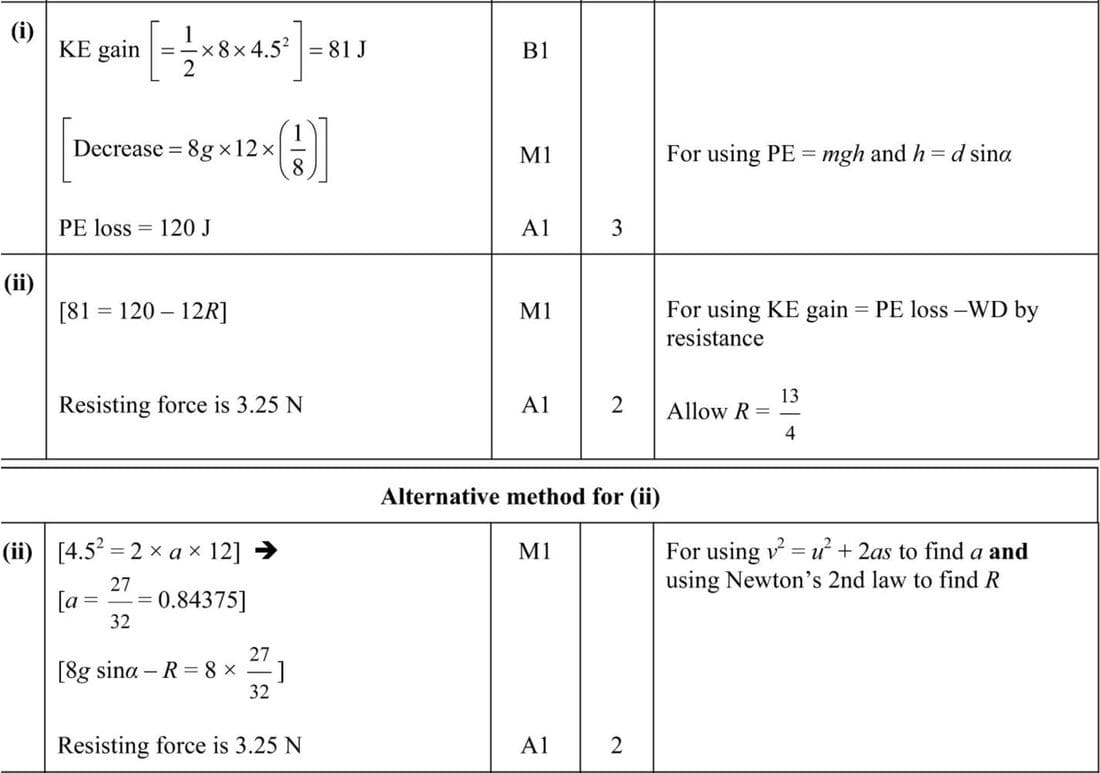
A plane is inclined at an angle of \(\sin^{-1}\left(\frac{1}{8}\right)\) to the horizontal. \(A\) and \(B\) are two points on the same line of greatest slope with \(A\) higher than \(B\). The distance \(AB\) is 12 m. A small object \(P\) of mass 8 kg is released from rest at \(A\) and slides down the plane, passing through \(B\) with speed 4.5 m s\(^{-1}\). For the motion of \(P\) from \(A\) to \(B\), find
- the increase in kinetic energy of \(P\) and the decrease in potential energy of \(P\),
- the magnitude of the constant resisting force that opposes the motion of \(P\).