Exam-Style Problems
⬅ Back to SubchapterNov 2013 p41 q7
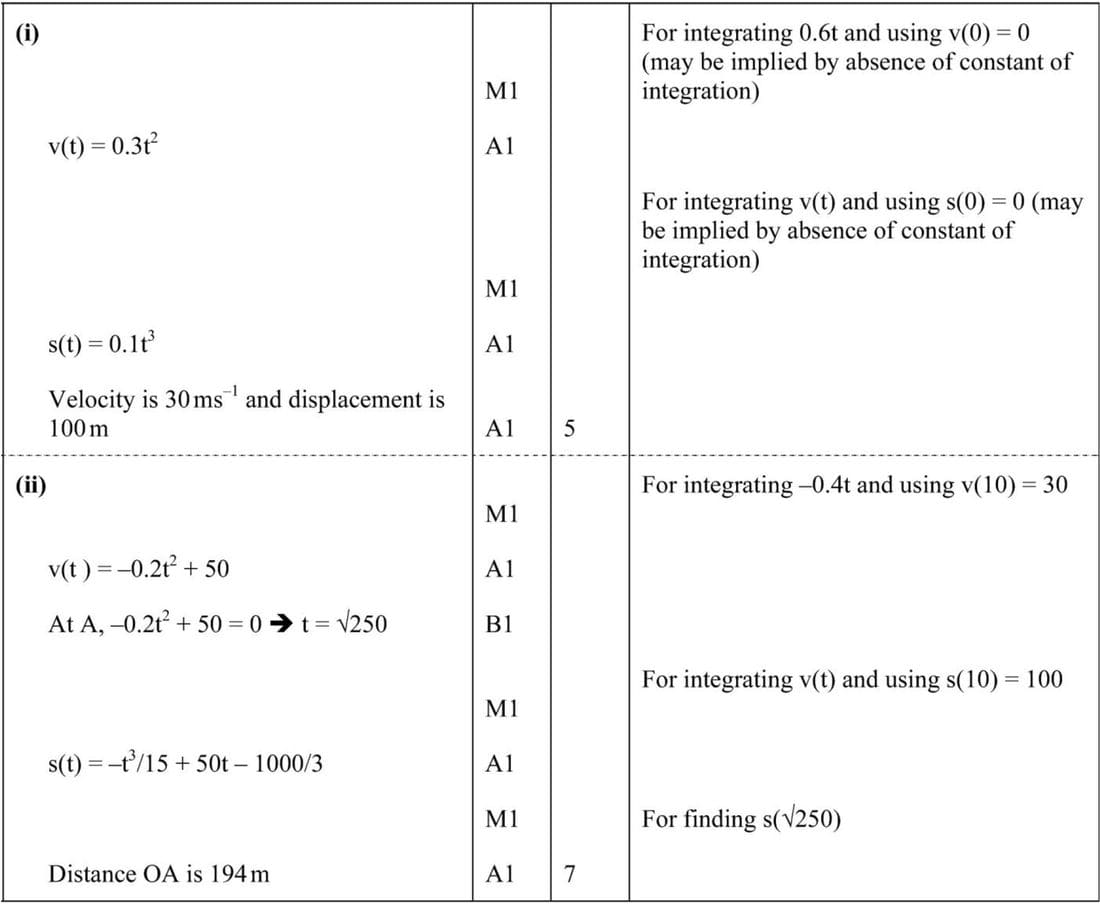
A particle P starts from rest at a point O and moves in a straight line. P has acceleration 0.6t m s−2 at time t seconds after leaving O, until t = 10.
- Find the velocity and displacement from O of P when t = 10.
\(After t = 10, P has acceleration −0.4t m s−2 until it comes to rest at a point A.\)
- Find the distance OA.
June 2013 p43 q4
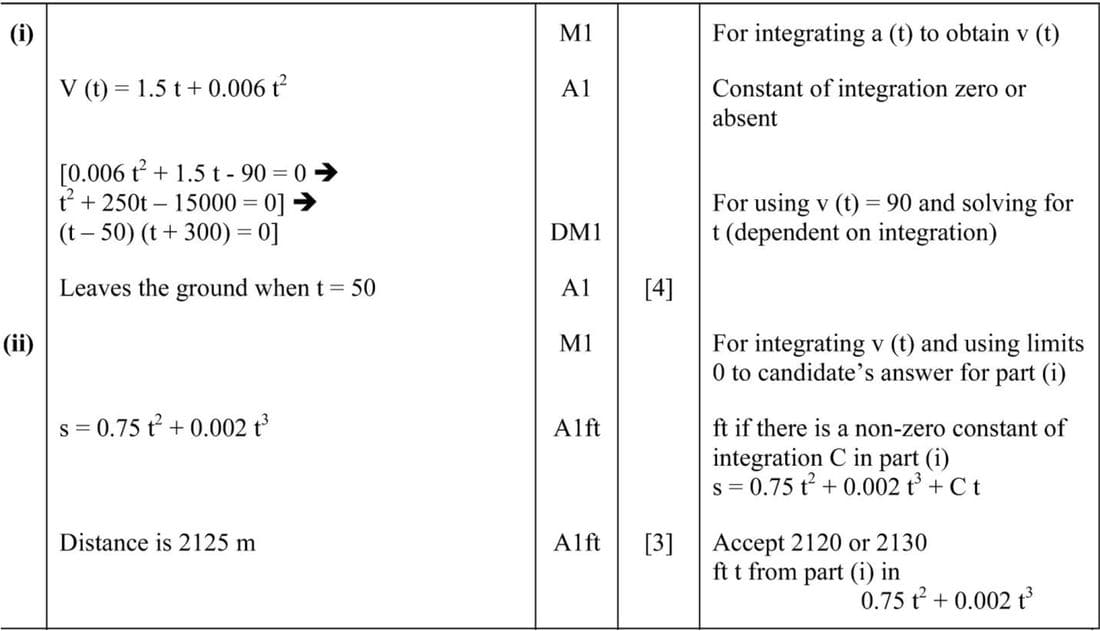
An aeroplane moves along a straight horizontal runway before taking off. It starts from rest at O and has speed 90 m s-1 at the instant it takes off. While the aeroplane is on the runway at time t seconds after leaving O, its acceleration is (1.5 + 0.012t) m s-2. Find
- the value of t at the instant the aeroplane takes off,
- the distance travelled by the aeroplane on the runway.
Nov 2012 p43 q2
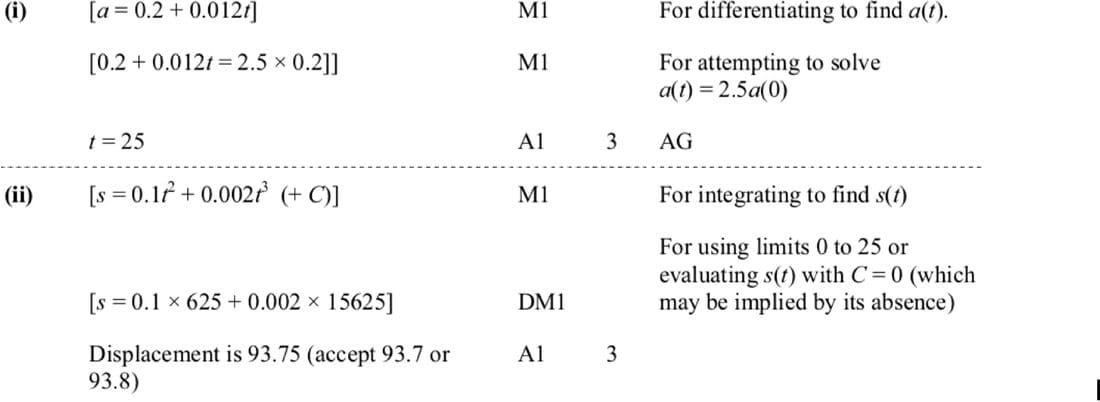
A particle moves in a straight line. Its velocity t seconds after leaving a fixed point O on the line is v m s-1, where v = 0.2t + 0.006t2. For the instant when the acceleration of the particle is 2.5 times its initial acceleration,
- show that t = 25,
- find the displacement of the particle from O.
Nov 2012 p42 q7
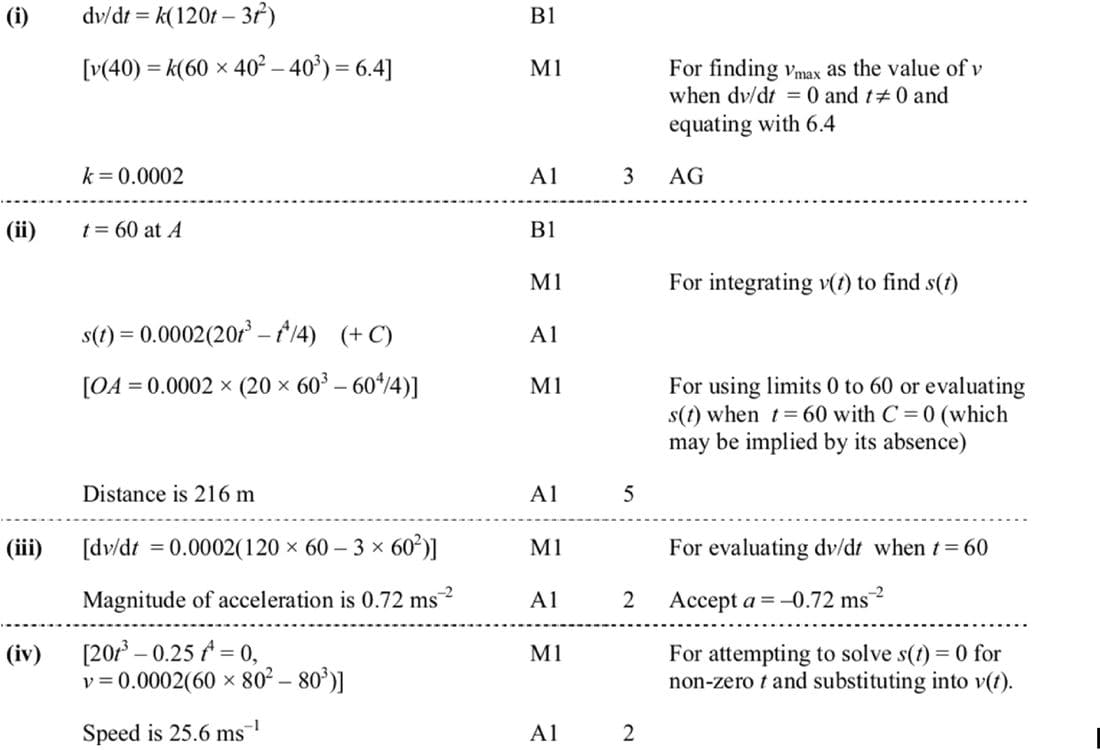
A particle P starts to move from a point O and travels in a straight line. The velocity of P is \(k(60t^2 - t^3)\) m s-1 at time t s after leaving O, where k is a constant. The maximum velocity of P is 6.4 m s-1.
- Show that \(k = 0.0002\).
P comes to instantaneous rest at a point A on the line. Find
- the distance OA,
- the magnitude of the acceleration of P at A,
- the speed of P when it subsequently passes through O.
Nov 2012 p42 q3
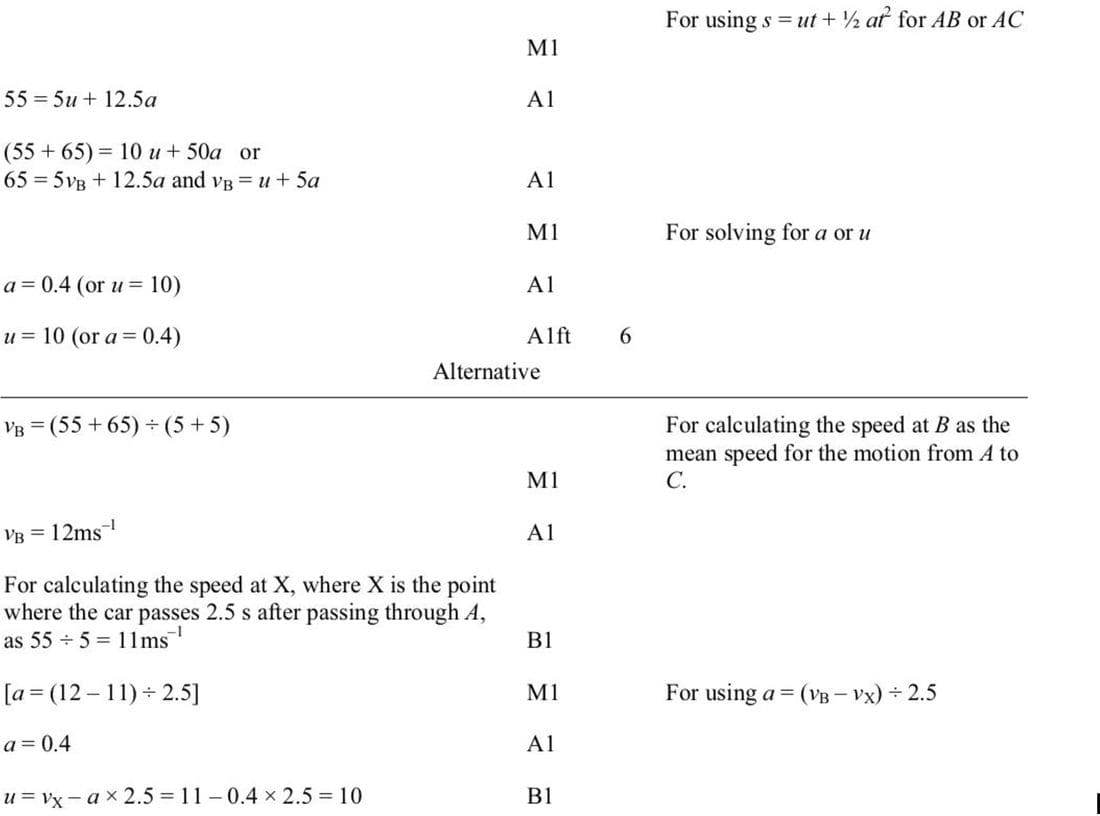
A car travels along a straight road with constant acceleration \(a \text{ m s}^{-2}\). It passes through points \(A, B\) and \(C\); the time taken from \(A\) to \(B\) and from \(B\) to \(C\) is 5 s in each case. The speed of the car at \(A\) is \(u \text{ m s}^{-1}\) and the distances \(AB\) and \(BC\) are 55 m and 65 m respectively. Find the values of \(a\) and \(u\).