Exam-Style Problems
⬅ Back to SubchapterJune 2017 p43 q7
3929
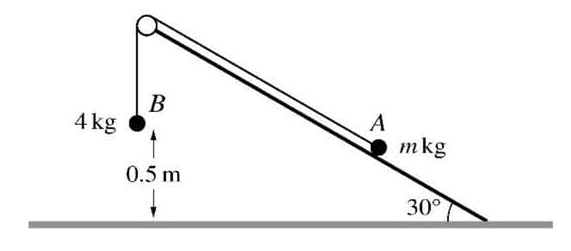
Two particles A and B of masses m kg and 4 kg respectively are connected by a light inextensible string that passes over a fixed smooth pulley. Particle A is on a rough fixed slope which is at an angle of 30° to the horizontal ground. Particle B hangs vertically below the pulley and is 0.5 m above the ground (see diagram). The coefficient of friction between the slope and particle A is 0.2.
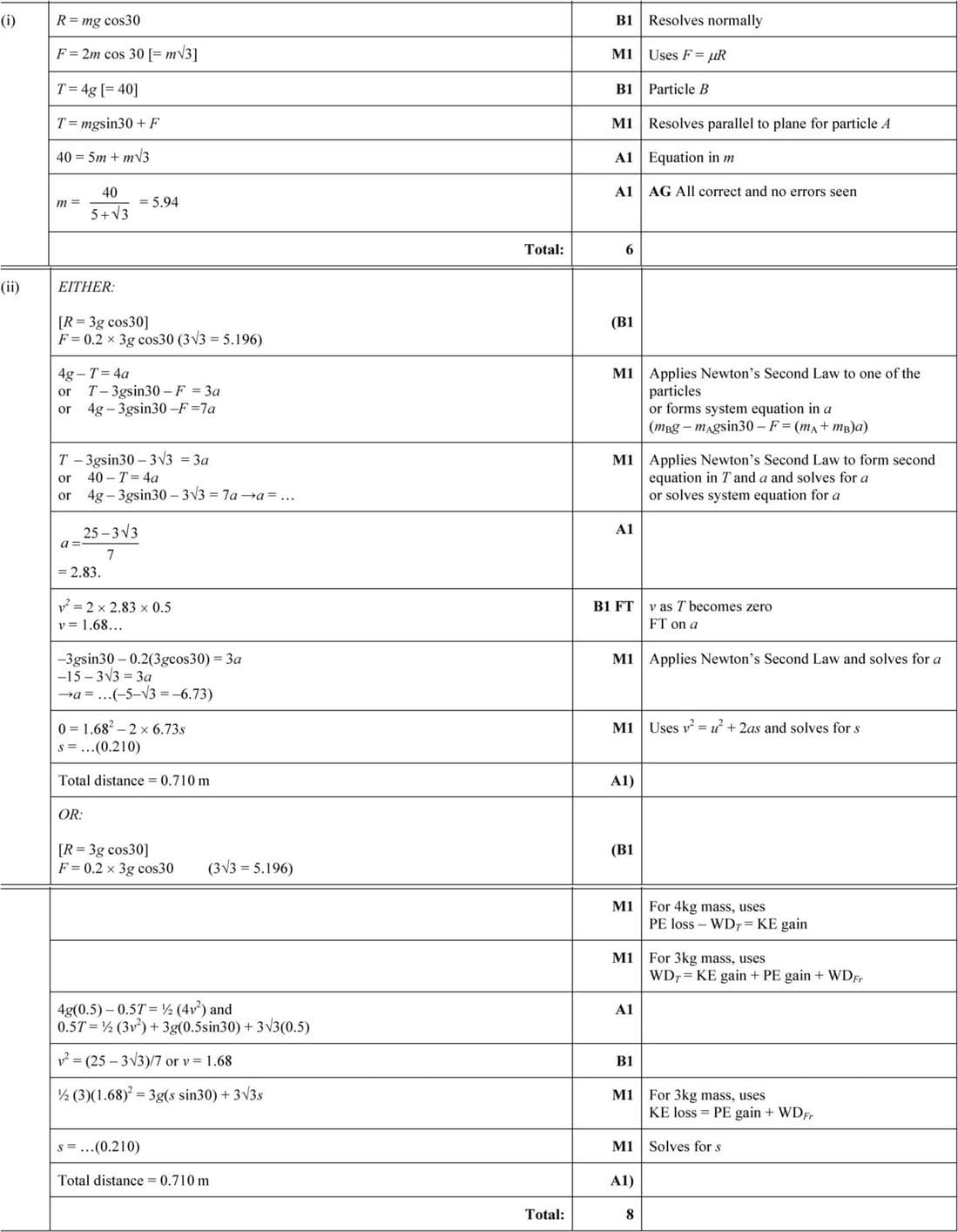
(i) In the case where the system is in equilibrium with particle A on the point of moving directly up the slope, show that m = 5.94, correct to 3 significant figures.
(ii) In the case where m = 3, the system is released from rest with the string taut. Find the total distance travelled by A before coming to instantaneous rest. You may assume that A does not reach the pulley.
June 2016 p41 q5
3930
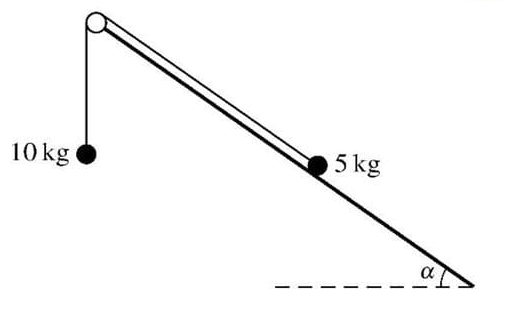
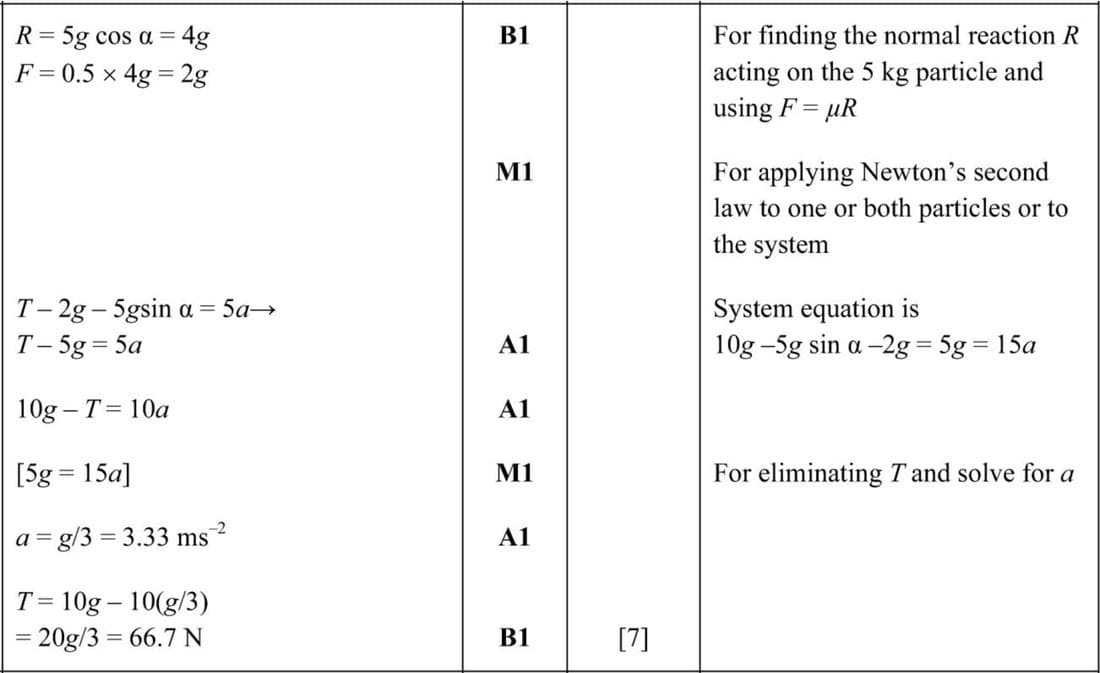
Two particles of masses 5 kg and 10 kg are connected by a light inextensible string that passes over a fixed smooth pulley. The 5 kg particle is on a rough fixed slope which is at an angle of \(\alpha\) to the horizontal, where \(\tan \alpha = \frac{3}{4}\). The 10 kg particle hangs below the pulley (see diagram). The coefficient of friction between the slope and the 5 kg particle is \(\frac{1}{2}\). The particles are released from rest. Find the acceleration of the particles and the tension in the string.
June 2022 p41 q2
3931
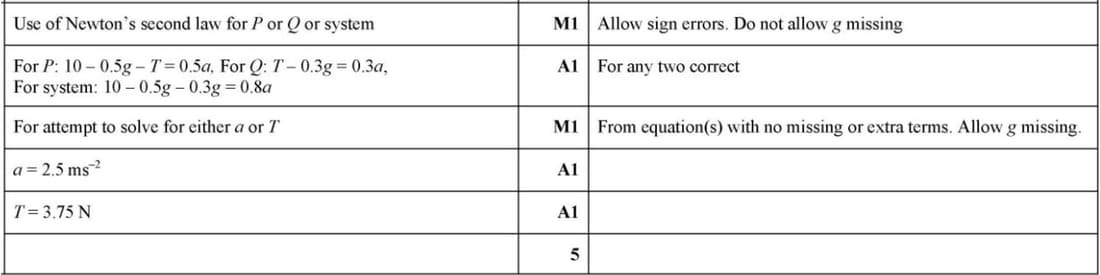
Two particles P and Q, of masses 0.5 kg and 0.3 kg respectively, are connected by a light inextensible string. The string is taut and P is vertically above Q. A force of magnitude 10 N is applied to P vertically upwards.
Find the acceleration of the particles and the tension in the string connecting them.
June 2012 p42 q5
3932
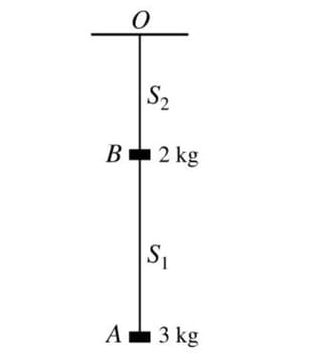
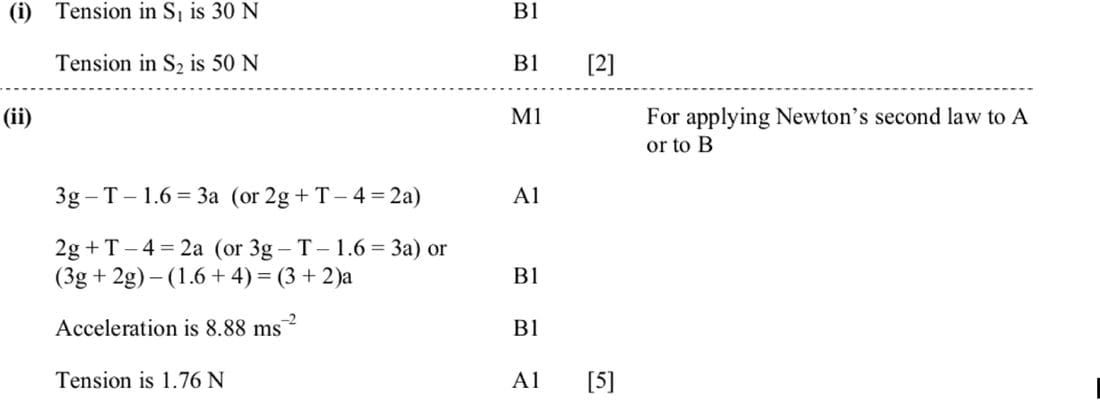
A block A of mass 3 kg is attached to one end of a light inextensible string S1. Another block B of mass 2 kg is attached to the other end of S1, and is also attached to one end of another light inextensible string S2. The other end of S2 is attached to a fixed point O and the blocks hang in equilibrium below O (see diagram).
- Find the tension in S1 and the tension in S2.
The string S2 breaks and the particles fall. The air resistance on A is 1.6 N and the air resistance on B is 4 N.
- Find the acceleration of the particles and the tension in S1.
June 2003 p4 q5
3933
O
S1
A
S2
B
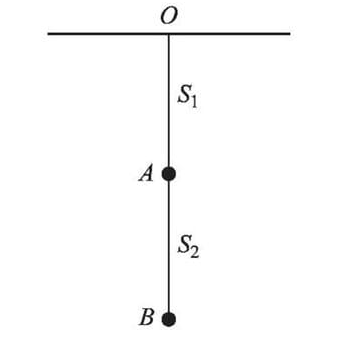
S1 and S2 are light inextensible strings, and A and B are particles each of mass 0.2 kg. Particle A is suspended from a fixed point O by the string S1, and particle B is suspended from A by the string S2. The particles hang in equilibrium as shown in the diagram.
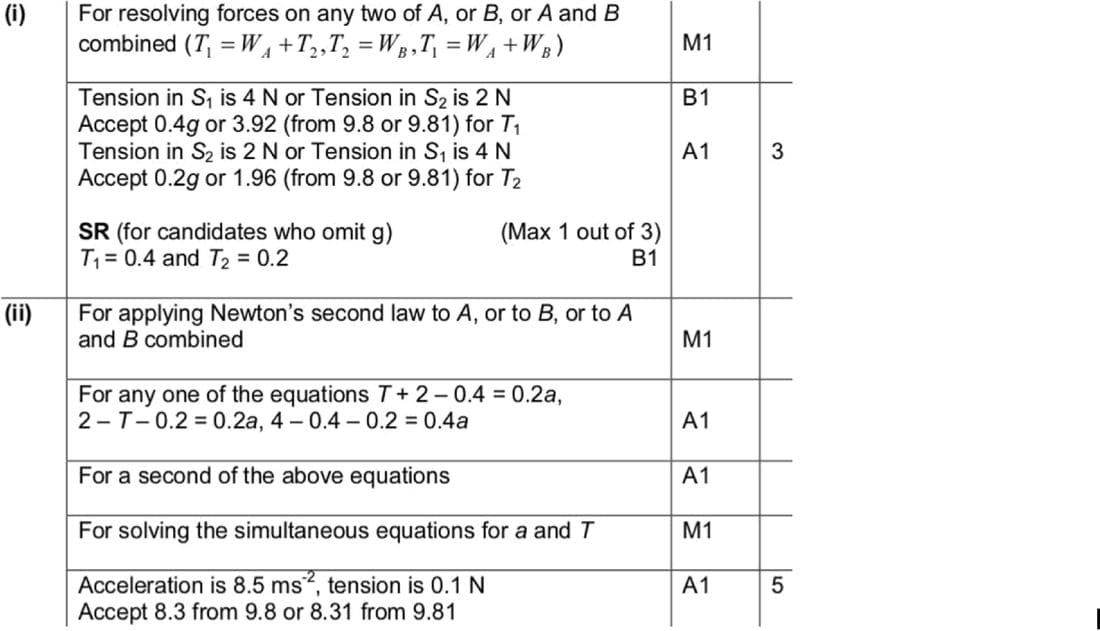
(i) Find the tensions in S1 and S2.
The string S1 is cut and the particles fall. The air resistance acting on A is 0.4 N and the air resistance acting on B is 0.2 N.
(ii) Find the acceleration of the particles and the tension in S2.