Exam-Style Problems
⬅ Back to SubchapterJune 2011 p41 q4
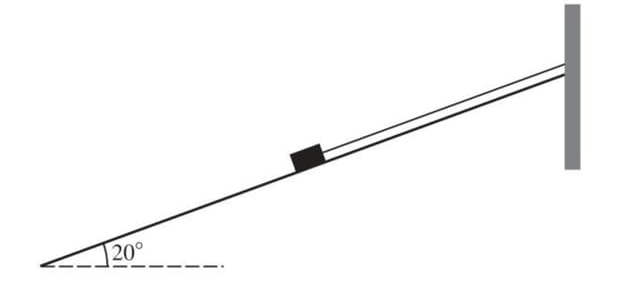
A block of mass 11 kg is at rest on a rough plane inclined at 30° to the horizontal. A force acts on the block in a direction up the plane parallel to a line of greatest slope. When the magnitude of the force is 2X N the block is on the point of sliding down the plane, and when the magnitude of the force is 9X N the block is on the point of sliding up the plane. Find
- the value of X,
- the coefficient of friction between the block and the plane.
June 2009 p4 q4
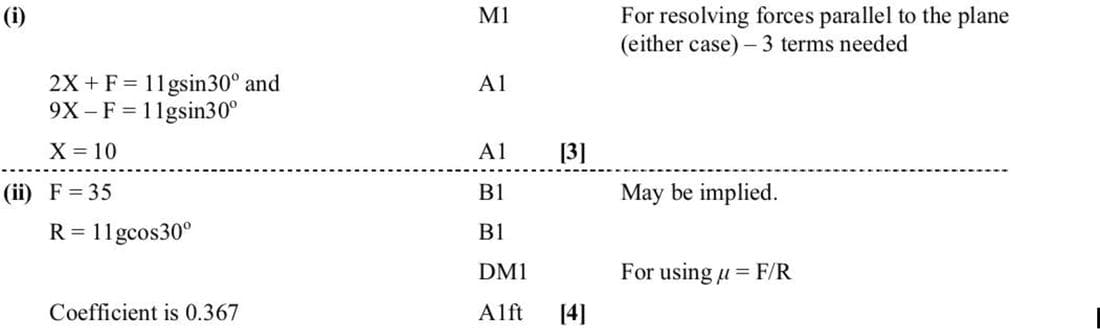
A block of mass 8 kg is at rest on a plane inclined at 20° to the horizontal. The block is connected to a vertical wall at the top of the plane by a string. The string is taut and parallel to a line of greatest slope of the plane (see diagram).
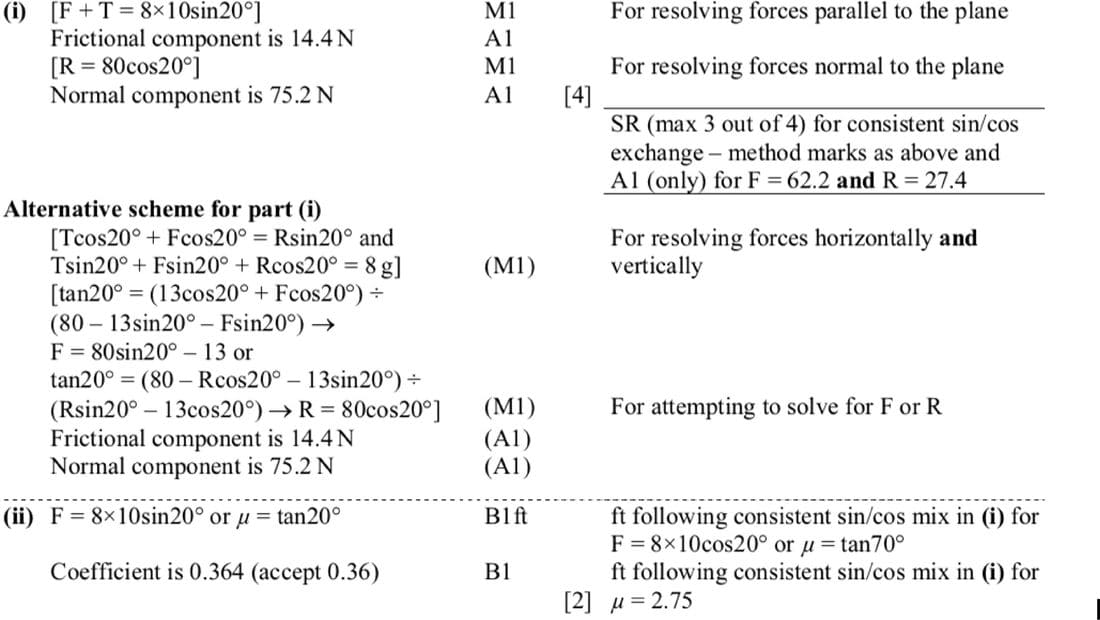
(i) Given that the tension in the string is 13 N, find the frictional and normal components of the force exerted on the block by the plane.
The string is cut; the block remains at rest, but is on the point of slipping down the plane.
(ii) Find the coefficient of friction between the block and the plane.
Nov 2008 p4 q2
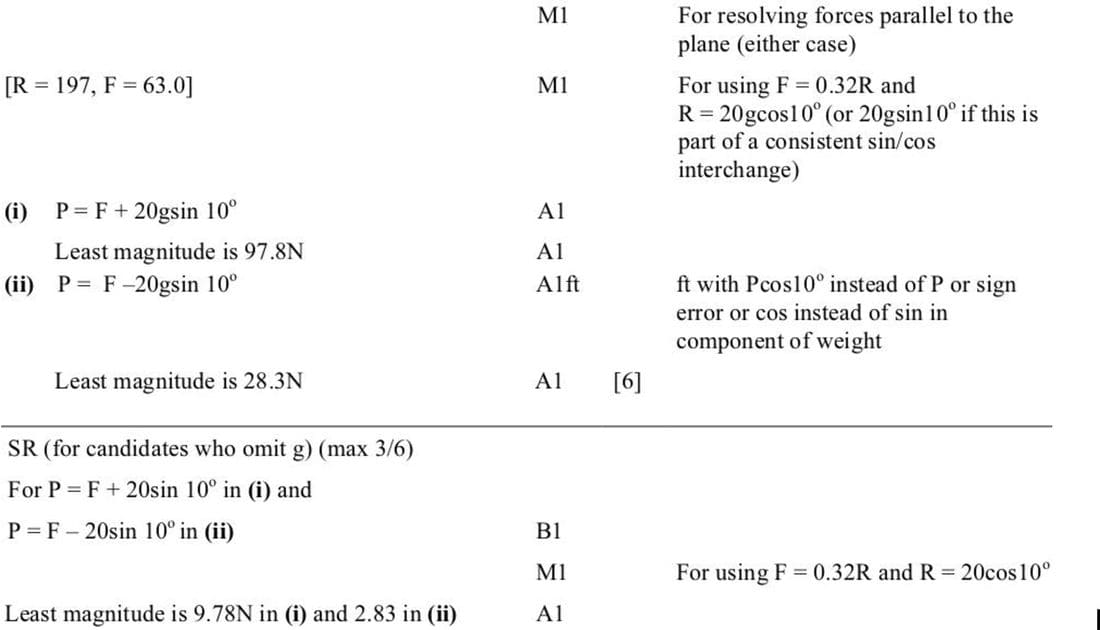
A block of mass 20 kg is at rest on a plane inclined at 10° to the horizontal. A force acts on the block parallel to a line of greatest slope of the plane. The coefficient of friction between the block and the plane is 0.32. Find the least magnitude of the force necessary to move the block,
- given that the force acts up the plane,
- given instead that the force acts down the plane.
Nov 2002 p4 q5
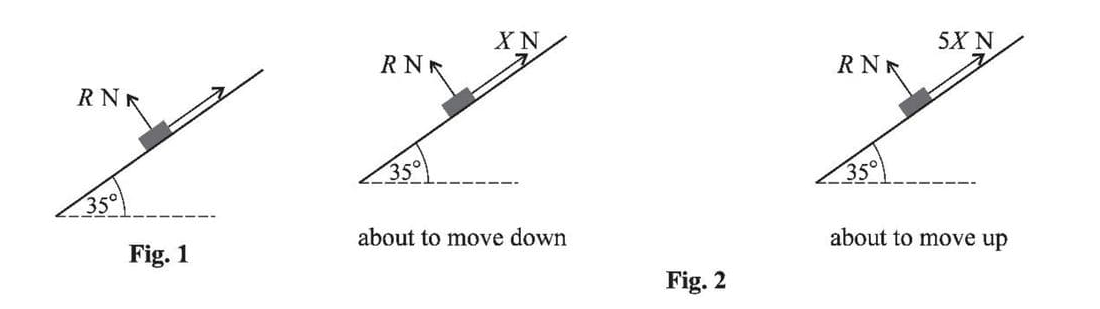
A force, whose direction is upwards parallel to a line of greatest slope of a plane inclined at 35° to the horizontal, acts on a box of mass 15 kg which is at rest on the plane. The normal component of the contact force on the box has magnitude \(R\) newtons (see Fig. 1).
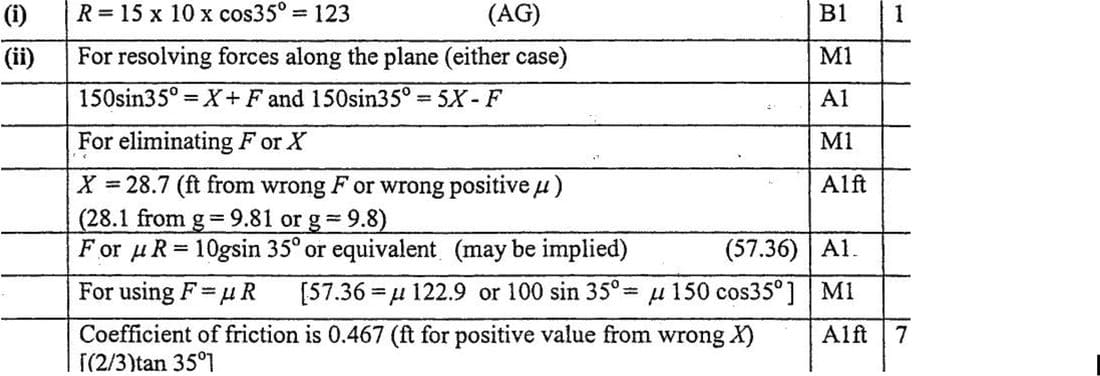
(i) Show that \(R = 123\), correct to 3 significant figures.
When the force parallel to the plane acting on the box has magnitude \(X\) newtons the box is about to move down the plane, and when this force has magnitude \(5X\) newtons the box is about to move up the plane (see Fig. 2).
(ii) Find the value of \(X\) and the coefficient of friction between the box and the plane.
Nov 2021 p41 q4
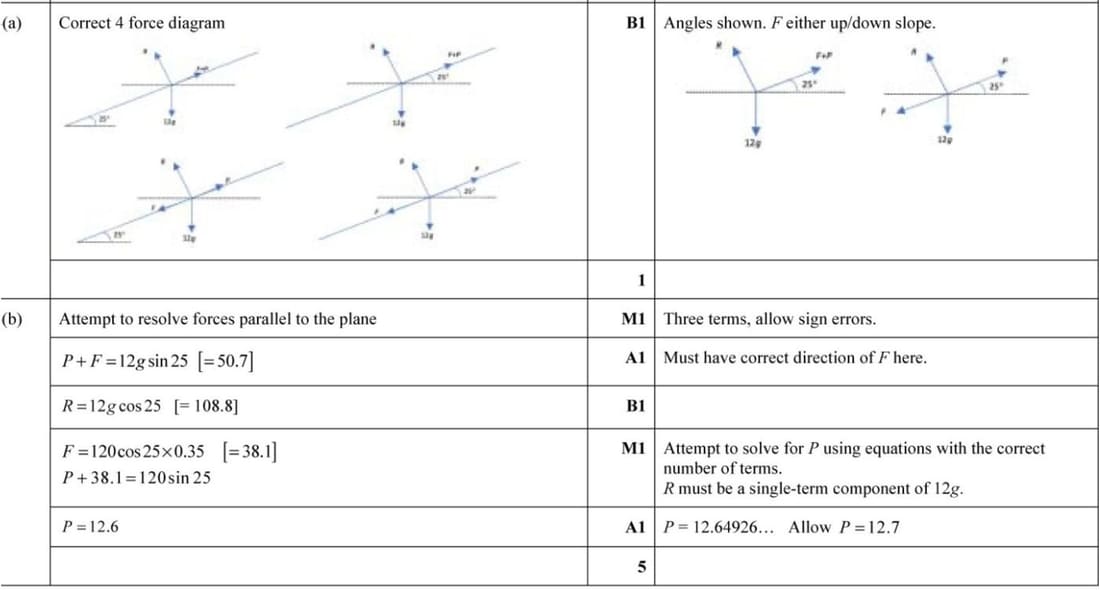
A particle of mass 12 kg is stationary on a rough plane inclined at an angle of 25° to the horizontal. A force of magnitude \(P\) N acting parallel to a line of greatest slope of the plane is used to prevent the particle sliding down the plane. The coefficient of friction between the particle and the plane is 0.35.
(a) Draw a sketch showing the forces acting on the particle.
(b) Find the least possible value of \(P\).